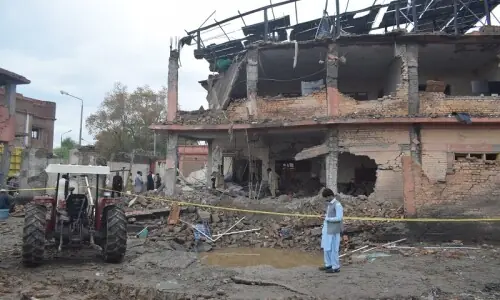
ALTHOUGH Operation Ghazab lil-Haq has led to a decline in the number of terrorist attacks in Pakistan, the threat has not been entirely eliminated, as the recent suicide bombing targeting Domel police station in KP’s Bannu shows.
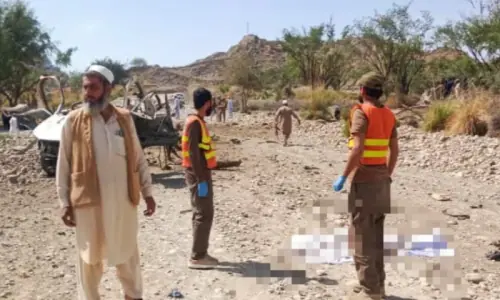
At least five people were martyred — all civilians reportedly belonging to the same family. Meanwhile, a planned suicide bombing targeting a police station was foiled by law enforcers in Lakki Marwat’s Bittani area. Police personnel raided a forested area and captured the terrorists suspected of planning the attack.
This part of KP is particularly plagued by terrorism, and its proximity to Afghanistan makes it vulnerable to attacks by groups such as the banned TTP.
To bring peace to these long-disturbed areas, the state must concentrate on two fronts: externally, by confronting the terrorist threat from Afghanistan, and internally, by improving intelligence capabilities and busting terrorist networks before they strike. The action in Lakki Marwat shows that when LEAs have good intelligence, they can save lives.
Regarding Afghanistan-based terrorists, Kabul and Islamabad are continuing talks in the city of Urumqi facilitated by China. The engagement is the first major effort to resolve the dispute diplomatically after hostilities broke out between the two states in February. The Chinese foreign ministry spokesperson said that talks are “advancing steadily”.
However, for a fruitful outcome, the Afghan Taliban must take verifiable action, as Pakistan’s Foreign Office has said, to prove that they are no longer providing sanctuary to terrorist groups such as the TTP.
Without such guarantees, the negotiations are likely to stall — as have earlier efforts — and the exchange of fire between both countries will continue. China is aware of the threat Afghanistan-based terrorist groups pose to neighbouring states — its concerns about ETIM highlight this fact — hence it can impress upon Kabul to address Pakistan’s legitimate concerns.
Internally, through better intelligence and counterterrorism actions, Pakistan must secure areas in KP and Balochistan where terrorists operate with relative freedom. The seemingly endless cycle of moving forces into disturbed areas, conducting operations, clearing the areas, and then witnessing the resurgence of terrorist activity must end. Far too many security personnel and civilians have been martyred in these actions, while local populations have faced upheaval and relocation.
Securing the border is essential, but internal vigilance is equally important. The elements facilitating the terrorists, for example, through the provision of arms, funds and other support, must be identified and prosecuted.
Long-term peace in KP and the rest of the country is contingent on kinetic actions, as well as a solid CT policy that identifies and tackles threats before they become difficult to manage.
Published in Dawn, April 5th, 2026