THE US director of national intelligence, Tulsi Gabbard, recently made uncalled-for comments regarding Pakistan’s missile and nuclear capabilities. The Foreign Office must be commended for promptly setting the record straight.
Grouping Pakistan with Russia, China, North Korea and Iran during a threat assessment briefing to the US Senate’s Intelligence Committee, Ms Gabbard took issue with these nations’ research and development of “an array of novel, advanced, or traditional missile delivery systems with nuclear and conventional payloads, that put [America] within range”. She mentioned Pakistan’s development of long-range missiles, which she claimed could include intercontinental ballistic missiles with the capability to strike US soil.
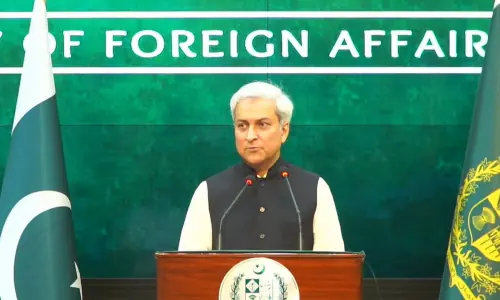
Yet Pakistan has no rational reason to strike America or, for that matter, any country outside South Asia. It defies understanding why a senior US intelligence officer would make such an assessment in good faith. It is widely understood that Pakistan’s programme has always been aimed at establishing deterrence within its own neighbourhood. This much was underlined quite forcefully by the FO spokesperson on Thursday, who affirmed that Pakistan’s missile programme is below intercontinental range and remains “firmly rooted in the doctrine of credible minimum deterrence vis-à-vis India”.
The spokesperson also reiterated that Pakistan’s strategic capabilities remain exclusively defensive and have always been aimed at safeguarding national sovereignty and maintaining peace. There is no reason Pakistan should be apologetic about them. Pakistan has also demonstrated that its nuclear programme remains extremely secure. It should therefore continue to pursue whatever means are lawful, reasonable and necessary to safeguard itself in an increasingly hostile neighbourhood.
It is not for any third party to cast aspersions on Pakistan’s decisions regarding how best to protect itself and its interests, especially when such concerns are not underpinned by any rationale or sound reasoning. It may be recalled that a similar claim had been repeated in December 2024, following which the US had said it would impose additional sanctions on entities it saw as tied to Pakistan’s ballistic missile programme. It is now up to Islamabad to make sure its indignation is heard in Washington as well.
The US should avoid the perception that it plays favourites in South Asia. India’s missile capabilities extend beyond 12,000 km. As such, they should be a much bigger problem.
Published in Dawn, March 20th, 2026