Women MNAs contribute nearly half of National Assembly agenda


 0
0

• Fafen report reveals they account for 48pc of plenary agenda despite holding less than 22pc of seats • On average, each woman lawmaker submits three times more items than their male counterparts
• Females raise wide range of policy issues beyond gender matters
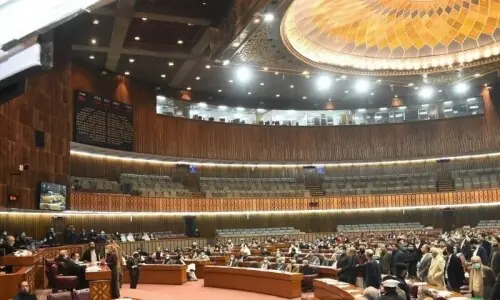
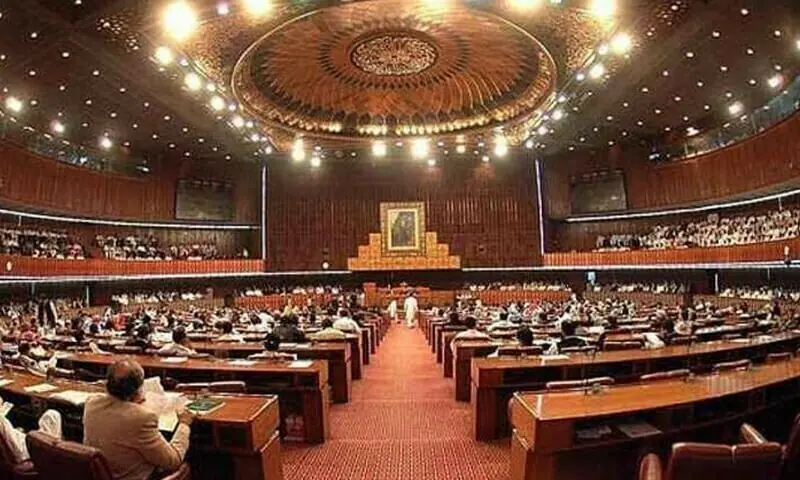
ISLAMABAD: Female members contributed around 48 per cent of the regular plenary agenda of the lower house during the second parliamentary year (2025–2026) of the 16th National Assembly.
According to the latest Women Parliamentarians Performance Report released by the Free and Fair Election Network (Fafen), the contribution is significantly higher than women’s share in the assembly’s membership, which remains below 22pc.
Most women lawmakers currently enter the House through reserved seats rather than through direct election.
Titled ‘Women Did It Again!’, the Fafen report evaluates the parliamentary performance of female members of the National Assembly (MNAs) across five dimensions: their contribution to the parliamentary agenda; participation in plenary debates; attendance in House sittings; parliamentary treatment of agenda submitted by women MNAs; and individual profiles of women lawmakers.
The report focuses solely on plenary performance and does not cover committee work or constituency activities. Moreover, verbal interventions during Question Hour, such as supplementary questions, are also excluded.
On a per capita basis, female MNAs submitted agenda items at a substantially higher rate than male MNAs. On average, each female MNA submitted 16 agenda items during the year, compared with five items per male MNA.
However, women’s overall share of the agenda declined from the 55pc recorded in the previous parliamentary year (2024–2025).
Parliamentary treatment
The report introduces the Gender Responsiveness Score (GRS) to measure how frequently the House addresses agenda submitted by female MNAs compared with that submitted by male MNAs.
The overall GRS for the reporting period stands at 1.0, indicating that the National Assembly addressed women lawmakers’ agenda at a similar rate as that of male MNAs. However, category-wise analysis reveals differences.
Private members’ bills, motions for public interest discussions and proposals to amend the assembly’s rules of procedure submitted by female MNAs were addressed less frequently than those submitted by male MNAs in these categories.
Policy areas
The report also challenges the assumption that women parliamentarians primarily focus on gender-specific issues.
Agenda submitted by female MNAs covered a wide range of policy areas, including economic policy, taxation, national security, local governance and parliamentary procedure, in addition to legislation relating to women’s rights and social protection.
Overall, 72pc of agenda items submitted by female MNAs addressed national-level policy issues.
The analysis also identifies differences between women elected on general seats and those occupying reserved seats.
Women MNAs elected on general seats participated in debates at higher rates than reserved-seat ones. On the other hand, female MNAs elected on reserved seats contributed a larger number of agenda items.
Published in Dawn, March 12th, 2026