Stocks nosedive 6.3pc in jittery week on geopolitical concerns
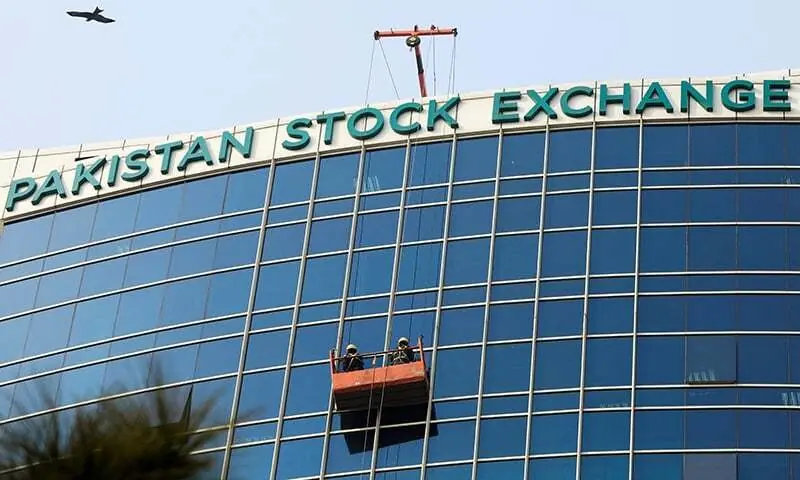
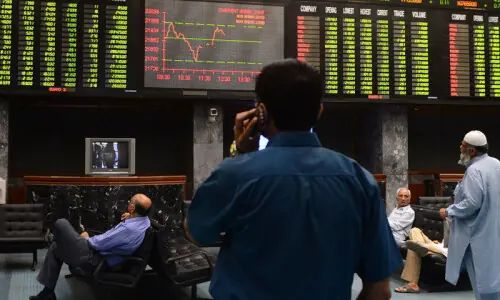
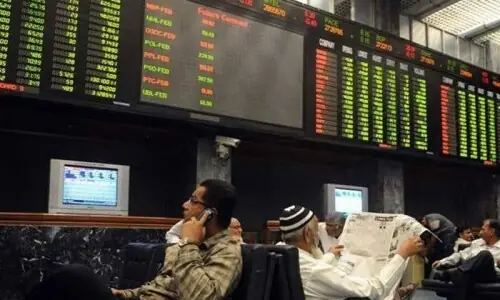
KARACHI: The Pakistan Stock Exchange (PSX) experienced an unprecedented decline during the outgoing week amid geopolitical tensions following the outbreak of conflict in the Middle East and border disputes along the western front.
On the first day of trading on Monday, the benchmark KSE-100 index suffered a historic decline, wiping out over 16,089 points or 9.57 per cent in a single session, causing equity investors to lose Rs1.7 trillion as overwhelmed and panicked investors hurried to exit the market amid fears of a prolonged war in the Gulf.
Although bargain-hunting on Tuesday and Thursday triggered a partial rebound, sentiment remained fragile. Investors were also unsettled by heightened security concerns following Pakistan’s retaliatory airstrikes targeting terrorist camps inside Afghanistan.
The US-Israel nexus’s illegal war against Iran has caused significant instability in the Middle East, impacting the global economy. This unrest led to disruptions in oil supplies as major shipping companies halted operations to and from the Gulf, causing energy prices to rise and prompting the government to adopt contingency measures, including weekly reviews of petroleum prices to pass on the increased costs to consumers and Covid-like measures such as working from home, switching to online classes to conserve oil stocks.
Index slips to 157,496 on panic-selling
As a result, extending the losses for the sixth straight week, the benchmark KSE-100 index recorded a steep decline of 6.3 per cent, or 10,566 points, closing at 157,496 points.
According to Topline Securities Ltd, the week’s decline reflected investors’ efforts to reduce exposure amid mounting risks to global energy supply chains and regional stability.
Foreign investors remained net sellers during the week. Foreign corporates offloaded equities worth $25.5 million, while mutual funds also recorded significant selling of about $54.5m due to redemption pressure.
In contrast, domestic institutions provided some support to the market. Banks purchased equities worth $36m during the week, while insurance companies and local corporates added $15.7m and $14.3m, respectively.
On the macroeconomic front, inflation rose to 6.98pc year-on-year in February, up from 5.8pc in January, marking the highest level since October 2024.
Arif Habib Ltd (AHL) noted that exports in February stood at $2.3bn, down 8pc year-on-year, while imports were recorded at $5.3bn, down 1.6pc. The resulting trade gap stood at around $3bn. Meanwhile, Pakistan’s trade deficit widened to $2.98 billion in February, increasing 8pc month-on-month and 25pc year-on-year.
Market activity remained relatively strong despite the volatility. Average daily trading volume stood at 658 million shares, while the average daily traded value was Rs36.2bn.
In the construction sector, cement despatches rose 12.53pc year-on-year to 4.19 million tonnes in February compared with 3.73m tonnes a year earlier. However, fertiliser demand remained weak, with provisional urea offtake falling 28pc year-on-year to 251,000 tonnes, the lowest monthly level recorded.
Energy production also declined slightly. Gas output slipped 0.1pc week-on-week to 2,687mmcfd during the fourth week of February, while oil production dropped 2.9pc to 59,103 barrels per day.
In the debt market, the government raised Rs581.7bn through a treasury bill auction during the week, with yields increasing across all tenors by 21.5 to 39.3 basis points.
Pakistan’s total public debt rose by 1pc month-on-month in February to Rs79.3tr, representing a 10pc increase compared with the same period last year.
Meanwhile, the country’s liquid foreign exchange reserves stood at $21.4bn, including $16.3bn held by the State Bank of Pakistan and $5.1bn by commercial banks. The rupee remained largely stable against the dollar, appreciating marginally by 0.02pc week-on-week to Rs279.41.
According to AKD Securities Ltd, the week’s sharp market reaction reflected heightened investor anxiety following the escalation of military tensions in the Middle East, alongside security concerns on the Pak-Afghan border.
The brokerage noted that the Monday meltdown appeared to be an overreaction, with the market staging a partial rebound in the following sessions.
The Middle East conflict has also pushed global oil prices higher. The benchmark Arab Light crude rose 16.3pc during the week to $83.1 per barrel, raising concerns about energy security, inflationary pressures and the impact on Pakistan’s external account.
Other notable developments included a rise in the State Bank’s foreign exchange reserves to $16.3bn, a major oil and gas discovery by OGDC in Kohat, and government efforts to secure crude supplies through alternative routes following the disruption of shipping operations.
Sector-wise, refinery stocks were the only major gainers, rising 0.5pc during the week. In contrast, vanaspati and allied industries, property and transport sectors recorded the steepest declines.
Looking ahead, analysts believe the market’s direction will largely depend on geopolitical developments in the Middle East and the State Bank’s upcoming monetary policy announcement.
Analysts noted that the KSE-100 index is currently trading at a price-to-earnings ratio of 8.1 times, offering a dividend yield of about 6.3pc. They added that any de-escalation in the Middle East conflict could trigger a strong rebound in equities, as the recent correction has made valuations significantly more attractive.
Published in Dawn, March 8th, 2026