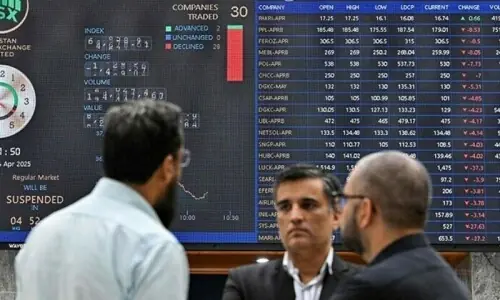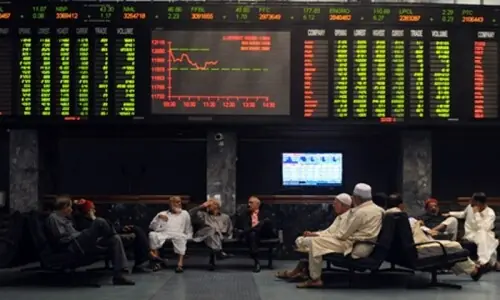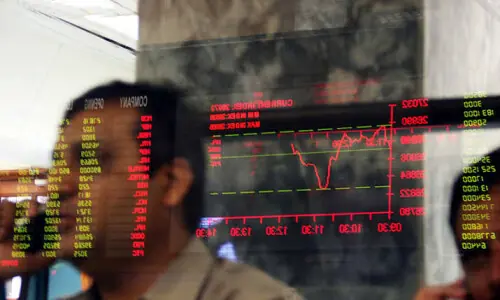


KARACHI: Equity prices fell like ninepins on Thursday as the Pakistan Stock Exchange (PSX) came under intense selling pressure, driven by escalating geopolitical tensions and a negative corporate earnings surprise that unnerved investors.
War-related rhetoric between the United States and Iran heightened fears of a broader regional conflict, prompting a swift shift towards risk aversion and triggering one of the benchmark’s second sharpest single-day routs in absolute terms.
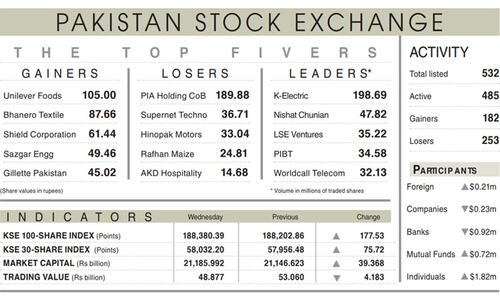
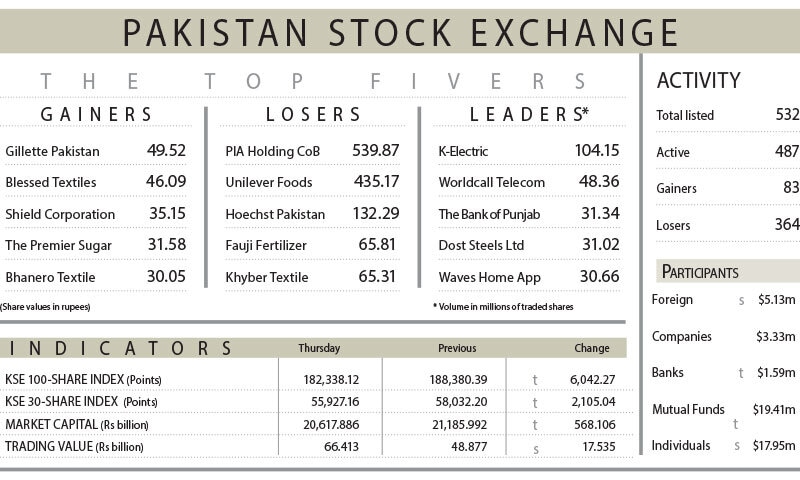
The KSE-100 index plunged 6,042.12 points, or 3.21 per cent, to close at 182,338.12, erasing over Rs568 billion in market capitalisation in a single session. The slide breached the psychologically important 185,000 level, with the index touching an intraday low of 181,961.
Topline Securities said equities witnessed a sharp sell-off as the market entered a severe downturn amid broad-based selling.
Risk-off sentiment deepens amid US-Iran tensions, weak corporate results, causing Rs568bn loss to equity investors
The steep decline was largely catalysed by Fauji Fertiliser Company’s (FFC) earnings announcement, which fell short of market expectations owing to weaker-than-anticipated gross margins. Speculation had also built up around a potential stock split or bonus issue, neither of which materialised. The gap between expectations and outcomes triggered panic selling as investors rushed to book recent gains, amplifying downward momentum.
Heavyweight stocks bore the brunt of the sell-off. Fauji Fertiliser, United Bank, Engro Holdings, Oil and Gas Development Company and Hub Power collectively shaved 3,155 points off the benchmark during the session. FFC alone accounted for 1,902 points of the decline.
Investor participation weakened, with traded volume slipping 2.18pc to 933 million shares. However, the traded value surged 35.87pc to Rs66.4bn, reflecting aggressive selling in high-value scrips.
Responding to Dawn’s queries, Ali Najib, Deputy Head of Trading at Arif Habib Ltd, said investors were reallocating funds from equities to safe-haven assets, notably gold, amid rising global uncertainty. “There is clear evidence of partial asset reallocation. Gold’s surge to record highs reflects growing risk aversion driven by trade tensions, geopolitical stress and expectations of prolonged global monetary easing,” he said.
Domestically, he added, the State Bank of Pakistan’s surprise decision to keep policy rates unchanged reduced near-term equity catalysts while enhancing the appeal of defensive assets. “For local investors, gold also serves as a hedge against currency risk and macro volatility. However, this shift appears tactical rather than structural — long-term institutional flows into equities remain intact, but short-term capital is clearly seeking safety until visibility improves,” Mr Najib said.
On the macroeconomic front, he cautioned that a widening current account deficit, driven by import-led growth and weak exports, raised sustainability concerns, particularly alongside declining foreign direct investment inflows. “This combination increases external financing vulnerability and constrains policy flexibility,” he noted.
Persistent core inflation further complicates the outlook, limiting the central bank’s room to soften monetary policy aggressively despite slowing growth. “Together, these factors pressure the currency, elevate sovereign risk perception and dampen investor confidence. While reserves and remittances provide some buffer, the macro mix underscores the need for export-led growth, productivity reforms and credible disinflation to avoid medium-term balance-of-payments stress,” he said.
High business costs also weighed on sentiment. Elevated energy tariffs, taxation and financing costs, coupled with the aggressive recovery of super tax following court rulings, have materially dented investor confidence, Mr Najib said.
He pointed to the sharp deceleration in quarterly GDP growth to 3.71pc in 1QFY26 from 6.17pc a year earlier as reinforcing fears that the rebound is losing momentum. “While fiscal consolidation is necessary, its timing and intensity risk undermining confidence unless balanced with pro-growth reforms and relief for the formal sector,” he added.
Market participants also cited likely institutional-led, across-the-board selling as exacerbating losses and fuelling fears of further downside.
Analysts said 180,000 now stands as a key support level. A weekly close above 185,000, they added, would be required to signal a resumption of the bullish trend in the coming week.
Published in Dawn, January 30th, 2026