Power data flaws spark concerns
ISLAMABAD: Industrialists on Tuesday highlighted flaws in Power Division data, impacting decision-making, as Discos sought around 43 paise per unit higher quarterly tariff adjustments (QTA) for the next three months.
As Power Division’s team, led by Additional Secretary Mehfooz Bhatti, reported 45 per cent of industrial consumers availing the benefit of the government’s incremental package, leading to substantial growth in consumption.
Industrial representatives, Rehan Javed from Karachi and Amir Sheikh from Lahore, wondered why consumers had to pay higher capacity charges both for higher and lower consumption.
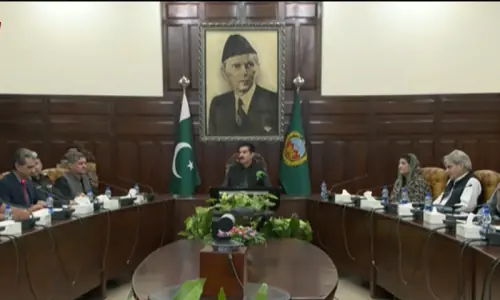
At a public hearing remotely presided over by Nepra Chairman Waseem Mukhtar, Mr Javed contested the Power Division’s assertions and claimed that based on a cross-check from gas companies and power companies, the increase in consumption was a depiction of diversion of large captive power consumers from gas to the power grid and had little to do with the incremental package that benefited only a few. He demanded that the incremental incentive power package be reformed in consultation with industrialists.
Industrialists question accuracy of stats as Discos seek 43 paise per unit hike
Power Division’s Naveed Qaiser responded that such conclusions were premature and results should be examined over a longer six-month period. He, however, struggled to contest Mr Javed’s data-based assertions.
Nepra Member Amina Ahmed came to the Power Division’s rescue, asking it to cross-check industrialist data sets and not to respond immediately. Interestingly, the same situation and rescue operation was used a few days ago on similar questions on monthly fuel price adjustments.
Mr Rehan said that the data from May 2025 to November 25 showed almost the same units, while the November 25 units were higher than those in December, even without the incremental package. He said the 27pc (609m units) growth was driven by the captive shutdown and not new demand. He claimed that only part of captive demand -about 306 million units - was shifted to the grid, and almost half (13.4pc) was destroyed, indicating curtailment of industrial activity.
The shift was concentrated in large users (B3 & B4) due to fuel substitution rather than broader industrial activity, and no smaller category (B1 & B2) benefited. This meant that a Rs11 per unit burden was shifted to all consumer categories.
He said the overall consumers would be paying the Rs6bn burden for six months to allow the power bureaucracy to make a course correction. Power Division’s Naveed Qaiser said a previous positive QTA of 33 paise per unit had just expired, and the new QTA, of roughly the same size, would not result in a net increase for consumers in the coming quarter.
The estimated increase of around 42 paise per unit in additional charges for April to June is mostly due to capacity charges paid to power producers during the second quarter (October-December) of FY26. This is based on the request of ex-Wapda distribution companies (Discos) seeking recovery of Rs10.832bn from consumers under QTA mechanism.
The Discos sought adjustments on account of capacity charges, transmission charges & market operator fee, the impact of incremental consumption package announced by the government for industrial and agricultural consumers for three years, besides the impact of transmission and distribution losses on monthly fuel costs and variable operations & maintenance charges for the 2nd quarter of FY25, i.e. October to December 2025.
The total additional impact of capacity charges comes to about Rs24.25bn for the said quarter. However, these are partly compensated through negative adjustments on account of almost all other factors, including variable O&M (Rs1.655bn), use of service charge (Rs3bn), impact of incremental package (Rs7.5bn) and FCA impact of system losses (Rs1.2bn), bringing down the total additional amount chargeable to consumers to Rs10.83bn.
Three out of eleven Discos have sought additional QTA for the second quarter. These include Hyderabad, Peshawar and Quetta Electric Supply companies, seeking negative adjustment of Rs3.5bn, Rs5.1bn and Rs4.1bn, respectively.
On the other hand, Multan Electric has demanded a higher increase of Rs5.6bn, followed by Rs4.8bn for Gujranwala, Rs4.1bn for Islamabad, Rs3.7bn for Lahore, Rs2.9bn for Sukkur, and Rs1.9bn for Faisalabad Electric. Newly created Discos Tribal Electric and Hazara Electric have sought Rs303 million and Rs140m additional recovery.
Once approved, the QTA would also apply to K-Electric. However, the Quarterly Tariff Adjustments (QTAs), the Debt Service Surcharge (DSS), and negative FCAs are not applicable to eligible consumers of the government-announced special tariff package for incremental consumption.
Published in Dawn, February 18th, 2026