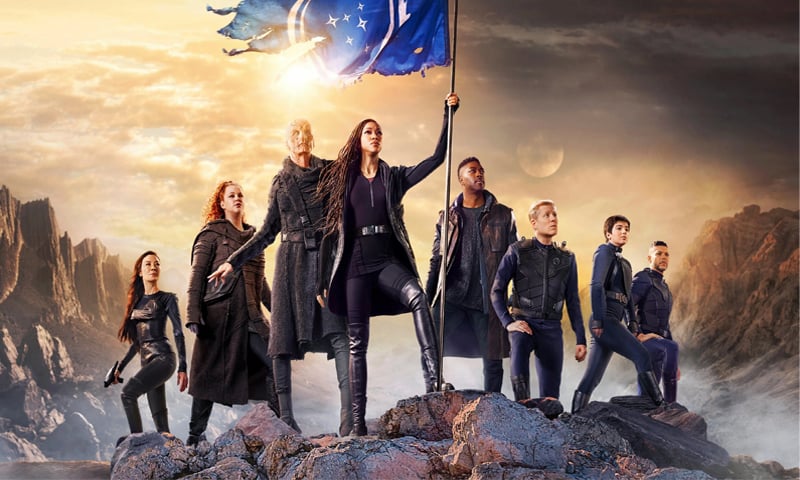

With Star Trek: Starfleet Academy, the idea of “going where no one has gone before” pivots hard and regresses even harder into a domain few thought possible: Karan Johar’s Student of the Year! You might think this is a joke, but I kid you not. I swear by every over-lit set and hot bod in the show.
Starfleet Academy, now five episodes in, is a continuation of the expanded Star Trek universe under the “creative” hands of showrunner Alex Kurtzman. Kurtzman was the screenwriting partner of the late Roberto Orci, who wrote a fair number of blockbusters: Mission: Impossible III, the first two Transformers, The Amazing Spider-Man 2, The Mummy (the Tom Cruise one, which Kurtzman directed), and the first two Star Trek films. This, of course, is where the franchise’s future became intellectually stunted. Kurtzman is the de facto boss of all Star Trek shows and movies for this generation.
After Section 31, this is the second dud under his helming. And like Section 31, it is getting ripped apart by fans and the internet, with due reason. The show jumps 800 years from the 24th to the 32nd century, but judging by its looks and writing, one could mistake the future for the present.
The premise centres on unruly, smart, body-built teenage jocks and jockettes who indulge in high-school romance and contend with personal tragedies. Space exploration, or any worthwhile idea Star Trek’s late creator Gene Roddenberry ever came up with, is replaced with unenticing, done-to-death stories, layered thickly with inclusivity and woke-ism.
After watching Paramount+’s intellectually stunted Star Trek: Starfleet Academy, it’s obvious that the franchise has drifted into deep space without a lifeline
Add the bright, excessively lit sets and hot-genius characters, and one wonders when the audience has beamed on to the sets of a Karan Johar film.
STAR TREK OR THE ARCHIES?
Starfleet Academy features a bad version of the Archies — not the comics, but the teenage romance-thriller TV series. Here, hotness takes centre stage, and fun and dorkiness are kicked out the airlock.
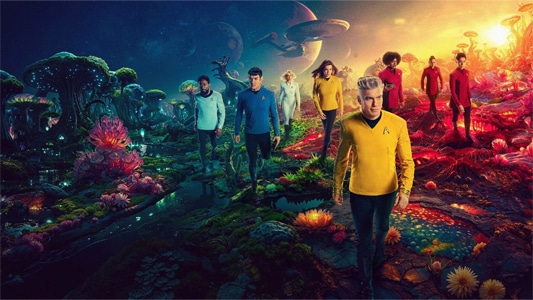
We have a hot, genius rebel (Sandro Rosta, the hot Archie), his equally adept, good-looking foil (George Hawkins, the good-guy Reggie), an athletic, sporty girl with a good heart (Bella Shepard, aka Betty), and the unspoilt rich girl and the hero’s romantic foil (Zoë Steiner, the reverse Veronica).
Since dorks, brainiacs and dumdums are no longer a necessity — only the best get into the academy — Jughead, Dilton and Moose are replaced by walking, talking “statements”.
One of them is a homosexual, pacifist Klingon (Karim Diané) with big, unblinking blue eyes and a proclivity for birdwatching. The other is a “recently born” sentient hologram programme (Kerrice Brooks) — the first of her kind to enrol, and take the diplomatic mantle of emissary from a planet of holograms. Since she is new, she is giddy with excitement and, for some reason, overweight.
Such a Klingon — a race where war and rage are in the DNA — is genetically impossible according to lore. Also, why make a hologram overweight, especially when the academy enforces and requires rigorous physical training? Since holograms are essentially programmes created by the United Federation of Planets, why does she need to “learn” anything when the data is a download away?
The rebellion against conventions doesn’t end here. There’s Nahla Ake, played by Holly Hunter, whose acting sends shivers up the spine. Nahla is a former captain-turned-chancellor who is a zany bohemian and the single biggest turn-off of the show. She walks around barefoot, slumps into chairs in bizarre postures and reads with glasses, despite instantaneous corrective eye surgery being routine in the future.
One should remember that space exploration in Star Trek carries both diplomatic and militaristic demands. Cadets and officers are required to be in prime physical condition, ready to make split-second decisions that carry life-or-death consequences.
Though banter existed, there was always a strict adherence to duty and protocol, both of which are entirely absent here.
For a show about the future, thinking strictly within the constraints and politics of the present is both preposterous and limiting.
THE LOST ‘PRIME DIRECTIVE’
As a lifelong Trekker, Star Trek — be it the original series, The Next Generation, or Voyager — has always offered relaxation and intellectual stimulation. Amid the space action were big ideas about consciousness, first contact, sentience and diplomatic solutions to conflict. Many episodes carried surprising weight and melancholy, with the hope and belief that overwhelming odds can be overcome by human resilience.
Contrary to many, I am a fan of the rebooted Kelvin timeline and all three films. For the most part, J.J. Abrams understood that, while updating the aesthetic and pacing for modern audiences — blinding them with lens flares and bright sets before blowing everything to smithereens — the core still had to remain intact. While the bombastic nature of the films can be forgiven — cinema audiences rarely want heavy ideas and deliberate pacing — the shows always carried a different tonality. However, the new shows have forgotten that distinction.
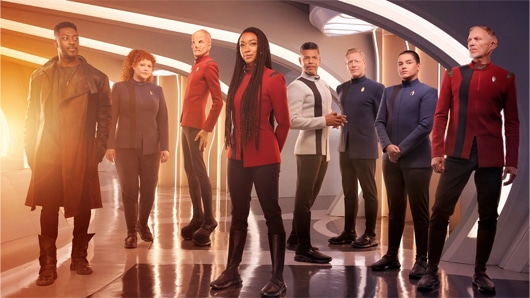
Having sporadically watched a few episodes of the new shows Discovery, Picard, Strange New Worlds, Lower Decks and Prodigy, one arrives at a disheartening conclusion: the franchise has drifted into deep-space without a lifeline.
Contrary to the trimmings — the ships, uniforms, species and vernacular — much has gone off-course. Discovery turns out to be a serialised action show; Picard, a conspiracy thriller steeped in gratuitous violence, and Strange New Worlds, closest in spirit to classic Star Trek, indulges in bombastic set pieces over thoughtful dialogue.
Lower Decks, a surprisingly enjoyable adult animation series, channels a Futurama-Simpsons sensibility. Prodigy, a CG-animated kids’ show that could pass for Star Wars, incorporates Kate Mulgrew’s Captain Janeway as a hologram to remind us that what we’re watching is still Star Trek, somehow.
And then there’s Starfleet Academy. As per storytelling tropes, each character gets a dedicated episode about their problems which, for better or worse, remain rooted in the issues and beliefs of the showrunners of our 21st century. Gone — or perhaps never contemplated — is genuine speculation about what a 32nd century learning institution might actually look like. Especially in a society that has instantaneous access to all human knowledge.
We never see young people from radically different species navigating interpersonal or cognitive differences. Also missing are the rules needed to govern a multispecies academy that trains future explorers and diplomats. These questions remain unasked because Starfleet Academy is not interested in contemplative, forward-thinking science fiction.
A BLACK HOLE
Star Trek is Paramount’s flagship franchise, perhaps its only remaining tentpole with genuine cultural prestige and a global fanbase. In trying to be everything to everyone, modern Star Trek has become nothing in particular.
It has lost the larger vision Roddenberry imagined, which would have taken care of basic necessities holding back a society. His future is free from the bounds of money and material wants — where replicators can conjure anything from food to clothes, and healthcare is universal.
Since humanity solved its terrestrial problems and turned its gaze outwards to the stars, merit, resolve and curiosity replaced anxiety and social and societal dilemmas about diversity and inclusivity that worry us in the 21st century. Contrary to the new shows, conflicts are resolved through dialogue and ingenuity rather than firepower and storytelling tropes — tropes, mind you, that pulled you from the future and threw you into the past.
The tragedy is not that Starfleet Academy is bad fare — without the Star Trek brand, it functions as disposable fare. The tragedy is that it represents a franchise that has forgotten why it mattered.
The writer is Icon’s film reviewer
Published in Dawn, ICON, February 15th, 2026