Comeback queen Brignone wins super-G at Winter Olympics
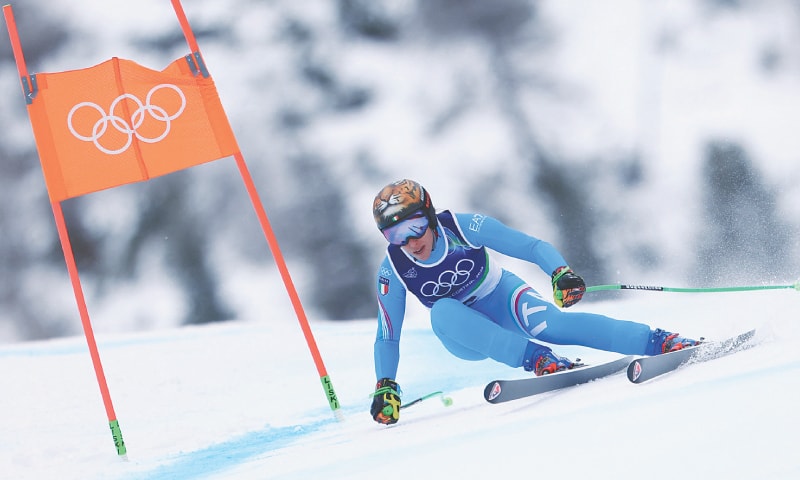

CORTINA D’AMPEZZO: Federica Brignone crowned a sensational comeback from broken leg to win the women’s super-G at the Winter Olympics on Thursday, battling through the pain to bring gold medal joy to the host nation.
Nicknamed ‘The Tiger’, the Italian roared down the slope in Cortina d’Ampezzo in 1min 23.41sec to win her first Olympic gold less than a year after she suffered a double leg fracture in April 2025.
Brignone, at 35, became the oldest ever Olympic gold medal winner in alpine skiing, surpassing Norway’s Aksel Lund Svindal by a few months. The Italian also surpassed Lindsey Vonn, who is coached by Svindal, as the oldest female medallist.
It was Italy’s fifth gold of the Milan-Cortina Games and came in front of Italian President Sergio Mattarella by finishing 0.41sec ahead of France’s Romane Miradoli, with Cornelia Huetter rounding out the podium.
And Brignone basked in the applause and chants of “Fede” from the stands as the Italian Air Force’s aerobatic unit Frecce Tricolori soared high overhead.
“I don’t think I’ve felt as good as this at any point in the last 10 months,” a jubilant but exhausted Brignone told reporters.
“I’ve had a lot of difficult days in that time... and I’ve always believed that I could compete and I know how to grit my teeth with the pain.
“The other day I put my ski boots on and I couldn’t ski. Luckily that was the other day and not today.”
Brignone’s participation in the Olympics was in doubt as recently as three weeks ago due to the double fracture of the tibia in her left leg from a crash in a race in April 2025.
She had only raced four times before Thursday’s super-G, finishing 10th in the downhill which kicked off the women’s alpine skiing events in Cortina.
Cooper Woods delivered Australia’s first gold of this edition as he won the moguls competition after edging Canada’s Mikael Kingsbury on a tiebreak.
The 25-year-old Australian claimed victory by the finest of margins with a turns score of 48.4 to Kingsbury’s 47.7, which was used as the tiebreaker after both scored a total of 83.71.
Woods had already signalled his form in his first run in the final, putting up an impressive 83.60 points to lead the pack.
Japan’s World Cup leader Ikuma Horishima, who led earlier in the final with 83.44, claimed bronze after setting the benchmark with a rhythmic run packed with difficult tricks.
UKRAINE’S HERASKEVYCH BANNED
Meanwhile, Ukrainian skeleton racer Vladyslav Heraskevych was disqualified from the Winter Olympics on Thursday after refusing to back down over his banned helmet, which depicts victims of his country’s war with Russia.
The athlete had insisted he would continue to wear the headgear, which carries pictures of Ukrainian sportsmen and women killed since Russian forces invaded Ukraine in 2022, in competition.
But the International Olympic Committee said Heraskevych had been kicked out of the Milan-Cortina Games after failing “to adhere to the IOC athlete expression guidelines”.
Ukraine President Volodymyr Zelensky had defended the 27-year-old’s right to wear the helmet but gestures of a political nature during competition are forbidden under the Olympic charter.
The IOC’s decision was labelled a “moment of shame” by Ukrainian Foreign Minister Andriy Sybiga while a defiant Heraskevych posted on X: “This is (the) price of our dignity”, alongside a picture of his helmet.
Heraskevych has the option to appeal to the Court of Arbitration for Sport but CAS told AFP it had not heard from him.
The IOC said in a statement that the skeleton racer’s accreditation had been withdrawn after he had been given a final opportunity to change his mind.
“The decision followed his refusal to comply with the IOC’s Guidelines on Athlete Expression,” it said. “It was taken by the jury of the International Bobsleigh and Skeleton Federation (IBSF) based on the fact that the helmet he intended to wear was not compliant with the rules.”
Athletes are permitted to express their views in press conferences and on social media, and on Tuesday the IOC had said it would “make an exception” for Heraskevych, allowing him to wear a plain black armband during competition.
Published in Dawn, February 13th, 2026