Foreign Office ‘does not subscribe’ to judge’s opinion on ‘terrorist states’ in Imaan Mazari case
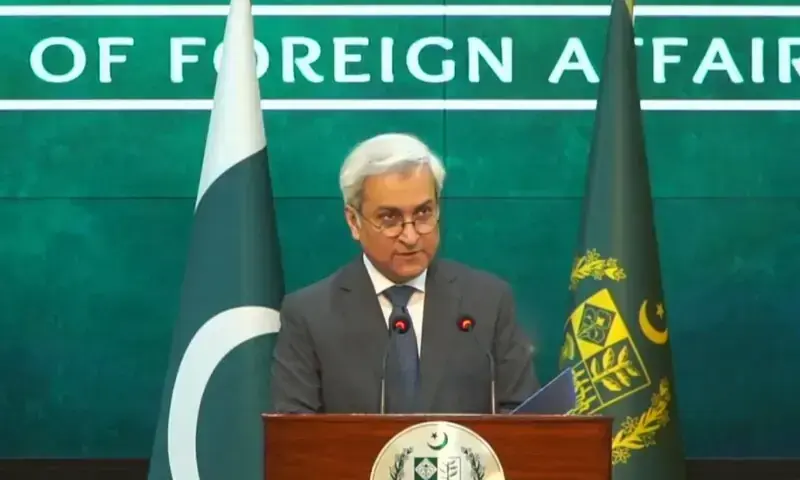


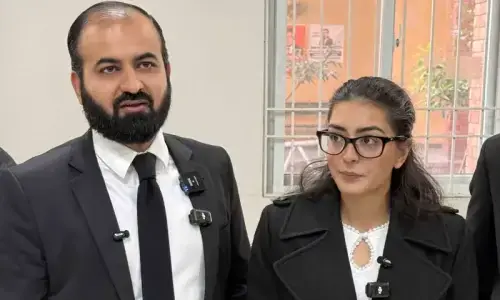
ISLAMABAD: The Foreign Office (FO) on Thursday stated Pakistan did not “subscribe to the opinion” of the judge — who convicted lawyer Imaan Mazari-Hari and her spouse, Hadi Ali Chattha — on “terrorist states”.
In his verdict, Additional District and Sessions Judge Muhammad Afzal Majoka had noted: “Currently there are four countries designated as terrorist states, which are Cuba, the Democratic Republic of Korea, Iran and Syria.”
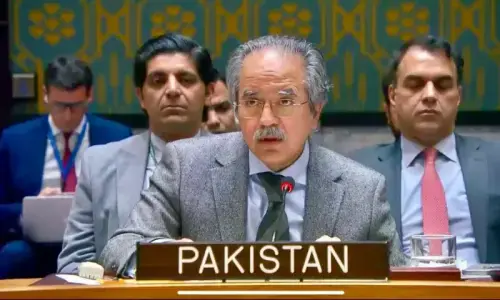
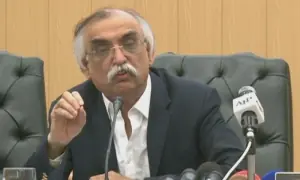
Asked about that judgment during his weekly press briefing in Islamabad on Thursday, FO spokesperson Tahir Hussain Andrabi said, “This judgment […] is the view of the learned judge. Pakistan, of course, does not subscribe to this opinion.
“And frankly, this kind of designation does not exist either under the United Nations (UN) or under international law,” he said.
Judge Majoka had made the observation while noting that Pakistan was “not included in the list of terrorist states”.
It is worth mentioning that the UN does not maintain a list of “terrorist states”.
The United Nations Security Council (UNSC) has a “Consolidated List” of individuals, entities and other groups that it subjects to certain measures, such as sanctions, due to various reasons. While it may include certain government-affiliated departments, it does not name any country in its entirety.
Imaan and Hadi were sentenced on January 24 under the Prevention of Electronic Crimes Act’s (Peca) sections 9 (glorification of an offence), 10 (cyberterrorism), and 26-A (false and fake information).
They were handed a total of 17 years in jail, with the longest sentence being 10 years, and fined Rs36 million each collectively.
In his judgment, Judge Majoka had remarked about the four countries while noting that the couple had “intentionally in their tweets mentioned the [sic] Pakistan as a terrorist state”.
Earlier on Thursday, the European Union’s (EU) Spokesperson for Foreign Affairs and Security Policy Anouar El Anouni raised concerns over the conviction of Imaan and Hadi.
In a post on X, the EU official said their convictions “over social media activity goes against freedom of expression and independence of lawyers”.
“These are not only key democratic principles but also part of [Pakistan’s] international human rights commitments,” Anouni said.
Andrabi was asked to comment on Anouni’s remarks during the briefing, to which he said: “This is a domestic affair of Pakistan, the trial and conviction took place under our local laws through a judicial process.
“The relevant individuals have a right to appeal and have a right to a judicial recourse,” he said.
“As such, there is a domestic remedy available to these individuals. Whilst we remain engaged with the EU on all issues, we do make a distinction about our domestic affairs,” he said.
On Iran-US rift
The FO spokesperson was also asked about whether Pakistan was making any efforts to ease tensions between Iran and the US in view of a threat of war between the two.
In his response, Andrabi said Pakistan had always advocated for peace and diplomacy to settle all outstanding issues.
“Pakistan remains firmly opposed to interference in the internal affairs of our brotherly country, Iran. We have opposed the use of force; we have opposed the imposition of sanctions,” he added.
The FO spokesperson recalled that earlier this week, Foreign Minister Ishaq Dar had telephone conversations with his Iranian counterpart twice and Pakistan had also engaged with the US at the World Economic Forum.
“So, our advocacy for peace diplomacy continues and this remains our stated position. This region cannot afford war or turmoil because this, in essence, stops the economic development and prosperity. So, we hope that peace and diplomacy will prevail,” he said.
Board of Peace
Multiple questions were also asked about the Board of Peace, which is led by US President Donald Trump.
Trump announced the establishment of the Board of Peace on January 15 as part of his broader plan for Gaza, under which the ceasefire agreement was reached. The board was authorised by UN Security Council Resolution 2803 in November 2025.
The board was originally conceived to oversee the ceasefire and reconstruction of Gaza, but its charter expands its mandate to peace-building in all areas affected by or at risk of conflict.
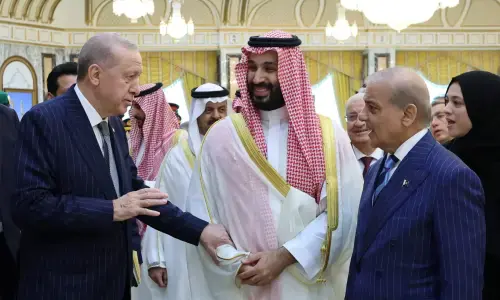
Prime Minister Shehbaz Sharif was among the world leaders who signed the board’s charter on January 22 in Davos.
Andrabi was asked on Thursday whether the FO had “prohibited” the premier or the government from signing the charter “for the time being” when the premier was leaving for Davos.
The FO spokesperson dismissed the reports, saying: “This news is incorrect.”
Responding to other questions on the matter, he said: “Pakistan has joined the Board of Peace in good faith. Our basic objective in joining the Board of Peace is threefold.
“One, to consolidate and sustain the ceasefire in Gaza; second, to support reconstruction; and thirdly, to advance a just and lasting peace based on the Palestinian right to self-determination.”
The FO spokesperson also pointed out that seven other Muslim countries had joined the board as well.
“As such, Pakistan joining the Board of Peace should be seen in the continuum of the initiative by these eight Arab Islamic countries to promote peace in Gaza, leading towards a lasting solution to the Palestinian question — and this initiative dates back to September and August last year.
“All eight countries have joined the Board of Peace with a single collective voice. The Board of Peace offers a viable glimmer of hope for Gaza and for the wider Palestinian question,” he asserted.
Andrabi further stated that for over two years, the people of Gaza had witnessed unprecedented suffering, death and destruction.
“The UN Security Council remained deadlocked on this issue. The International Court of Justice issued three advisory opinions, and the General Assembly adopted a number of resolutions, all of which failed to prevent the Israeli onslaught.
“So, in this backdrop, the Board of Peace is a glimmer of hope for Palestine,” he said.
Andrabi also clarified that it was a misconception that joining the board was in any way “connected to any Abraham accord or any sidetrack to this issue”.
“Pakistan’s positions remain unchanged, and we will not become a party to the Abraham Accord,” he said. He said the board “does not replace the United Nations”.
“It has been established with a specific mandate authorised by the UN Security Council resolution 2803. We understand that the Board of Peace is intended to complement and not undermine the UN system,” he said, adding that Pakistan had not decided to join the International Stabilisation Force (ISF) and the membership of the Board of Peace did not imply contributing to troops to ISF.
As for the decision to join the board itself, he said, the foreign ministry and all stakeholders held joint consultations.
“This was a collective decision taken with all procedural formalities completed in terms of the ‘Rules of Business’ of the federal government.”
Andrabi further stated: “We hope that the framework established by the Board of Peace will lead to concrete steps towards permanent ceasefire, expanded humanitarian assistance, the reconstruction of Gaza and will advance Palestinians people’s right to self-determination through a credible, time bound political process in line with international legitimacy and the relevant UN resolutions, culminating in an independent, sovereign, contiguous state of Palestine, based on the pre-1967 border with Al Quds Al Sharif as its capital.”
He said Pakistan looked forward to continuing to play a constructive role as part of the Board of Peace in achieving these goals and in ending the suffering of Palestinian brothers and sisters.
The FO spokesperson explained that representation at the Board of Peace depended on “at what level the meeting is taking place. I mean, there could be a summit level, or a ministerial level. So, on this issue, we will know, as we advance in this process”.
“As for the status of the membership, there is basically a three-year membership. And after three years, there is a certain payment. There is no permanent and non-permanent category, as such, linked to the financial contribution,” he added.
Andrabi was also asked about the steps taken for the removal of Pakistan from a list of countries facing recently imposed restrictions by the US on immigrant visas.
In his response, the FO spokesperson said, “This matter has been under discussion in Islamabad as well as in Washington through our diplomatic channels. This is an ongoing review. Our understanding is that eventually Pakistan will be excluded from this list.
“Our talks with the US, our diplomatic exchanges with the US are geared towards this objective.”