Hyderabad set to lose another famous landmark — house of Qamaruzzaman


 0
0
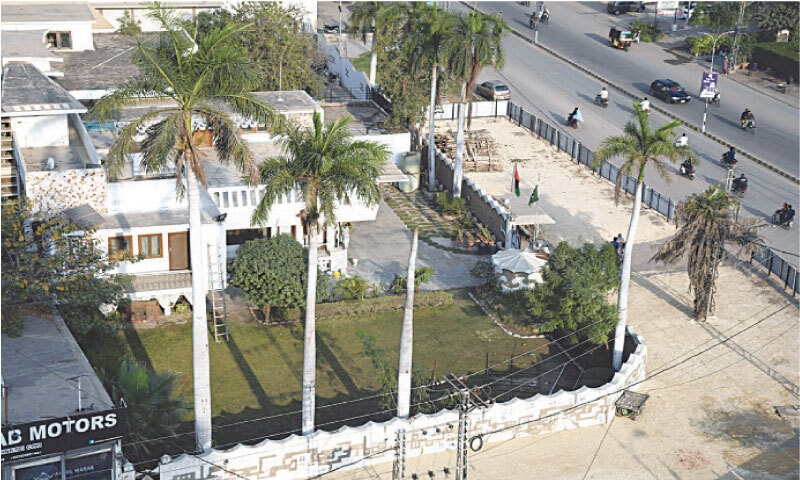
HYDERABAD: The city of Hyderabad has lost another famous identity, an over 50-year-old iconic house commonly known as Qamaruz Zaman Shah ka ghar. He was a PPP stalwart since the era of Z.A. Bhutto.
His family has sold it to some commercial concern. There was hardly anyone born in the mid-70s onwards who didn’t know this landmark. Because of its prime location in Unit-2 Latifabad, the house has served as an identity for those visiting from other cities.
Located at a roundabout, commonly known as “Qamar Zaman Shah chowk”, that connects City taluka with Latifabd taluka from Cantonment graveyard, it has been a famous reference for inhabitants of Hyderabad and other visitors. It would no longer be there in the days to come after the house witnessed the fourth generation of Shah growing up there.
“The house’s construction began in late 60s and I remember our family shifted there during the 71’s war [with India],” said Dr Syed Nadeem Qamar, younger son of late Syed Qamaruzzaman Shah. Sitting MNA of the PPP Syed Naveed Qamar is the eldest son of late Zaman.
Since 1971, it remained a centre for all kind of political and social religious activities
“Actually, everyone has shifted to Karachi. Nobody lives here now,” said Nadeem, a former chief of the National Institute of Cardiovascular Diseases (NICVD). His younger brother and sitting Sindh High Court judge, Miran Mohammad Shah, was the last one shifted from here to Karachi in 2008.
Zaman’s house has been the centre of all kind of political, social and religious activities. Mehfil-i-Naat attended by all and sundry even without invitation was a regular feature here as Mr Shah hardly missed it in his life.
Qamar Zaman has been an active part of Z. A. Bhutto’s Pakistan Peoples Party (PPP) to represent the party in the Senate and in Sindh Assembly in 70s. “Bhutto saheb visited this house thrice,” said Dr Nadeem. He added that the house was indeed a landmark for the people of the city.
A row of trees locally known as bottle palm was there on two sides of its lawn. It was a two-side corner house enlisted as 233-C Unit-2 Latifabad in record of rights, stretching over 1,500 sq. yds. A commercial venture would, however, be seen here as another high rise has already been raised on the other side of this very road of Latifabad.
According to another family member, “area has fast witnessed commercialisation and it was no longer an area that it once used to be. Secondly, everyone among us shifted to Karachi. “Our fourth generation has seen this house,” he said, alluding to children of Qasim Naveed, the paternal grandson of late Qamar Zaman. Late Zaman had headed the Sindh Chamber of Agriculture (SCA), a vibrant farmers’ body which later his sons Dr Nadeem Qamar and Miran Mohammad Shah also headed.
“Painting by Moharram Raz drawn on a canvas, depicting a peasant and his wife in the drawing room needs to be preserved or kept in museum,” said Dr Nadeem. “Raz used to present different designs before quite enthusiastically,” said Nadeem, a cardiologist by profession.
“Raz was the son of baba’s hairdresser and was a born painter. After working in the house, he became a celebrity himself and went on to work in many houses in Hyderabad including that of late Yousuf Kausar Bhatti, a Bhutto loyalist. New Majestic Cinema (now gone) was packed with his workmanship,” said Miran Mohammad Shah.
Qamar’s family led by Miran Mohammad Shah, his father-in-law, used to live in the Cantonment area where once famous Venus Cinema existed. The cinema was built after the plot was sold to Venus Cinema owner Chaudhry Latif. The family then shifted to Unit-2 house.
His family was then shifted to Unit-2 house. Besides Z.A.Bhutto, Benazir Bhutto also paid multiple visits and even stayed there. Bilawal Bhutto Zardari had also visited this residence.
Celebrated writer Noorul Huda Shah also can’t help reminiscing about her memories of her relative’s house. Her father was the first cousin of late Qamar Zaman and his wife. “Shah saheb had built this house with entirely new architecture that was not common in that era. This perhaps set the tone for raising a house with a new architecture,” she said, alluding to a particular kind of construction pattern on the outer wall which people always tried to decipher, out of curiosity, as something written in Sindhi language.
Ms Huda recalled how Qamar Zaman stood with her when she shot to fame due to her play Jungle televised by PTV in 1983, questioning feudalism in Sindh. “Jungle led to a controversy and I remember Shah saheb offering me full support when I faced this difficult phase,” she remarked.
“Shah’s family has been respected by Urdu speaking families settled here after partition and I didn’t hear of any adverse event even during the turbulent period this city had gone through in 80s and 90s. It was a bond between the family and Hyderabad’s people and that’s why we never saw a single gunman in or outside the house. Only a watchman used to be there,” she noted. “A large earthen jar was kept with the outer wall outside. Pedestrians and rickshaw wallas used to have drinking water there,” she said. The bungalow, she said, had embossed painting on the wall in the lawn, showing process of crop’s cultivation and harvesting.
Qamar Zaman died in 2016 at the age of 83. Naveed Qamar is the MNA from Tando Mohammad Khan, one of Hyderabad’s eight talukas until 2004. Miran M. Shah remained a UC Nazim in the Musharraf era from there in 2001. Naveed Qasim is now the chairman of T.M, Khan district council. The family owns agricultural lands in T. M. Khan district and prefers living there besides Karachi.
Published in Dawn, January 22nd, 2026