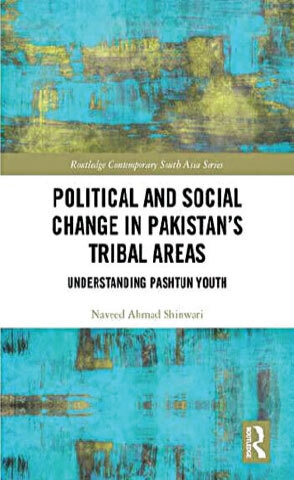
Political and Social Change in Pakistan’s Tribal Areas: Understanding Pashtun Youth
By Naveed Ahmad Shinwari
Routledge
ISBN: 978-1032956091
246pp.
For decades, the rugged region bordering Afghanistan, until recently known as Pakistan’s Federally Administered Tribal Areas (Fata), was framed almost as a geopolitical flashpoint. Journalists, policymakers and scholars portrayed it through the prism of conflict, echoing descriptions like “the most dangerous place on earth”, which narrowly overshadowed the everyday experience, social complexity and aspirations of the over five million Pakhtuns living there.
Naveed Ahmad Shinwari’s book, Political and Social Change in Pakistan’s Tribal Areas: Understanding Pashtun Youth, offers a substantive corrective to this prevailing imagery.
Moving beyond conventional depictions of conflict, Shinwari illuminates the lived realities of a society undergoing major structural changes. His central argument underscores that the true story of the former Fata, now called “merged districts” of Khyber Pakhtunkhwa following the 2018 constitutional integration, is not defined solely by residual violence, but by the rise of a politically conscious youth determined to reshape inherited structures of power.
Drawing on over two decades of development engagement and extensive field research, Shinwari offers a level of empirical depth that has long been missing from scholarship on the region. The book, which expands on his doctoral dissertation at the University of Sussex, fills a critical analytical gap.
Where policy debates often reduced the region to a laboratory of counterterrorism, Shinwari’s work depicts it as a dynamic social landscape, marked by contested authority, intricate kinship structures, evolving identities, and increasing political mobilisation.
A very timely scholarly book moves beyond conventional depictions of conflict in Pakistan’s ‘merged districts’ to illuminate the lived realities of Pakhtun society undergoing major structural changes
Structured into six chapters, the book opens with a rigorous examination of the Frontier Crimes Regulation, the colonial legal framework that governed the region for nearly a century. The chapter lays bare the punitive foundations of the system: arbitrary detention, collective punishment, property destruction and the near-total absence of due process.
Fata’s ambiguous constitutional status, combined with its strategic proximity to Afghanistan, rendered it a pawn in a succession of global and regional geopolitical struggles, from the times of British colonialism to Cold War politics and, later, the post-9/11 security order, until today. The effects were devastating: terrorism, mass displacement, drone strikes and economic marginalisation became recurring features of life, while sustainable development remained elusive.
The book also explores “unprotected” areas, indirectly governed by tribal elites or maliks and political agents rather than by formal state institutions. For example, the nikat system of hereditary entitlement concentrated power within select families, enabling them to nominate tribal police such as the Khasadar force. This structure entrenched unequal access to justice and severely restricted accountability, leaving ordinary citizens dependent on unelected intermediaries.
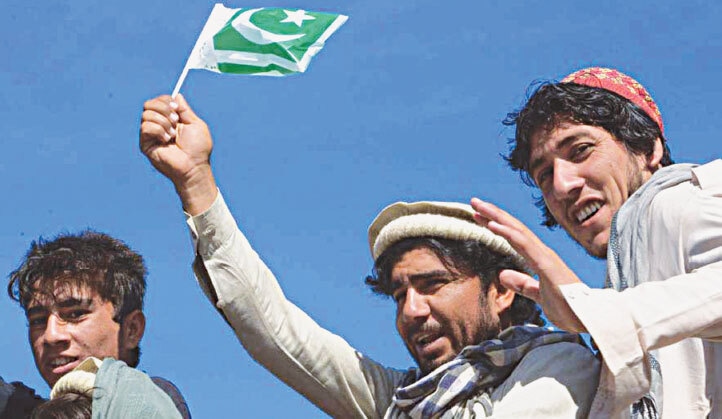
Chapter two examines the social organisation of Pakhtun youth, focusing on how they navigate these entrenched hierarchies while confronting the disruptive effects of conflict, large-scale displacement and modernisation. Exposure to urban centres and other countries, diversified livelihoods and expanding digital and road connectivity have reshaped their expectations. Traditional deference to maliks has eroded, giving way to a growing demand for transparency, rights and representation.
The core of the book lies in Shinwari’s analysis of three youth-centred movements that emerged from the region, each revealing how young Pakhtuns navigate, challenge and reinterpret structures of authority and violence.
Chapter Three explores the process of Talibanisation, presenting the Tehreek-i-Taliban Pakistan as a disruptive actor that exploited state neglect to remake the lives of young men through coercion and fear. Shinwari argues that recruitment stemmed less from ideology than from the group’s strategic exploitation of weak governance, poverty and social alienation. By selectively invoking Islamic and Pakhtun idioms, the TTP conceals its violent agenda and targets youth seeking protection, recognition or economic security.
Chapter Four shifts to the emergence of youth-led civil society initiatives, particularly the Fata Youth Jirga, a small but influential group of educated Pakhtuns from elite and middle-class backgrounds. Although not fully representative of all tribal youth, the Jirga played a decisive role during the 2018 merger debate, demonstrating the capacity of organised, non-violent civic activism to shape policy outcomes.
Chapter Five turns to the Pashtun Tahaffuz Movement (PTM), whose rise following Naqeebullah Mehsud’s extrajudicial killing in Karachi exposed deep grievances around militarisation, enforced disappearances, landmines and displacement. Despite its recent proscription by the state, Shinwari situates PTM within broader analytical debates on identity, state authority and post-conflict accountability, arguing that youth-led mobilisation now constitutes a transformative force in the region’s political landscape.
The concluding chapter compares the strategies, limitations and transformative potential of the three movements.
Shinwari’s book delivers a timely and powerful message: the socio-political future of the former tribal region will be shaped decisively by its youth. Through three case studies, he shows how the erosion of hereditary authority has opened space for a new, digitally connected Pakhtun middle class to press for justice, accountability and meaningful political inclusion — one of the most significant transformations in the region’s modern history. The book also highlights a recurring grievance among residents, who contend that persistent misunderstanding of Pakhtun social structures by non-Pakhtun decision-makers has deepened instability.
The book resonates with an earlier work by the late French scholar and my mentor, Mariam Abou Zahab, whose Kashar Against Mashar (youth against elders) framework captures generational tensions shaping local politics. It further aligns with arguments by politician Afrasiab Khattak, political sociologist Husnul Amin and researcher Sartaj Khan, who trace how conflict, economic mobility and emerging middle-class identities have fuelled neo-Pakhtun nationalism.
Although the book maintains the formal tone characteristic of research emerging from doctoral work, it offers fewer personal narratives than some readers might expect. Yet it remains an authoritative contribution. Its insights are particularly relevant amid the resurgence of militant groups such as the TTP following the Taliban’s 2021 takeover of Afghanistan. This is especially so at a time when persistent poverty, administrative uncertainty, and the slow pace of institutional integration continue to strain the region’s social fabric, long after its 2018 merger into the country’s constitutional framework.
In a nutshell, Shinwari provides more than a scholarly assessment: he offers a framework for understanding how marginalised communities can assert their agency. He argues that preventing youth from gravitating toward violent extremism requires policymakers to listen to young people, address their lived grievances, and include them meaningfully in peace-building and development planning.
The reviewer is a journalist and researcher.
He can be reached at zeea.rehman@gmail.com
Published in Dawn, Books & Authors, December 28th, 2025