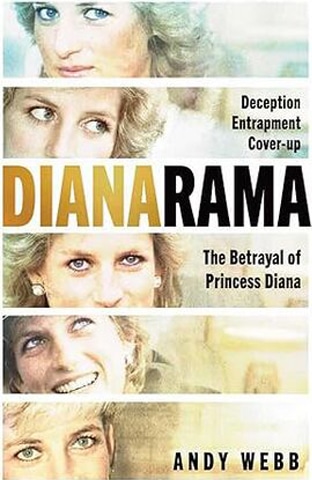
Dianarama: Deception, Entrapment, Cover-Up — The Betrayal of Princess Diana
By Andy Webb
Pegasus Books
ISBN: 979-8897100880
432pp.
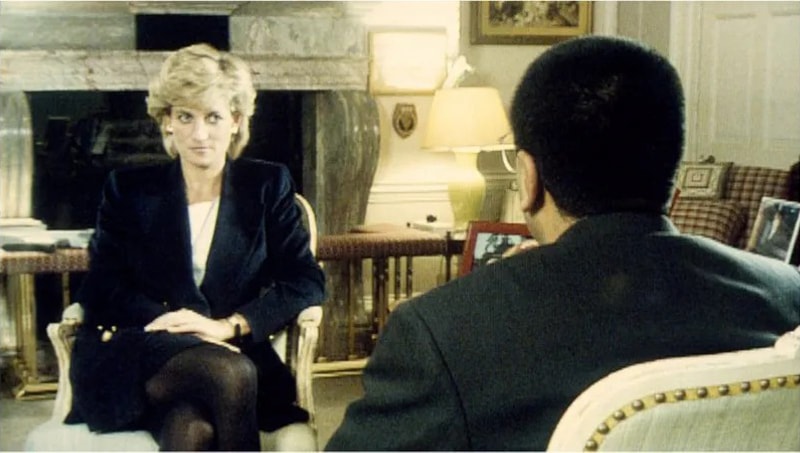
Andy Webb is a senior journalist who worked for decades with the BBC and Channel 4. Like others, he was moved by the plight of Diana, the late Princess of Wales, who felt compelled in November 1995 to give a very candid interview about her feelings to Martin Bashir (of the BBC) for Panorama.
Her admission of adultery in that programme, coupled with her statement that Prince Charles (whom she indicated was an adulterer himself) should be passed over as king in favour of Prince William, eventually led to Queen Elizabeth II requesting that Diana and Charles divorce. The interview’s ramifications gained traction because the BBC has long been considered one of the finest reporting and journalistic venues globally. Andy Webb’s Dianarama, however, elucidates that the BBC initially engaged in a massive cover-up of how Martin Bashir utterly unethically manipulated the princess to obtain this famous interview.
Perhaps Webb would not have been able to publish this exposé without the help and support of Diana’s brother, Charles, Earl Spencer. According to Webb, Bashir commissioned Matt Weissler, a graphic designer, to create forged bank statements, implying that Earl Spencer’s head of security, Alan Waller, was receiving payments from the media in order to provide information to them on the Earl’s activities.
When shown these statements, Spencer apparently was taken in, and later introduced Diana to Bashir. Gaining momentum, Bashir displayed ‘financial proof’ to the princess of disloyalty on the part of her private secretary, Patrick Jephson. In a private meeting with Diana and Spencer at Knightsbridge, Bashir claimed that both Jephson and Prince Charles’s private secretary, Richard Aylard, were benefitting financially by leaking royal insider information to the press.
A former journalist’s book on Princess Diana’s infamous 1995 Panorama interview with Martin Bashir expects readers to consider Bashir and the BBC’s top brass as the only villains
Why Charles Spencer and the late princess were so easily fooled is anybody’s guess. Bashir, a second-generation Pakistani immigrant who converted to Christianity in his teens, had risen rapidly through the ranks of the BBC, largely due to his charm and persuasiveness. According to Webb, Bashir then played upon the princess’ internal paranoia by convincing her that her children’s nanny, Alexandra ‘Tiggy’ Legge-Bourke, was in a sexual relationship with the Prince of Wales, who would divorce his wife in order to then legally roll in the hay with the nanny.
However, for a reader to believe that both her and Earl Spencer (scions of one of the richest and most established noble households in Britain, and no strangers to the intricacies of high-level political drama) had gullibly fallen for Bashir’s alleged traps requires a stretch of the imagination to say the least. Diana didn’t hold a single O-Level, but Spencer attended both Eton and Oxford. To quote Uncle Digory from C.S. Lewis’s Narnia Chronicles, ‘Bless me… what do they teach them at these schools?’
Though Webb underscores that a paranoid Diana told her law firm, Mishcon de Reya, that the Palace was planning to exterminate her, it was ridiculous of the law firm to hold back about nipping such thoughts in the bud. On a side note, this might explain why they could only come up with a paltry 17 million GBP divorce settlement for her, chump change for the former Prince of Wales, who pulled tens of millions from the Duchy of Cornwall alone.
I’m not saying that Martin Bashir was a saint. The so-called mock-ups may well have been used illicitly to create the pathway to bagging a phenomenally sensational interview, but Webb also wants us to believe that Bashir acted independently and that higher-ups, such as the BBC’s Director-General John Birt, were unaware of his nefarious actions at the time.
Given that Bashir was going to interview one of the most famous women in the world, it is highly unlikely that his bosses would have been completely clueless about what was happening. Oddly enough, during the immediate aftermath of the interview, Earl Spencer remained taciturn about his involvement in introducing his sister to Bashir. The nobleman only became far more active in trying to take the BBC to task years later, ie when his sister had passed away and could not be actively asked to confirm or deny anything.
Bashir was undeniably a pro. His plan was carried out with extraordinary skill, overcoming, as very few reporters were able to do, first Charles Spencer’s bristling hostility to the media and then penetrating the very inner sanctum, Diana’s sitting room at Kensington Palace. Once there, he was able to conjure just the right words and spill them in such a way that Diana, no fool she, was entranced, then terrified, then done up like a kipper. Those are fearsome skills, as darkly admirable as the paparazzo who can snatch sharp photos single-handed from a racing motorbike or snap the million-dollar picture from a hiding place half a mile away. — Excerpt from the book
Webb notes that Tony Hall (a later director-general of the BBC) conducted a half-hearted inquiry into the matter in 1996 and, even though BBC executive Tim Suter knew Charles Spencer personally and could have contacted the earl about various concerns, he chose not to do so. Webb’s claims that Spencer was somewhat removed from matters in 1996 by having relocated himself and his family to South Africa make for a relatively thin argument, especially since Spencer himself is a journalist and writer and would hardly have been unaware of the shockwaves emanating from the interview on both the public and private scales.
What irritates me most about this book is how readily we are expected to label Bashir and the BBC’s top brass as being the only villains in this story. Apparently, Earl Spencer provided Webb with a copy of a disturbing fax sent to him by Bashir during the months leading up to the interview (a document which the author reproduces in the book). But Webb never breathes a word about whether the fax was authentic or not; he simply assumes that it is genuine. Or rather, he wants the reader to assume that that fax was truly sent from Bashir to Spencer.
I am sure that when the Panorama matter was more closely examined in 2020 by Lord Dyson, his shrewd legal mind would not have missed this basic point. I’m not saying that Spencer’s guilt and grief at his sister’s death in a car accident in 1997 were not genuine. But that does not mean that the fax he proffered, underscoring Bashir’s alleged villainy, was.
The book is an engaging read, though parts of it are undoubtedly racist. Noting that Diana trusted Bashir because he had Pakistani roots, like her penultimate major lover Hasnat Khan did, or that she liked dark-skinned men, comes across as silly at best and xenophobic at worst.
Bashir himself was obviously not above playing the victim and stating in writing that his ‘second-generation immigrant’ status had irked upper-class Brits, but this was utterly disingenuous of him since he holds a Master’s degree in theology from King’s College London (hardly a shabby school; its current patron is King Charles III himself). Indeed, during the latter part of his career, Bashir was granted the post of the BBC’s editor of religion. The white-skinned Weissler, however, ended up having to take on menial jobs in order to survive.
Intriguingly enough, Queen Elizabeth II is alluded to only once in the book, although I have absolutely no doubt that she was being briefed about the situation throughout. In a rather foolishly heroic move, Webb used the Freedom of Information Act (which came into force in the UK in 2005) to seek emails related to the Panorama fiasco, but the 3,288 messages were so heavily redacted as to be almost useless.
Using license fees, the BBC eventually paid compensation to individuals such as Alexandra Legge-Bourke (her married name is Pettifer), Patrick Jephson and Matt Weissler, among others. Regardless, the whole affair turned out to be a storm in a teacup, except the teacup was the size of the Grand Canyon. Still, a storm in a teacup.
The reviewer is Associate Professor of Social Sciences and Liberal Arts at the Institute of Business Administration. She has authored two collections of short stories, Timeless College Tales and Perennial College Tales, and a play, The Political Chess King
Published in Dawn, Books & Authors, February 22nd, 2026