FESTIVAL: LITERATURE IN THE TIME OF BASANT


This year, it looked like cultural and literary activities were squeezed into a small timeframe across Pakistan in general and in Lahore in particular, due to the impending start of Ramazan. It meant that all cultural and literary events had to be held before that. In Lahore, the Lahore International Book Fair, Basant, the Asma Jahangir Conference and the Lahore Literary Festival (LLF) all coincided on February 6, 7 and 8.
There was a lot of hullabaloo and commotion due to Basant that was taking place after a gap of about two decades. Nobody wanted to miss it, including Gen-Z, whose memories are not attached to the cultural event that was once almost synonymous with life in Lahore. Initially scheduled for the weekend prior, LLF was forced to shift to the dates clashing with the much-awaited Basant Mela because of administrative orders and it was a brave call by the organisers to accept the new dates.
On the same days, the Karachi Literature Festival (KLF) was also taking place and some of the panellists were featured in both these festivals, taking flights from Lahore to Karachi or vice versa to ensure their presence. While booksellers and publishers were making hay while the sun of literary events was shining, the impact of all these activities did have some effect on the LLF and it was visible in the crowds.
The 14th edition of LLF appeared like an attempt to diversify the festival that generally focuses on English language literature and art. The organisers put more focus on history this time and that took the central space during all the three days. There were about 16 sessions, including book launches, on history and about an equal number of sessions on Urdu and other regional languages.
The 14th Lahore Literary Festival put its focus on history and in diversifying away from English but was impacted by scheduling clashes with the much-awaited Basant festival, among other goings on
Historian and Oxford University Professor Robin Lane Fox delivered the keynote speech to open this edition of the LLF. He, very intelligently, chose a subject that the Lahori audience as well as non-Lahori delegates could relate to — Alexander the Great, who conquered parts of India more than two millennia ago. Prof Fox painted a picture of Alexander based on facts, not the legends that are popular around the world as well the legends that he left behind when he returned.
He deconstructed the myths surrounding Alexander as well as his great teacher Aristotle, the biggest of them all being that both the disciple and teacher had no sense of geography when the former came to India. Prof Fox also talked of the five “Ws” that were important vis-à-vis Alexander’s time spent in India — war, war elephants, women, weather and wealth. Prof Fox repeated almost the same lecture when he went to Karachi later.
Other scholars featured in the LLF included Audrey Truschke of Rutgers University in the US — whose work on Mughal emperor Aurangzeb and, recently, on 5,000 years of the Subcontinent’s history is well known — and British-Pakistani Ziauddin Sardar who has written extensively about Muslim thought and societies.
Indian-Canadian filmmaker Deepa Mehta, director of movies such as Fire, Earth and Water, was perhaps the most anticipated delegate of the festival. Her session was well-attended and she spoke of how she ventured into filmmaking under the influence of her father, learning the art of editing as the start. She also spoke about how chance played a big role in leading her to make her Aamir Khan-starrer Earth. In addition, she shared the politics and political interests that brought about a backlash for some of her films, including Water.
The first day of the litfest had few sessions but its pace picked up on the second and third days, though Basant had affected the number of people in attendance.
Saad Abbasi, a vet who has been attending the LLF over the years, also felt the difference, saying that he did not find it as good as the previous years.
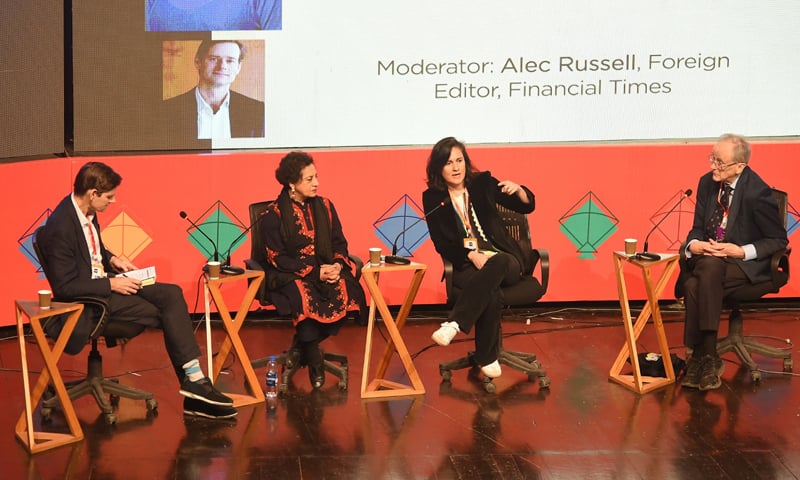
“There are fewer people this year. Basant can be the reason. But I did find some sessions to my liking and liked the views of the panelists,” he tells Eos. One of the sessions that he liked was about world politics, ‘Remains of the Day: The Post-1945 World Order and Diplomacy in a Time of Resurgent Great-Power Rivalry’, which included Michael Pembroke, historian and former judge of the Supreme Court of New South Wales in Australia; former Pakistan foreign minister Hina Rabbani Khar and Mohammad Yahya, the UN’s Resident Coordinator.
Moderated by Lyse Doucet of the BBC, the session discussed the dirty role the US has been playing in the world since World War II. Pembroke pointed out that the CIA’s precursor, the OSS, played a similar role in undermining the Italian Communist Party as the CIA and Israel’s Mossad played recently in Iran. Khar referred to a “civilisational regression” in the West.
However, not everybody comes to litfests like LLF with views like those of Saad Abbasi. People attend them for a myriad of reasons. Litfests are an attraction not just for those interested in world politics, culture and literature, but also provide space for socialising with like-minded people.
Freelance journalist and rights activist Umaima Ahmed attends the LLF every year but she does not go inside the halls of Alhamra Art Centre. She stays on the lawns and sits in the food court, hanging out with friends and those she meets only at such events. “I come only for socialising,” she admits, “otherwise, nobody has time in their busy routine.”
During the festival, there were talks on art, history, economy, migration, regional languages and literature in English, Punjabi, Seraiki and Urdu languages.
At the book launch of Shattered Lands: Five Partitions and the Making of Modern Asia by Sam Dalrymple — the son of noted historian William Dalrymple — the younger Dalrymple spoke about, among other things, the real reasons for Mohammad Ali Jinnah leaving India and his return. According o to him, Jinnah left mainly because of his daughter’s schooling and returned mainly to answer Jawaharlal Nehru’s taunt that his political career was finished.
At another session on Seraiki, novelist and journalist Kashif Baloch asserted that liberal order and nationalism had replaced feudalism and its aesthetics. While Seraiki poets and writers were aware of the oppression of aesthetics, he claimed no significant parallel voices were heard in Punjabi.
Pakistani-British novelist Kamila Shamsie, in her session, spoke about the impact of migration on her. She also discussed how important it was for the writers to venture into the subjects that they are unfamiliar with, just as she did with Burnt Shadows, her novel set in Nagasaki.
Fatima Bhutto was eagerly awaited after the publication of her recent memoirs, but could not make it to the festival. The LLF was sandwiched between Afkaar-i-Taza, ThinkFest and the Faiz Festival, three main literary events of Lahore, and comparison between all three becomes natural if they happen in such close proximity.
The LLF had the least number of visitors while the Faiz Festival, the weekend after, had the most, so much so that, on Sunday, the organisers of the latter had to shut doors in some halls of the Alhamra due the rush of people. One obvious difference is that of language. The LLF caters to mainly the English-speaking class while the Faiz Festival is held mostly in Urdu and a majority of Pakistanis can relate more to the latter than the former, hence the obvious pull.
What can be the other reasons for lower attendance should be left to the LLF organisers to ponder. However, for holding the event despite the obvious challenges, including Basant, they deserve kudos. One hopes that next year the clash of schedules will have been worked out.
The writer is a member of staff.
X: @IrfaanAslam
Published in Dawn, Books & Authors, February 22nd, 2026