EVERY generation inherits a story, and for the youth of Pakistan, one story shines brightest: the struggle and vision of Mohammad Ali Jinnah. His life, mission and foresight will remain forever relevant.
They are a compass for a generation navigating transformation, uncertainty, and possibility. Today, the youth stands at the intersection of technological acceleration, volatile geopolitical realignments, climate disruptions, cultural shifts, economic uncertainty, and a rising global consciousness that increasingly binds individual destinies into a shared human trajectory. The 21st century has not merely changed the world; it has rewired it. In this disorderly landscape, youth are tasked not only with survival but with ‘meaning-making’, which is to discover purpose, shape identity, and wield agency to craft a society that is equitable, resilient, and vibrant. As Jinnah once said to students in 1948, “You must devote yourself wholeheartedly to your studies, for that is your rst obligation to yourselves, your parents and to the State”.
Pakistan’s youth are acutely aware of the systemic challenges their country faces: entrenched inequalities, political volatility, and social injustice. Yet they carry both the responsibility and the capacity to act. The roof of Frere Hall in Karachi, immortalised in the brushstrokes of Sadequain, serves as a silent witness to these realities. A symbolic canvas capturing the lives, struggles, and resilience of millions. In its stillness, the artwork reects the persistent challenges of governance, social inequality, and the desperate need for ethical stewardship. It reminds the youth that leadership is both moral and practical. It requires courage, vision, and empathy.
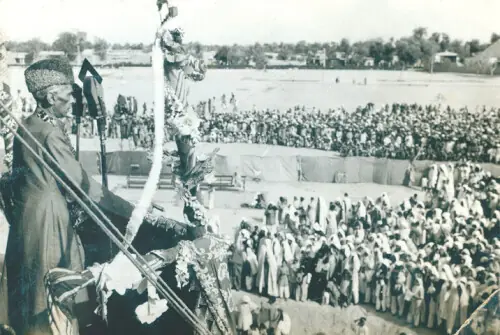
The country’s young are breaking free from the shackles of saviour-centric leadership. They believe in their own ability to act, to create, and to chart the course for themselves and their communities. Leadership is not imposed through brute force. It is driven by compassion, and is collaborative in nature. It is more like horsemanship than command: a skilled rider does not force a horse but works in partnership, guiding with subtlety, awareness, and responsiveness. From the campaigns of Alexander the Great in Punjab to the Mughal emperors whose mastery of horses symbolised coordination, strategy, and grace, horsemanship has long been a part of Pakistan’s turbulent history. In Lahore, the annual Horse and Cattle Show continues to teach lessons of discipline, responsiveness, and balance, observed and absorbed by the country’s youngsters who are growing up amid these rich traditions. Just as horsemanship requires attunement to the horse, leadership requires awareness of environment, context, and community. It is a principle that extends naturally to Pakistan’s agrarian heritage.
Jinnah’s words in 1945 resonate across time: “With faith, unity and discipline … there is nothing worthwhile that you cannot achieve”. He reminds the youth that discipline, ethical action, and vision are foundational. Horizontal leadership, community engagement, and principled decision-making are the only ways to embody the founder’s philosophical insight in contemporary Pakistan.
Equally instructive is Pakistan’s connection to the soil. Agrarian life instills a sense of place, responsibility, and identity. Understanding the soil and the seasons, rivers and ecosystems cultivates both practical knowledge and moral stewardship. A youth that grows up in the fertile valleys of Punjab, the riverine plains of Sindh, the rugged landscape of Balochistan and the scenic, culturally-rich environs of Khyber Pakhtunkhwa inherit a lived understanding of interdependence, resilience, and collective responsibility. The Indus River, owing from the northern mountains through the plains into the Arabian Sea, embodies Pakistan’s identity as well as the Quaid’s progressive vision of unity and coexistence. It is both a lifeline and a symbol that unites diverse landscapes and equally varied communities into a shared national narrative. Similarly, the deserts of Thar, the highlands of Khyber Pakhtunkhwa, and the majestic peaks of Gilgit-Baltistan teach lessons in adaptation, resourcefulness, and perseverance.
These landscapes shape worldviews and provide a profound sense of continuity and belonging. Ideally, they should reinforce the founding father’s lessons of collaboration, patience, equality, integrity and foresight.
The youth’s task is to navigate complexity with agency. This involves creating meaning in the age of disorder.
And the time is now to not just survive global climate shocks, heightened economic insecurity, and political volatility, but to also intervene, frame, and transform the world around them.
Young Pakistanis are positioned to recognise problems, design solutions, and seize policy windows that allow structural impact. Whether advocating for climate adaptation strategies across the country, creating digital innovation hubs in Islamabad, or devising systems for sustainable agriculture, the youth must act as architects of policy and society, and bridge local realities with global frameworks.
Opportunities for the youth have never been more expansive. Pakistan’s mountains, deserts, and mineral-rich regions invite exploration and mining initiatives.
The coastlines open doors for maritime trade, research, and renewable energy, while its urban centres provide a springboard into the digital economy. Articial intelligence, blockchain, and emerging global marketplaces are arenas where Pakistani youth can compete, innovate, and lead. The world is theirs to claim. Not waiting for permission, but seizing opportunities with initiative, creativity, and ethical responsibility.
Pakistan’s youth are also shaping identity and belonging in a horizontal and empathetic manner. They are redening leadership as one that is relational and rational as exemplied by Jinnah, and through the creation of networks of cooperation, mentorship, and mutual accountability. Authority is earned through skill, foresight, inclusivity and responsiveness — echoes of Quaid-i-Azam Mohammad Ali Jinnah’s thoughts. Our leader has given us a map that shows the way to earning trust through sensitivity, receptiveness, honesty and determination, much like an astute farmer who understands the rhythms of the land. Ethical action and collaboration will enable the youth to earn trust and credibility. However, they must not wait for a messiah to emerge. Instead, they should focus on transforming into their own saviours.
And without any doubt, the country’s future is theirs to claim.
This connection to land, culture, and history is not merely symbolic. It provides the moral foundation for leadership. Pakistan’s diverse landscapes, with its mountains, plains, deserts, and coasts teach us patience, adaptation, and resilience. Agrarian life connects action to consequence, discipline to outcome, and collective effort to shared benet. The youth are therefore equipped not only with agency but also with the moral lens required to guide communities, protect natural resources, and uphold identity and belonging.
Jinnah’s words in 1945 resonate across time: “With faith, unity and discipline … there is nothing worthwhile that you cannot achieve”. The Quaid’s immortal message serves as a reminder for the youth to embrace discipline, justice, and vision as foundational guidelines for success. Horizontal leadership, community engagement, and principled decision-making are the only ways to embody the founder’s philosophical insight in contemporary Pakistan. Our youth has to act as stewards of belonging, custodians of identity, and architects of possibilities. The power lies with the country’s young to build a nation that represents both historical wisdom and the promise of innovation.
As Pakistan celebrates Mohammad Ali Jinnah’s birthday, it is tting to honour not only his formidable legacy but the potential of today’s youth to carry it forward. The nation’s future depends on those who claim their agency, embrace horizontal leadership, and act with courage, empathy, and vision. The Quaid once told the youth in 1948 to “learn to obey, for only then you can learn to command”, reminding them that humility and discipline form the foundation of true leadership.
Today, his words echo louder than ever: the youth of Pakistan can and must shape the country’s destiny. The question is not whether Pakistan’s youth are capable. The question is whether they trust themselves to lead, innovate, and dene their own present and future.
In doing so, they honour Jinnah. The founding father, a most remarkable and determined leader, can never become a relic of history. He lives on as a compass for participation, achievement, and nation-building.
The writer holds a PhD, and teaches political economy and comparative politics at Brevard College.