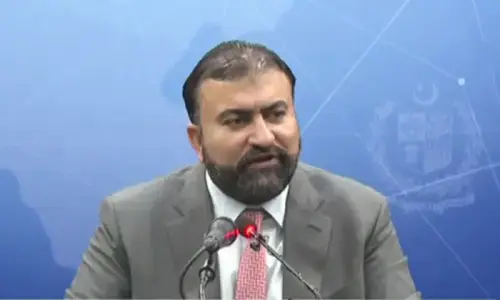
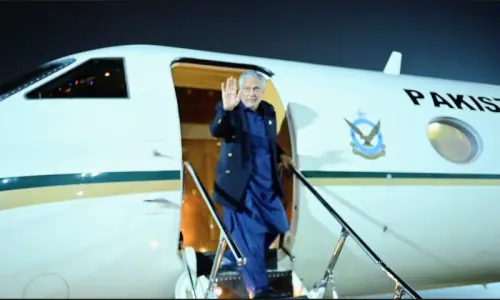
ISLAMABAD: Deputy Prime Minister and Foreign Minister Ishaq Dar on Friday accused India of “weaponising water” and urged the international community to press New Delhi to immediately restore the Indus Waters Treaty (IWT), warning that continued violations risk destabilising South Asia.
“We also hope that in your national capacities, you will call on India for the immediate restoration of the IWT, stop weaponisation of water, uphold international law and treaty obligations and refrain from undermining peace and stability of South Asia,” Mr Dar told foreign diplomats based in Islamabad during a briefing on Indian breaches of the treaty.
“What we are witnessing now is material breaches by India that strike at the heart of the Indus Waters Treaty, with escalating consequences both for regional stability and sanctity of international law,” Mr Dar said.
Officials say they have recorded abrupt and unexplained fluctuations in the flow of the Chenab River in mid-December, the second such episode this year after similar variations were observed between late April and late May.
The latest disruptions have reduced water availability for irrigation canals in Punjab, affecting wheat and other crops and forcing authorities to suspend canal outflows in some areas.
“India’s most recent action clearly exemplifies the weaponisation of water, to which Pakistan has been consistently drawing the attention of the international community,” Mr Dar said.
“India’s manipulation of water, at a critical time of our agricultural cycle, directly threatens the lives and livelihoods, as well as food and economic security of our citizens,” he added.
Mr Dar warned that India’s failure to meet treaty obligations has wider consequences, arguing that the suspension of routine cooperation mechanisms undermines Pakistan’s ability to manage floods and droughts.
“India has also halted sharing advance information, hydrological data and joint oversight required by the treaty, which has exposed Pakistan to floods and droughts. Such illegal and irresponsible Indian conduct has all the potential to trigger a humanitarian crisis in Pakistan,” he said.
A letter sent by several UN special procedures and mandate holders to the Indian government expressed concerns over New Delhi’s decision to hold the treaty in abeyance.
The experts also noted that India’s home minister declared in June that his country would never restore the treaty and would instead divert waters to India’s Rajasthan via a new canal.
“We also take note, in this regard, of the communication by several UN special procedures and mandate holders addressed to India, in which serious legal, human rights and humanitarian concerns have been expressed regarding Indian illegal actions pertaining to the IWT,” Mr Dar said.
He rejected India’s position that the treaty is no longer operative, saying international legal forums had already ruled otherwise.
“The Permanent Court of Arbitration, in its recent decisions of June and August 2025, reaffirmed the continuing validity of the IWT and its binding dispute-resolution mechanisms. These rulings leave no ambiguity. The Indus Waters Treaty is alive, and its provisions remain binding on the parties. Indian impunity must not be accepted by the international community,” he said.
Mr Dar also criticised India for refusing to participate in treaty-mandated arbitration processes. “Alarmingly, India is now subverting the treaty’s own dispute resolution mechanism. By refusing to participate in the Court of Arbitration and Neutral Expert Proceedings, India is pursuing a deliberate strategy to sabotage the well-established arbitration process under the treaty provisions,” he said.
The foreign minister said he had written to the UN secretary general, the president of the UN Security Council and the president of the General Assembly to draw attention to the issue, warning that the stakes extend beyond bilateral ties.
“If India is allowed to violate treaty obligations with impunity, we are setting a dangerous precedent,” Mr Dar said.
Published in Dawn, December 20th, 2025