India’s counter-terrorism agency said on Monday that it had filed charges against six people in connection with a deadly attack on tourists in India-occupied Kashmir.
The chargesheet from India’s National Investigation Agency (NIA) “charged the banned LeT/TRF as a legal entity for its role in planning, facilitating and executing the Pahalgam attack,” an agency statement alleged.
The Lashkar-e-Taiba was banned in 2002 by the Pakistan government during the rule of then-military ruler Pervez Musharraf. The Resistance Front – a little known oragnisation that was blamed by New Delhi for the attack – was recently designated as a terror group by the United States.
Three of those named are dead, while two are said to be in Indian custody.
The trio were killed by Indian security forces in a forest in held Kashmir weeks after the attack, according to NIA. Two local men, Parvaiz Ahmad and Bashir Ahmad Jothatd, arrested in June on charges of harbouring the attackers, have also been charged.
Pahalgam was the site where gunmen killed 26 tourists on April 22. India blamed the attack on Pakistan, without evidence – an allegation that Islamabad had strongly denied while calling for a neutral investigation – triggering a series of tit-for-tat diplomatic measures that escalated into a four-day conflict in May of this year.
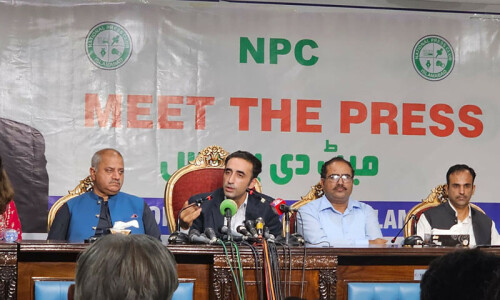
After the four-day conflict, Prime Minister Shehbaz Sharif decided to send a diplomatic delegation to important world capitals in the aftermath of the recent military escalation with India. He entrusted the PPP Chairman and former foreign minister Bilawal Bhutto-Zardari to lead the delegation.
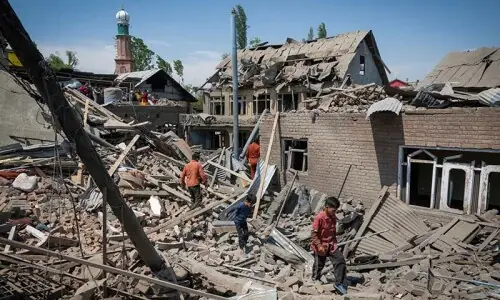
Meanwhile, in the aftermath of the attack, Indian forces arrested more than 2,000 Kashmiris and demolished several homes in a sweeping crackdown.
The arrests were carried out across multiple districts, including Srinagar, Ganderbal, Bandipora, Kupwara, Baramulla, Budgam, Islamabad, Pulwama, Shopian and Kulgam.