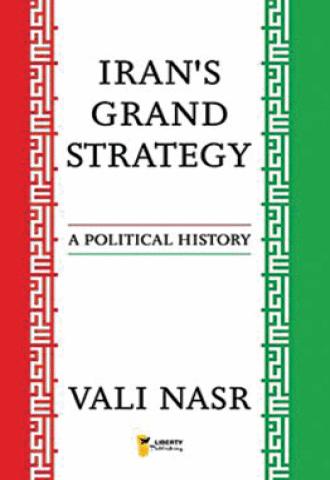
Iran’s Grand Strategy: A Political History
By Vali Nasr
Liberty Publishing
ISBN: 978-6277626693 408pp.
It is very difficult to take seriously most modern Western ‘scholarship’ and media discourse on the Islamic Republic of Iran, as the majority of these narratives lack nuance and balance. Instead of understanding the Iranian perspective — which, if included, is limited to critics and opponents of the Islamic Republic — we usually see cartoonish tropes centred around ‘mullahs’, ‘terrorism’ and the Islamic Republic’s ‘proxies’, especially in West Asia, trotted out.
That is why one was a bit hesitant to pick up Dr Vali Nasr’s Iran’s Grand Strategy, a book that attempts to analyse the subject of its title. There is no doubting the US-based academic’s scholarly credentials. But his dislike for the Islamic Republic, particularly its Supreme Leader, Ayatollah Sayyed Ali Khamenei, and his closeness to the US foreign policy establishment, made one wonder if this would be an honest appraisal.
Surprisingly, Dr Nasr has done a fairly decent job of describing the Islamic Republic’s post-1979 grand strategies, from ‘sacred defence’ — birthed during the brutal Iran-Iraq war — as well as the more recent and complementary ‘forward defence’ — formulated after the 2003 American invasion of Iraq, and further refined during the Syrian civil war. In the latter, Iran played a central role in propping up Bashar al-Assad’s regime until the jihadist takeover of Damascus in December 2024. Of course, there are moments of open bias in the work but, overall, the book is useful for those seeking to understand Tehran’s geopolitical and geostrategic grand plans.
The book was written before the Iran-Israel war of June 2025. Therefore, some of the analysis has been overtaken by events, which are occurring at an intense speed. But the general summary of Iranian ideology that the book has presented remains relevant.
A book by a scholar on Iran may be riddled with typical Western biases but is also surprisingly useful for those seeking to understand Tehran’s geopolitical and geostrategic grand plans
The author takes us through the Qajar and Pahlavi periods succinctly to give a background and context of the current trajectory of Iranian ideology, revisiting the 1979 hostage crisis which, Dr Nasr argues, exacerbated the distrust between the Islamic Republic and the US. The chapters on the Iran-Iraq war, and the Rafsanjani years, are also instructive.
As the writer has rightly pointed out, the West’s understanding of Iran is “hopelessly inadequate”, and works like these help fill in the gaps, particularly where the strategic thinking of the Islamic Republic’s ruling elite is concerned, though this is not the whole picture.
Interestingly, the writer’s descriptions of the Islamic Republic’s post-1979 elections expose the myth that Iran is a theocratic dictatorship. Though the supreme leader has the ultimate say, the fact that governments that diverged considerably from Ayatollah Khamenei’s strategic thinking (Rafsanjani, Khatami, Rouhani) came to power shows that there is a fair degree of flexibility in the Iranian system.
Of course, when it comes to survival of the nezam [Islamic system] in Iran, the rulers will put their foot down. He aptly encapsulates the system thus: “It would not evolve into a closed dictatorship and would have real electoral [contests]… narrowly confined by the boundary lines of official ideology.”
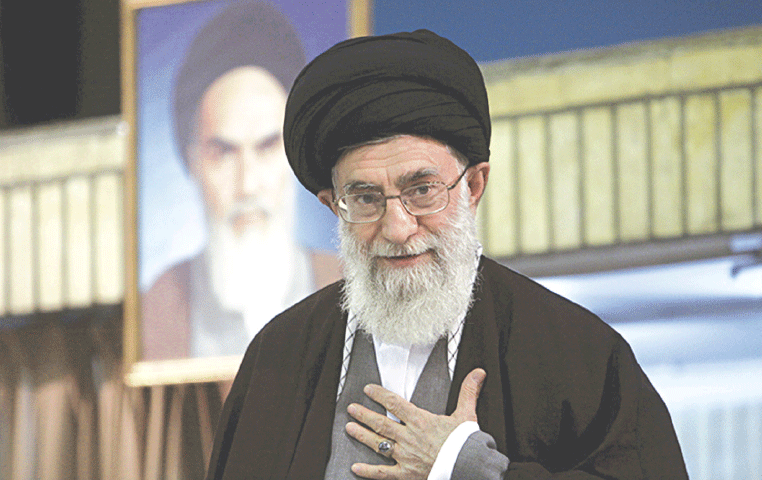
While the writer is critical of the Iranian clerical leadership’s supposed intransigence and stubbornness towards opening up to the West, particularly the ‘great Satan’ America, the various instances of American double-dealing he himself recounts prove that Ayatollah Khamenei’s fears may not be unfounded.
The most recent examples of America’s actions include the US withdrawal from the Iran nuclear deal during Donald Trump’s first term in 2018, and Mr Trump’s attack on Iran earlier this year. As he quotes ex-president Mohammad Khatami, who sought to engage with the US in 2003 but was spurned by Washington: “America had proved the supreme leader correct.”
Dr Nasr’s description of the ‘forward defence’ strategy — which was epitomised by Gen Qasem Soleimani before he was murdered in an American drone strike in Iraq in 2020 — is also instructive, while his critical questioning of the costs — particularly economic — of Iranian resistance to the West, cannot be dismissed entirely.
Yet, there are instances in the book that could do with revision. His description of Ayatollah Ruhollah Khomeini, founder of the Islamic Republic, as an individual “who saw himself above all of his peers” is problematic. Those who knew the late ayatollah intimately recall a firm but humble man, who lived simply despite being the most powerful man in Iran.
Moreover, Dr Nasr’s framing of some of Iran’s external policies as ‘terrorism’, and that of Israel’s as ‘sabotage’ is incredibly problematic. While Iran may have indulged in questionable external activities, only one state in the Middle East has been rightly accused of carrying out a genocide: Israel. Whatever Iran has done in the region and farther afield pales in comparison to what Israel has been doing for decades, particularly to the Palestinian and Lebanese people.
Elsewhere, when he refers to Shia ‘saints’, one assumes he is referring to the Imams of the Ahlul Bayt. This suggests a narrative tailored to a white, Western audience. Moreover, his use of the word “raves” for popular mourning gatherings is a culturally insensitive and puzzling characterisation.
These missteps aside, the book provides some meaningful insights. While Iran’s clerical leadership may have made mistakes at home and abroad, after reading this volume, one arrives at the conclusion that the path of resistance — though a difficult one — has ensured the Islamic Republic’s survival. Dr Nasr quotes Ayatollah Khamenei as saying: “National security is ensured by resistance alone.”
The fact that the Islamic Republic has now completed five decades of existence, and has survived the onslaughts of Israel and the US, has proved the ayatollah right up till now. And as the next Israeli-American war approaches, Iran’s commitment to, and effectiveness of, resistance and sacred defence will be put to the test again.
The reviewer is a member of staff
Published in Dawn, Books & Authors, December 7th, 2025