THE fragile ceasefire between Pakistan and Afghanistan has been tested yet again, this time with an exchange of fire along the Afghan border in Balochistan. Hostilities began late on Friday, with officials saying the Afghan side had resorted to “unprovoked firing”. The Afghan Taliban, meanwhile, accuse Pakistan of instigating the hostilities at Spin Boldak.
Though the exchange ended, it illustrates that without a permanent mechanism between both sides, flare-ups can occur at any time, with the potential of evolving into larger confrontations. Kabul had also accused Pakistan of conducting strikes in November — an accusation the government has denied. A ceasefire was signed in October following mediation by Qatar and Turkiye after heavy fighting between Pakistan and Afghanistan.
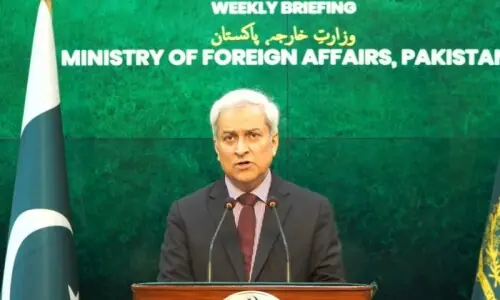
Perhaps one of the reasons that limited outbreaks of violence continue is that the negotiation process appears to be stalled. Turkish negotiators were due to arrive in Islamabad, but the visit has not materialised. As per the Foreign Office, “perhaps a lack of cooperation” from the Taliban is behind the delay. Pakistani and Afghan officials also met recently in Riyadh, but that process also seems to have stalled without producing any results. However, friendly states should continue their mediation efforts, and both Islamabad and Kabul should participate fully in these endeavours in order to arrive at a peaceful solution to the bilateral impasse. The alternative — continued hostilities — is in neither country’s interest.
Yet the key sticking point remains the Taliban’s refusal to act against terrorists based on Afghan soil, and in particular not attempting to stop them from conducting cross-border attacks. Pakistan has long been a victim of terrorist groups such as the TTP and BLA based in Afghanistan. But as recent events have shown, the security of other regional states has also come under threat due to the lax policies of the Afghan Taliban towards terrorist groups active in their country.
For example, a number of Chinese workers were killed in Tajikistan last month in attacks that originated from Afghanistan. Dushanbe has condemned the “illegal and provocative actions of Afghan citizens”. As this paper has previously argued, Pakistan, along with Afghanistan’s other neighbours, needs to communicate in unambiguous terms the need for the Afghan Taliban to clamp down on cross-border terrorism. If left unattended, the problem will grow, adding to insecurity across the entire region.
For Pakistan, along with continuing the process of mediation facilitated by friendly states, there is also a need to remain vigilant at the border. Yet Islamabad’s decision to allow UN humanitarian supplies into Afghanistan needs to be welcomed. As the FO spokesperson noted, Pakistan intends no harm to the Afghan people. Therefore, while remaining firm on its demand for Kabul to end cross-border terrorism, Pakistan should continue to facilitate humanitarian and people-to-people exchanges with Afghanistan.
Published in Dawn, December 7th, 2025