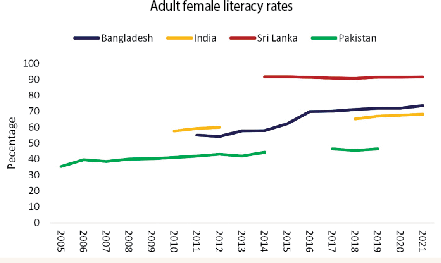
In 1976, the earliest year for which the World Bank has data, the global average literacy rate for adult females (as a percentage of females aged 15 and above) was 57 per cent. Even that figure is higher than Pakistan’s 49pc, reported by the World Bank in 2021.
Since then, the Economic Survey has shown slight improvement, with female literacy inching up to 53pc. But that still means about five out of 10 adult women in Pakistan cannot read and write with understanding a short, simple statement about their everyday life, which is the definition used by the World Bank.
Ahsan Saleem, one of the founders of The Citizen Foundation (among the largest private school networks in the world), has long emphasised the importance of girls’ education. When a girl is educated, the impact compounds across generations because she will move mountains to ensure her children are educated too.
In the aftermath of the pandemic, he feared that 60,000–70,000 girls would leave the TCF school system, because when resources are scarce, the girl child’s education is the first to be cut. In a country where even the issuance of a CNIC is considered pointless for a woman by some, educating her becomes an easy expense to discard.
In many households, female education is discouraged.—a reality reinforced and distorted by Pakistani dramas. On TV, in many serials, girls appear to go to college only to become entangled with male classmates, implying deep family dishonour. This is a far cry from a 2000s song/advertisement that showed a boy and girl falling in love at college under the approving gaze of their smiling parents. Suno Zara had catchy lyrics that subtly embedded the message of family planning through the contraceptive ‘Touch.’ Today, girls studying alongside boys, falling in love, and practising family planning have all become taboo subjects.
If families do not intend for their daughters to work, they see little point in educating them. Without education, there are no pathways to employment. Without employment, women are expected to simply make peace with whatever circumstances they inherit.
Published in Dawn, The Business and Finance Weekly, December 1st, 2025