FOR nearly five months since June, police in Khyber Pakhtunkhwa’s southern Bannu district have battled not just militants on the ground, but have also had to fend off enemy attacks from the sky.
“One eye on the barrel of the gun and the other on the sky,” a senior police officer in Bannu remarked.
For months, militants from the adjoining tribal areas launched multiple armed quadcopter sorties on and police stations and posts.
“Fifty attempts in one week,” recalled Khyber Pakhtunkhwa Inspector General of Police (IG) Zulfiqar Hameed.
Police in Bannu said they faced more than two hundred attacks, which employed commercially available, low-cost drones weaponised by militants to target them since June.
After losing the technological advantage to militants armed with US-made weaponry and drones, the security apparatus has spent billions to reclaim the balance of power
Changing tactics
The introduction of drone warfare by militants — the first time they have been employed against Pakistani forces — manifested a new phase and perhaps the most deadly transformation of the decades-long war that has claimed thousands of lives, both civilian and uniformed, and uprooted hundreds of thousands of others.
Unprepared for the deployment of quadcopters modified to drop improvised munitions on targets, police initially started to deploy nets over their installations or simply installing a canopy overhead to obstruct the munitions ahead of impact.
“We had to position snipers on rooftops to shoot down any approaching object,” Bannu Additional Inspector General of Police (AIG) Sajjad Khan said.
The quadcopters, equipped with thermal imaging, are used for surveillance and dropping munitions. Militants are also adapting to changing battlefield conditions and now routinely change the frequencies on which their drones operate to try and stay one step ahead of jammers employed by security forces.
Intelligence and police officials said such tactics and knowledge require training and can only come with expertise. They also do not discount the presence of foreign terrorists in the region, as a likely source of such expertise.
Losing ‘the edge’
For nearly two decades until August 2021, Islamabad and its forces had the edge in terms of weaponry and tactics, although for the police, it still was an almost equal fight; close-quarters combat while armed with AK-47 rifles.
All of that changed when the United States, exhausted by the seemingly unending war in Afghanistan after spending trillions of dollars, withdrew from the country and left behind $ 7.1 billion worth of military equipment and defence articles.
Armed with US weapons with night vision and thermal capabilities, snipers shot and killed security personnel from as far as 1,500 meters, while steel-core 5.56 millimetre ammunition made short work of bulletproof vests and helmets.
“They were killing our men like sitting ducks,” a senior police officer said.
Even the military-issued G-3 rifles fell short on range and efficacy compared with the US M-4s and M-16s.
As casualties began to mount, with militants relishing targeting unsuspecting personnel with thermal imaging scopes and uploading the videos on the internet, policymakers began to figure out what to do next.
What followed, according to senior police officers, was a process of long deliberations, interviews, and debriefings with scores of their colleagues in uniform who survived night attacks, to understand militants’ tactics and weapons used in the assaults and “reshape our tactics”.
“We were very late in adopting new technology,” IG Hameed acknowledged.
His men were not only short on better weapons, but also on trained manpower to use them.
‘Tipping the balance’
With help from the military, efforts to procure an assortment of weapons and equipment from the international market began immediately.
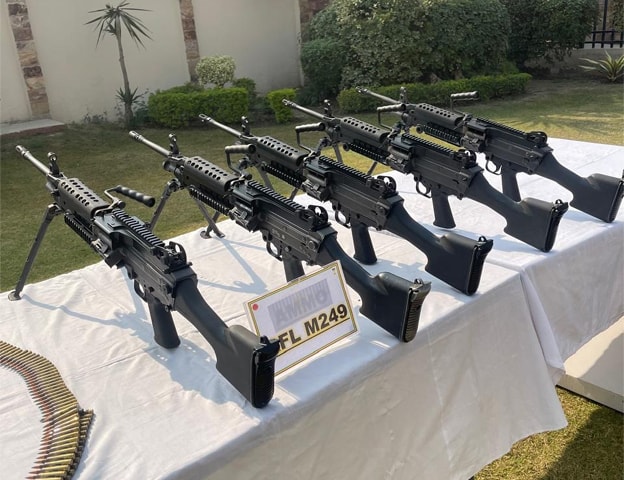
The list of the systems purchased so far includes American M-16s, M-24 sniper rifles, M-249 machine guns, light sniper rifles (LSRs), thermal weapon sights (TWS), anti-drone guns, medium and long-range surveillance and assault drones and high frequency jammers to shield armoured vehicles from roadside bombings.
Personnel are also being trained in marksmanship and special operation teams (SOTs) are being formed at the divisional level. They would later be expanded to district levels and are being armed and equipped with the latest weaponry to respond to threats and defend positions.
Police and military officials say the availability of better weaponry is already having an impact on the battlefield. “We are tipping the balance”, the IG said.
In Bannu, the police say they are now seeing fewer quadcopter attacks on their police stations, while the number of drone and night attacks is also declining in areas where militants realise state forces have night vision and anti-drone capabilities.
But as one senior police officer remarked, this was a long haul, a battle of nerves, resources and strategy. “We may be killing them, but are we killing the problem?”
A detailed version of this article can be accessed on Dawn.com
Published in Dawn, November 26th, 2025