FAIZ Ahmed Faiz’s immensely popular poem, usually referred to as Hum Dekhenge’, (we shall see), is surrounded by a few misunderstandings. Firstly, contrary to common belief, Faiz had not composed this poem as protest against General Ziaul Haq’s martial law, albeit he was definitely against the regime and had written the poem during Zia’s martial law.
The poem pronounces that the day would come when crowns would be tossed and thrones would be knocked over, which was interpreted as a protest against martial law. But the poem was in fact inspired by Iranian revolution and Faiz had paid tribute to common people who had brought about the revolution.
Presenting Iranian revolution as a proof, he expresses his firm belief that we shall one day see the end of exploitative system and the proletariat would snatch power from the feudal lords.
Secondly, the actual title of the poem is not Hum Dekhenge, but these are the first words in the opening line. The actual title of the poem, written in 1979, is a part of the verse 27 of Quran’s chapter 55 (Surah Rahman).
The poem alluding to the Day of the Judgement intends to remind that the day would come when the justice would prevail and those who committed atrocities would be punished. What inspired Faiz to pen this poem was 1979 Iranian revolution when Iranian monarch Mohammed Reza Pahlavi had to flee the country as millions of people took to street in protest.
Dr Sajid Siddiq Nizami, while explaining the poem in an article, has given the backdrop against which this poem was created. He says that Agha Nasir has mentioned that when he visited Faiz in London in 1979, Faiz handed him over two hand-written poems and asked him to distribute these poems among the friends in Pakistan. Faiz said one of the poems is on Iranian revolution, which had occurred a few months ago.
Agha said the Iranian revolution was an Islamic revolution and how could you write a poem on it (since Faiz was a leftist). Faiz replied a revolution is a revolution, not Islamic or un-Islamic.
When people take to street it becomes a mass revolution. On another occasion, says Dr Nizami, Faiz had commented that after the French revolution the Iranian evolution was the greatest one as it was brought about by general public.
In addition to revolution in Iran, Faiz must have had in his mind, adds Nizami, the situation in Pakistan where an elected government was toppled and the former prime minister was likely to be hanged. The poem became immensely popular when in 1986 Iqbal Bano sang it in a gathering at Lahore. Ever since the poem is considered the voice of the downtrodden and politically oppressed. So much so, that even in India it was recited to voice protest over the Citizenship Amendment Act of 2019.
The poem was included in Mere Dil Mere Musafir (1981), a collection of Faiz’s poetry. Iftikhar Arif had the original manuscript of the book, written in hand by Faiz. It was also part of Faiz’s collected works Saare Sukhan Hamaare (London, 1982), but was not included in Nuskha Hai Vafaa (1984), complete poetic works of Faiz.
Perhaps it was a precautionary measure taken by the publisher. Later on, it was included in it but a few lines were abrogated. Dr Nizami’s article analyses the poem and explains that Faiz has used certain Islamic symbols and Sufi motifs to convey the theme.
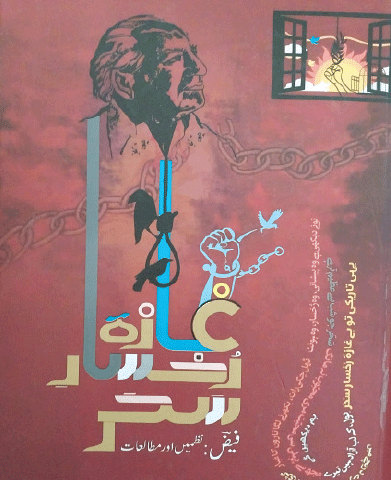
Nizami’s article is included in an anthology tilted Ghaazaa-i-Rukhsaar-i-Sahar. Published by Lahore’s Collage Publications and compiled by Ghulam Ali — a Lahore-based young scholar — the book proffers 34 articles by renowned critics from India and Pakistan.
Some of the veterans whose article have made it to the anthology include Meera Jee, Syed Sajjad Zaheer, Fateh Muhammad Malik, Ashfaq Husain, Tabassum Kashmiri, Sarvarul Huda, Jabir Ali Syed, Qamar Raees, Ahmed Mehfooz, Aftab Ahmed, Ziaul Hasan, Nasir Abbas Nayyar and some others.
The book is, as mentioned by Nasir Abbas Nayyar in his blurb, a study known as Close Reading, or the in-depth analysis based on linguistic and structural features for deeper understanding.
Faiz died in Lahore on November 20, 1984.
Published in Dawn, November 24th, 2025