POSTCOLONIAL discourse is not anything new: back in 1978 with the publication of Edward Said’s book Orientalism the postcolonial studies had emerged on the academic scene with a bang. But in Pakistan it was something almost unheard of till the late 1990s. Though a few Urdu books on critical theories did discuss the impact of colonial and imperial policies on Urdu language and literature — especially some progressive writers and critics with a traditionalist bent of mind had criticised the exploitative nature of the colonial policies — no detailed and organised study on the topic existed in Urdu.
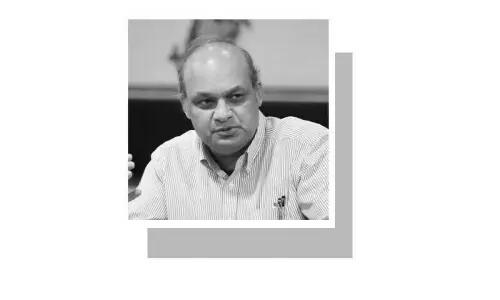
Dr Nasir Abbas Nayyar began writing research papers in Urdu on postcolonialism and his book Maba’d Nauabadiyaat: Urdu Ke Tanazur Mein, first published in 2013, was a pioneering effort in the field. The book, adorned with proper references, opened up the discourse to a readership that did not have direct access to the works published in English on the issues related to postcolonial studies. Nayyar’s book crystalised the notion that postcolonial discourse was not merely a literary or critical one but it was also a theoretical framework to understand the political, historical and cultural impact of colonialism. Nayyar has first presented the boundaries and distinctions of postcolonialism, then explained the knowledge and power in colonial context. He analyses Europe’s grand narrative and linguistic imperialism in the next chapters, explaining contributions of William Jones and John Gilchrist. ‘Racism and White Aesthetics’ is the chapter added in the new edition.
While criticising the western colonial powers and presenting some historical facts with an explanation from the point of view of the colonised, Nayyar is unemotional, substantiating his argument with references and original texts both from Urdu and English. Presenting excerpts from works by some colonial writers, such as, Rudyard Kipling and John Gilchrist, Nayyar proves the racism was the most lethal weapon of the colonialists. Orientalists worked on eastern languages and literatures to justify and reinforce colonialism and, proves Nayyar, postcolonialism is a kind of ideological response to the theory and practice of colonialism, thus presenting the postcolonial identity of the colonised.
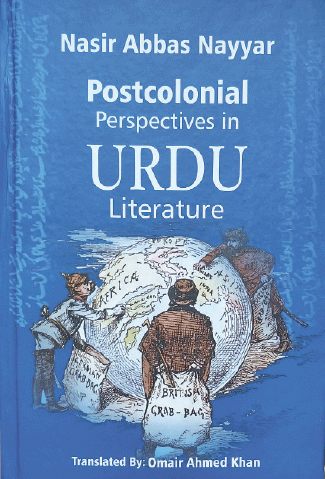
But the academic circles in the West were — and perhaps still are — generally, and naturally, unaware of the works carried out in Urdu on postcolonial perspective. Dr Omair Ahmed Khan, an educator and scholar of comparative literatures, came to know about some academic work-in-progress at a European university and was dismayed to note that the general perception there was that there was no such thing as a postcolonial study in Urdu. Having read Urdu literature vastly as well as Nayyar’s works, he decided to translate Nayyar’s book into English. So with permissions, Omair Khan began rendering the new edition of Nayyar’s Urdu work, published by Sang-i-Meel Publications in 2024, into English. Sang-i-Meel has just published the English translation, too.
Translation is a tricky business as it demands faithfulness to the original text but also needs a lucidity and accessibility, which is sometimes lost in translation, as idiomatic expressions or peculiarities of a language may cloud the meaning for a reader from a different linguistic and cultural background. Titled Postcolonial Perspectives in Urdu Literature, Omair Khan’s English translation of Nayyar’s Urdu book is a good example of a faithful translation taking care of some semantic issues that translators often confront with. Through this translation, Omair Khan has introduced postcolonial issues discussed in Urdu as well as Urdu criticism’s modern viewpoint to a greater readership since English is not only the preferred medium of the academia worldwide but it has also become the virtual global lingua franca. Translating an essential Urdu work on postcolonialism into English is in fact putting Pakistan and its literary and academic works on world literary map.
Omair Khan in his translation has been ever so careful of the original English quotations, given in Urdu text, and having traced the original sources in English, he has quoted directly from them. As for Urdu quotations, he has taken good care of the nuances and that is where his command over both the languages become more evident. Urdu quotations as given in Urdu text have also been reproduced in Urdu script, enabling the reader to compare and, of course, appreciate translator’s finesse.
Dr Omair Ahmed Khan is a script doctor. He did his doctorate in script writing and dramaturgy from Vienna’s University of Music & Performing Arts. Prof Dr Nasir Abbas Nayyar is one of the foremost critics of Urdu. His works on modernism, postmodernism and postcolonialism are now an integral part of syllabi at Pakistani universities. Nayyar has served Punjab University’s Urdu department as professor and currently is the editor of Bunyad, LUMS’s research journal.
Published in Dawn, October 20th, 2025