Zephyranthes candida, commonly called white rain lily, belongs to a genus of about 70 species in the amaryllis family. Rain lilies are summer-blooming bulbs that got their common name due to their tendency to burst into bloom immediately following periods of rain in late summer. This is why they are planted three to four months before the monsoon, preferably using bulbs instead of seeds, as bulbs grow faster and require less care.
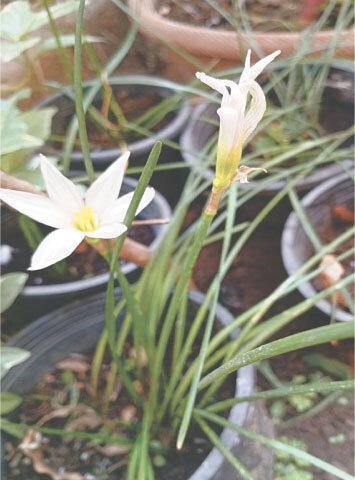
The sprouting of the leaves serves as the harbinger of the flowering stage. The buds of the white rain lily flower are hidden at the tip of a green stalk called scape, which grows from the centre of the plant. As the buds increase in size, they become visible to the naked eye at the tip of these stalks.
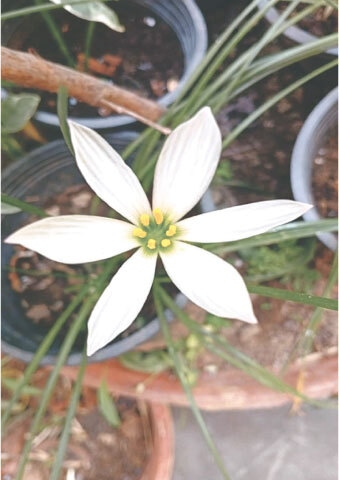
The white rain lily has a symmetrical, star-like shape, similar to the crocus. It has six smooth milky-white, slightly pointed petals, which are equal in size and shape. The flower also has six golden-yellow stamens sprouting from the centre. When in full bloom, the white and golden yellow contrast provides a visual delight.
One of the differences between the more common pink rain lily plants and the white rain lily plants is that the flowers of the former continue to bloom for up to a week, compared to the white rain lily, which blooms for between three to five days. For the flower to sustain this long, the temperature should be around 25 to 30 degrees Celsius. The flowering phase lasts around three months.
The white rain lily flower, which blooms for three to five days, is a fleeting beauty with its symmetry and star-like shape
The start of the flowering phase, ideally coinciding with the rainy season, requires an adjustment to the plant’s care routine. This includes the plant’s watering needs, particularly its watering needs if grown outdoors. One way to gauge water requirements is to insert a finger into the soil surface around the plant to check moisture levels. Water stress — whether from under-watering or excessive watering — can cause unopened buds to fall off and reduce the lifespan of bloomed flowers.
Regardless of the phase of the plant life cycle, waterlogging — either on the soil surface or around the plant roots — can result in root-rot. Initially, standing water disturbs flowers and buds. With prolonged exposure, the impact on the roots and, subsequently, the entire plant can be devastating.
Apart from exposure to excessive or scorching sunlight or water stress, certain pests and diseases can harm the white rain lily. Pest attacks are rare for this low-maintenance, hardy plant but, when they occur, the culprits are usually aphids, snails, mealy bugs and spider mites.
Similarly, diseases which are usually fungal in nature may also hamper the plant’s growth. The common diseases of the white rain lily plant include bulb-rot and leaf spots. One tablespoon neem oil mixed in one litre of water can be sprayed over the plant to stave off pest attacks and spore formation.
The fertiliser applied during the flowering phase is the same that is used during the bud growing phase: a balanced fertiliser with equal parts nitrogen, potassium and phosphorus, which may be added to the soil once a month. However, the quantity of the fertiliser should be reduced during the flowering phase, as excessive boosting can cause the leaves to turn yellow and the buds and flowers to fall off.

In mild climates like that of Karachi, the plant will continue to thrive after the flowering phase and may survive even throughout the year, likely blooming again in the upcoming season. In areas with harsh winters, the plant and leaves start to turn yellow or brown, signalling the end of the plant life cycle.
If the gardener can leave the dying plant undisturbed or keep the white rain lily gardening space untouched for a few months, they can develop and harvest white rain lily bulbs from the dying plant.g
Please send your queries and emails to doctree101@hotmail.com. The writer is a physician and a host for the YouTube channel ‘DocTree Gardening’ promoting organic kitchen gardening
Published in Dawn, EOS, November 23rd, 2025