Global chessboard


 7
7

THE global chessboard has become ever more complex. The rules and norms of interstate conduct framed in 1945 are no longer being applied. The world is in transition. Some contours of the evolving order are becoming visible. It will no longer be a unipolar world. Multiple power centres have emerged, each asserting its presence in its own way, some by military muscle, others by economic coercion or outreach. The most disturbing trend is of major powers using force unilaterally, blatantly, and with no regard for international law.
The second disturbing trend is the growing culture of hyper nationalism, which is producing populist leaders, who then become a force of division and polarisation. The net outcome is unashamed aggression, xenophobia, sanctions, tariff wars, export bans, and anti-globalism. The uncertainties of the global chessboard are being compounded by AI-assisted lethal technologies, cyber warfare, and disinformation.
Ironically, the process to dismantle the prevailing world order is being led by the country that was its chief architect, the United States. It started in 2003, when the US decided to invade Iraq, establishing two dangerous precedents: a strong country can unilaterally decide to attack another country and can do so pre-emptively. Ever since, Moscow unilaterally decided to aggress against Ukraine, and New Delhi against Pakistan. Israel, with the support of the US, has broken every conceivable international law to bomb and bleed Palestinians in Gaza. For vulnerable states, the breakdown of the world order has now emerged as a serious challenge.
Where, then, is the world headed? It appears that while the prevailing world order continues to erode, several centres of power are emerging, each trying to carve out its own area of influence. A kind of club of big players. If this trend is the harbinger of what is to come, then the world would become an even more chaotic place, particularly for small and medium-sized countries. It would be useful to get a sense of the contours of the new world order by looking into four theatres of contestation on this global chessboard: Europe, Palestine, East Asia, and South Asia.
Russia had invaded Ukraine to prevent the latter from joining Nato. Some justified the Russian attack on the grounds that the West had violated its commitment of not expanding the ambit of Nato eastwards. Others believe that a larger country invading a smaller neighbour has set a perilous precedent that must not be condoned. As the war lingers on, lives are being lost on both sides, more so in Ukraine, whose citizens have been displaced in the millions. Russians are also suffering because of the harsh economic sanctions by the West. Everyone is losing out, the biggest casualty being international law and order.
Several centres of power are emerging.
Israel has been unleashing lethal firepower to break the resolve of the Palestinians living in Gaza and the West Bank. With the US at its back, Benjamin Netanyahu has made no secret of his plans to create a ‘Greater Israel’ by annexing Gaza, the West Bank, and then expanding Israeli borders to several territories of the Arab world. For now, the Gaza peace plan brokered by the US has checked his ambition, but he is unlikely to halt his pursuit of establishing Israeli hegemony in the region, even as he now stands charged for war crimes and crimes against humanity.
The major power competition between the US and China is affecting nearly every region in the world, but nowhere is the rivalry more pronounced than in East Asia, particularly the South China Sea. The East Asian nations are struggling to avoid choosing a side in this difficult balancing act. Although the recent ‘G-2’ meeting between Donald Trump and Xi Jinping in South Korea was a step in the right direction, the region will likely remain unsettled.
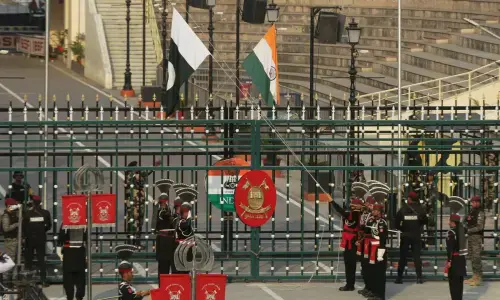
India, under Narendra Modi’s leadership, has aggressed against Pakistan at least thrice in the past nine years. To its embarrassment, India has learned that Pakistan has the capacity to not only defend itself but also inflict huge damage on the aggressor. The Indian leadership has vowed to resume its military Operation Sindoor. Meanwhile, India is relying on a sub-conventional and proxy war against Pakistan through Afghanistan. There is a chatter that India might attack Pakistan simultaneously from the south and across the Line of Control. That would be a huge mistake as the Pakistani nation, especially its armed forces, are confident that they can blunt any new Indian aggression.
For all aggressor states, there are lessons to learn. They will be the ultimate losers on the chaotic global chessboard they are trying to establish. A more prudent course would be to respect globalism and international law — that should be the only way to live and let live.
The writer is a former foreign secretary of Pakistan and chairman of Sanober Institute.
Published in Dawn, November 15th, 2025