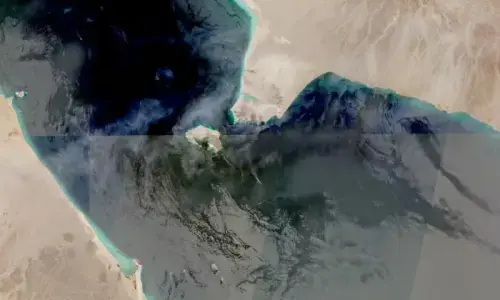
A whale shark was pulled ashore on to a beach in Gaza on October 17 amid great cheers. Raed Elwan, one of the fishermen who helped bring the creature ashore, said, “We felt the sea sent us a great blessing, as people in the camps had nothing to eat.” Whale sharks are only found in tropical waters and it is speculated it may have entered the Mediterranean from the Red Sea via the Suez canal.
The Gazan fisherman saw it as help from Allah, and soon parallels were made with the ‘Expedition of Fish’, which took place in another October, in 629 AD. Muslim expeditionary forces were suffering from famine, forced to eat leaves to survive, until a whale came ashore that fed them for several days.
Signs and miracles are a part of all religions, a reassurance of Divine presence. This is especially true of Abrahamic religions — Judaism, Christianity and Islam: the parting of the Red Sea, Moses striking a rock to cause 12 springs to gush forth, Jesus multiplying loaves of bread to feed 5,000, the appearance of the spring of Zam Zam as Hajrah ran the length between Safa and Marwa desperate for water for her baby, to name a few.
Once, signs and miracles influenced kings, and no decisions were taken without consulting a spiritual guide. Then came 18th century Western rationalism, and spiritual or religious beliefs were to have no place in matters of the modern state.
Religious beliefs and influences — once seen as relics of pre-modern belief — continue to dictate political struggles, shape identities and challenge the ‘secular promise’ of the modern world
At a social level, however, belief in signs and miracles continued. People look for signs as reassurance or warnings. Earthquakes and floods, the appearance of comets, or lunar and solar eclipses are often seen as Divine signs. Some have visions of the future, such as Shah Waliullah or Baba Vanga. People interpret dreams, consult astrologers, seek answers from istikharas [prayers seeking guidance]. These are viewed with scepticism by those who trust the science of things, and religious beliefs are expected to remain personal and private, with no place in the public realm. Nations where religion guides state policy are seen as regressive, undemocratic and even a threat to a civilised world order.
Yet, as the gloves are off in Gaza, the religious motivation of the conflict is becoming more evident. Israel’s actions in Gaza are now overtly declared to be the fulfilment of Biblical prophecies.
While the Palestinians, both Muslim and Christian, see the creation of Israel as an issue of usurping Palestinian land, the Israelis see it as fulfilling a religious right. After the 1967 Six-Day War, Israel found itself dominant for the first time, further motivating its expansionist ambitions. It was seen as a miraculous retelling of the story of David and Goliath. No surprises here.
What did blindside the world was the stepping into the fray by Christian Zionism, an unfamiliar term for many. First emerging with the Protestant Puritans in the 16th century, who incidentally also formed the first Europeans who migrated to America to avoid persecution in England, it gained momentum in the 19th century due to American evangelists such as William E. Blackstone who, in 1891, petitioned the US to return the Holy Land to the Jewish people.
This was partly to stem the unwanted migration of Jews to the US, but was justified by Biblical prophecies of a sequence of events necessary for the Second Coming of Christ, when Jews will finally recognise Jesus as the Messiah. Christian Zionism continues to influence US policies in the Middle East and, perhaps, explains the refusal of the US to curb Israel. The highly influential pastor Tim Lucas preaches that “America and Israel are doing the world a favour.”
The Israeli Zionists, for their part, have imported unblemished red heifers from Texas so that they can be sacrificed and their ashes mixed with water to purify the builders of the hypothetical ‘Third Temple’ in Jerusalem.
It is very strange territory to be navigating in the 21st century, after over two centuries of being pressured to accept the mantra of rationality, secularism, democracy, human rights, child protection, equal opportunity, Geneva conventions and UN charters.
Some believe scriptures are being misused to support political agendas. Others believe political agendas disguise religious ambitions. Whatever school of thought one ascribes to, we are witnessing democracies turn into theocracies.
Durriya Kazi is a Karachi-based artist.
She may be reached at
durriyakazi1918@gmail.com
Published in Dawn, EOS, November 9th, 2025