HISTORY: GURUS AND KINGS
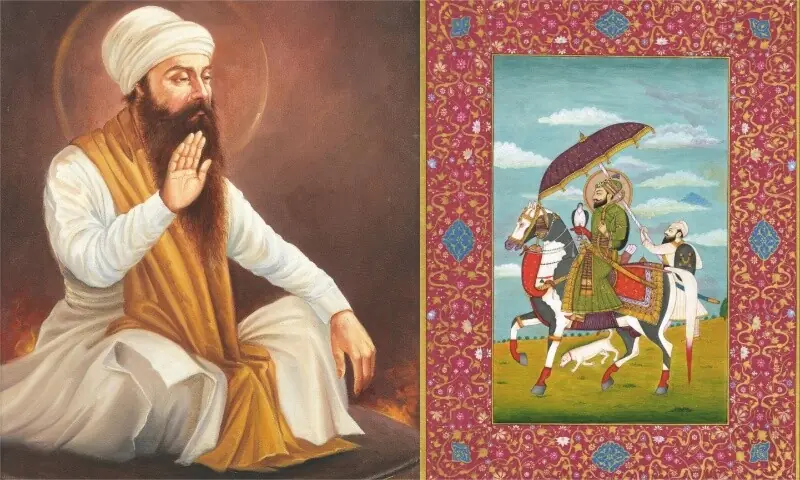
When Mughal Emperor Jahangir ordered the arrest and execution of Sikh Guru Arjan in 1606, few could have foreseen that a spiritual teacher’s death would set off centuries of political upheaval.
Seven decades later, when Emperor Aurangzeb ordered the beheading of Guru Tegh Bahadur, the ninth Sikh Guru, history came full circle — two empires collided, two visions of faith confronted one another, and a new chapter of defiance was written into South Asia’s story.
Between these two martyrdoms lies one of the Subcontinent’s most transformative journeys: the evolution of the Sikh community from a pacifist spiritual order into a disciplined martial brotherhood — a transformation born of persecution, betrayal and the refusal to bow before imperial power.
Guru Arjan: The First Martyr
Guru Arjan Dev, born in 1563, was the fifth of the ten Sikh Gurus and the son of Guru Ram Das. A poet, theologian and institution builder, he completed the Harmandir Sahib (Golden Temple) and compiled the Adi Granth, the precursor to the Guru Granth Sahib, Sikhism’s holy book.
Guru Arjan’s compilation was revolutionary, bringing together hymns of Sikh Gurus, Hindu bhagats [holy men] and Muslim Sufi saints, uniting a wide spectrum of devotion under one monotheistic vision of the Divine. It reflected the pluralistic soul of India — inclusive, yet firm in its belief in one God.
The stories of the martyrdoms of the Sikh Gurus are moral parables — reminders that true faith does not lie in dominance but in the courage to defend the rights of others
But this inclusivity soon alarmed the Mughal court. The Guru’s following in Punjab drew Muslims and Hindus alike. His independent institutions and moral authority began to worry Emperor Jahangir, who saw in him not merely a saint, but a rival source of loyalty.
The Arrest and Execution
The crisis peaked when Jahangir’s rebellious son, Prince Khusrau, sought blessings from Guru Arjan. Though the gesture was spiritual, the emperor interpreted it as political. Jahangir’s Tuzk-i-Jahangiri records his suspicion that the Guru’s fame had grown subversive.
Guru Arjan was arrested and brought to Lahore Fort. He was ordered to remove certain verses from the Adi Granth and pay a heavy fine. When he refused, he was executed. According to Sikh traditions, he was made to sit on a red-hot iron plate while burning sand was poured over him. After days of torment, he was immersed in the Ravi River.
Before dying, Guru Arjan is said to have sent word to his young son, Hargobind, telling him to arm himself — not for vengeance, but to defend justice. His death marked a turning point: the Sikh faith, until then centred on meditation and service, began preparing for armed resistance.
Guru Tegh Bahadur: The Defender of Faith
Seventy years later, another Sikh Guru would face imperial wrath. Guru Tegh Bahadur (1621-1675), the ninth Guru and son of Guru Hargobind, inherited a faith under scrutiny and an empire led by Aurangzeb — whose orthodoxy combined with an unyielding drive for imperial control.
By the 1670s, Aurangzeb had reinstated the jizya [tax on non-Muslims] and oversaw policies that pressured Hindu communities, particularly in Kashmir, where local officials’ zealotry drew petitions for help. They sought refuge and guidance from Guru Tegh Bahadur, whose reputation for integrity and fearlessness had spread far and wide.
When the Guru heard their plea, he declared: “If the emperor can convert me, the rest will follow. If not, let him leave all others free.” It was both irony and defiance — a spiritual challenge to absolute power.
The Martyrdom in Delhi
Guru Tegh Bahadur travelled to Delhi to meet Aurangzeb, refusing to bow or convert. When pressed to perform miracles to prove Divine favour, he declined, saying true faith required no spectacle. Imprisoned in the Red Fort, he endured persuasion and torture but remained steadfast.
In November 1675, he was publicly executed; his severed head displayed as a warning. His followers risked their lives to recover his remains — the head carried to Anandpur Sahib for final rites, the body cremated secretly in Delhi.
In Sikh memory, Guru Tegh Bahadur is remembered as “Hind di Chadar” — the Shield of India — the man who gave his life not for his own faith, but for the right to worship freely. His martyrdom shifted the Sikh moral compass: from endurance to active defence of conscience.
Guru Gobind Singh: Betrayals and the Birth of the Khalsa
Guru Tegh Bahadur’s death left his nine-year-old son, Gobind Rai, as the 10th and final Sikh Guru. He grew into a warrior, poet and nation-builder, who completed the Sikh transformation into the Khalsa, a disciplined brotherhood of saint-soldiers.
Guru Gobind Singh inherited not just a community but a legacy of resistance. Early conflicts arose not just with Mughals, but with local hill rulers who feared his growing influence. At the Battle of Bhangani in 1688, his outnumbered forces prevailed against a coalition of such chiefs and their Mughal allies, reinforcing their conviction that the Sikh cause was divinely guided.
Over the next decade, Guru Gobind Singh endured sieges and betrayals. In 1704, after months of starvation and blockade at Anandpur Sahib, Mughal generals and Hindu chiefs swore oaths of safe passage — then broke them. During the chaotic retreat, Guru Gobind’s family was separated. Two sons died in battle; two younger sons, aged nine and seven, were executed for refusing to convert. His mother also died in captivity.
Despite the loss, the Guru continued his mission. In 1699, he had already founded the Khalsa, erasing caste distinctions and commanding Sikhs to carry arms, wear the five symbols of faith and dedicate their lives to righteousness.
After Aurangzeb’s death, Guru Gobind Singh wrote the Zafarnama — a letter to Emperor Bahadur Shah Zafar accusing the Mughals of betrayal and reminding them that justice stands above kings. He was fatally wounded in 1708 by an assassin sent by Mughal loyalists. With his death, the line of human Gurus ended, and authority passed to the scripture, Guru Granth Sahib.
A Rift Forged in Fire
The killings of Guru Arjan and Guru Tegh Bahadur, and the trials of Guru Gobind Singh, fundamentally altered relations between the Sikh community and the Mughal state. The conflict was not theological — Sikh monotheism and egalitarianism shares affinity with Islam — but political, rooted in power and survival.
The Sikh Gurus drew inspiration from both Hindu bhakti [worship] and Islamic Sufi traditions. Their hymns celebrate a single God and human equality. Yet, as the Mughal authority hardened, independent spiritual power became an imperial threat. Suspicion bred persecution, persecution bred resistance, and resistance became a revolution.
By the early 18th century, the Sikh Panth [Way] had transformed into a sovereign moral force — neither Hindu nor Muslim, but something distinct and self-defining. The Mughal Empire, meanwhile, began to decline.
Legacy of the Martyrs
The legacy of the Sikh martyrs remains central to Sikh identity. Guru Arjan’s death sanctified spiritual defiance. Guru Tegh Bahadur’s sacrifice enshrined freedom of conscience as a sacred duty. Guru Gobind Singh’s trials forged the ideal of the Khalsa — fearless, just and uncompromising.
Their stories are not only religious memories but moral parables — reminders that true faith does not lie in dominance but in the courage to defend the rights of others.
More than four centuries later, the heat of the iron plate, the clang of the sword in Delhi and the cries of the young sons at Sirhind still echo in Punjab’s collective memory — a time when empires sought submission and saints answered with sacrifice.
The writer is an activist and founder of the Clifton Urban Forest, Karachi. X: @masoodlohar
Published in Dawn, EOS, November 2nd, 2025