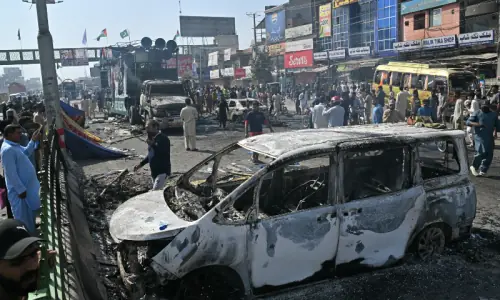
AS the administration expands its dragnet around the TLP, there is once again talk in official circles of applying the ‘hard state’ approach to tackling extremism. It is clear that after the TLP’s latest gambit failed — marching on Islamabad in supposed solidarity with Gaza — and resulted in deadly showdowns with the law, the state is giving no quarter to the hard-line outfit.
In the latest developments, along with mulling a ban on the party, the Punjab government says around 3,800 financiers of the TLP have been identified. The federal interior minister, while on a visit to Karachi on Tuesday, also said that armed groups would not be tolerated.
However, meeting with senior Barelvi clerics in the city, the minister assured them that the crackdown was not targeted at any particular sect. When Defence Minister Khawaja Asif was asked about the ban on TV, he did not confirm the decision. Yet he reiterated that Pakistan must act as a “hard state” to crack down on extremism.
The TLP’s tactics over its decade-long existence have been largely indefensible, as it has resorted to the use of violent agitation as an organisational tool, taking on the state at multiple junctures. Moreover, its campaigns of targeting minority groups have borne deadly results. In fact, it can be asked what took the state so long to notice its illegal, violent activities.
Yet it is also true that in the guise of fighting extremism, the state must not crack down on all opposition, and trample on civil liberties. This is all the more important when some representatives of the state use overly broad definitions of extremism, and lump together political opponents with bloodthirsty militants and hatemongers.
There is genuine concern that in their excitement to build a ‘hard state’, the rulers may further smother fundamental rights, while justifying crackdowns on opposition parties, going after dissenting journalists and restricting peaceful protests — all in the name of fighting ‘extremism’. While violent groups must be put out of business, constitutional safeguards need to be upheld, and civil liberties protected.
As this paper has stated, instead of banning groups, the best way to proceed against outfits such as the TLP would be to prosecute them under relevant sections of the law, for example, those that deal with inciting violence and promoting hate speech. Sadly, proponents of the hard state overlook the root problems that have fuelled militancy in the country. In those parts of Pakistan that have been hardest hit by terrorist activity — KP and Balochistan — poverty, injustice and underdevelopment have helped militant groups increase their ranks.
Therefore, while those who promote violence must be prosecuted, the state’s long-term goal should be to promise justice, inclusivity and prosperity across the country, particularly in its deprived areas.
Published in Dawn, October 23rd, 2025