26th Amendment case: CJP has power to form full court, lawyer tells Constitutional Bench
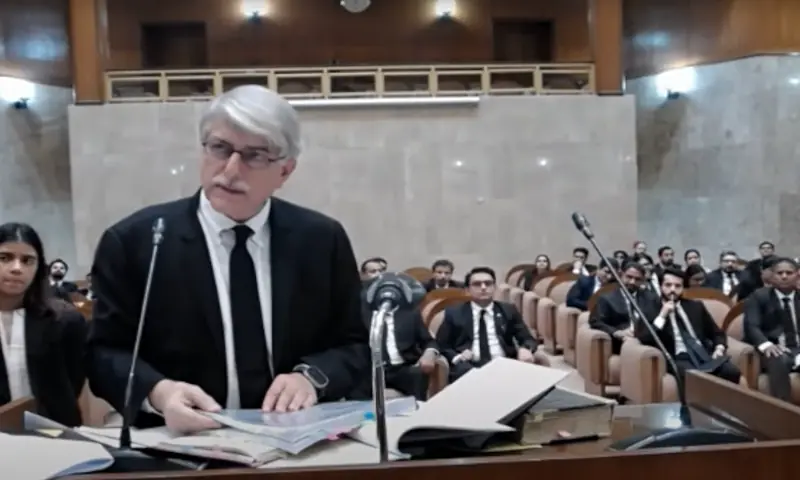
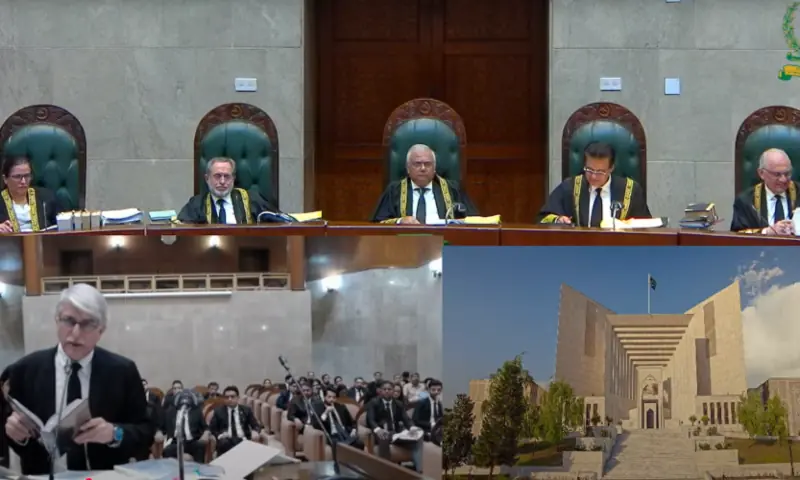

Senior lawyer Abid Shahid Zuberi on Tuesday told the Supreme Court’s (SC) Constitutional Bench (CB) that the chief justice of Pakistan (CJP) had the power to form a full court as it took up a set of petitions against the 26th Amendment.
The 26th Amendment was passed by Parliament during an overnight session in October last year, with the PTI claiming seven of its lawmakers were abducted to gain their favour as the party opposed the legislation. The Balochistan National Party-Mengal (BNP-M) also alleged its two senators were being pressured, with both later defying party line to vote in the tweaks’ favour.
The legislation, which altered judicial authority and tenure, has been a lightning rod for debate with both opposition parties and legal experts questioning its impact on the judiciary’s independence.
The tweaks took away the SC’s suo motu powers, set the CJP’s term at three years and empowered a Special Parliamentary Committee for the appointment of the CJP from among the three most senior SC judges. It also paved the way for the formation of the CB, which is now hearing petitions against the very legislation that enabled its establishment.
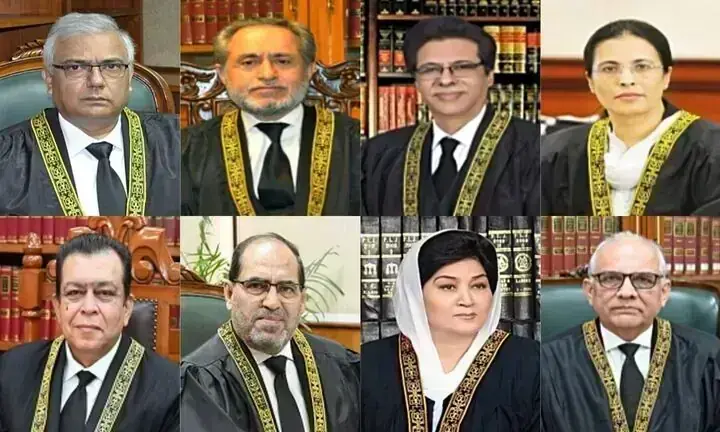
The bench hearing the pleas is headed by Justice Aminuddin Khan and also includes Justices Mandokhail, Muhammad Ali Mazhar, Ayesha Malik, Syed Hasan Azhar Rizvi, Musarrat Hilali, Naeem Akhtar Afghan and Shahid Bilal Hassan.
Thus far, Zuberi, Lahore High Court Bar Association (LHCBA) lawyer Hamid Khan, Balochistan High Court Bar Association (BHCBA)’s counsel Munir A. Malik, and petitioner Barrister Salahuddin Ahmed have presented their arguments. They have sought the formation of a 16-member full court as per the number of judges present in the SC in Oct 2024, when the Amendment was passed.
Judges have questioned whether the CB has the power to issue orders for the constitution of a full court, as requested by petitioners.
The bench will first determine whether the challenges should be heard by a full court comprising all available SC judges or by the same eight-judge CB, before deciding on the legality of the 26th Amendment.
The case was initially taken up in January, and after the CB’s approval of petitioners’ request for it, the proceedings were being live-streamed on the SC’s YouTube channel since October 8.
The hearing
Zuberi, also a former Supreme Court Bar Association (SCBA) president, continued his arguments in the case today. The hearing was later adjourned till 11:30am tomorrow.
The live-stream for the hearing began with a delay of about 40 minutes due to internet issues. The Pakistan Telecommunications Limited (PTCL) has said users would experience degraded internet services today as a submarine cable is being repaired.
“There are internet issues today. The live stream will not be possible,” Justice Aminuddin said at the outset of the hearing. Justice Mazhar also said the livestream YouTube link was down and asked staff to check this.
Zuberi then cited various past court verdicts to support his arguments.
“A party cannot raise an objection on the judge. The judge has the authority [to decide] whether to hear a case or not,” the former SCBA president said.
“On the one hand, you are saying 16 judges and on the other, you also talk about ‘collective knowledge’,” Justice Mandokhail remarked when Zuberi sought a full court comprising pre-Amendment judges. The judge asked the lawyer to clarify what his request was.
“Do not say a full court; say ‘those judges who were present from before the Amendment’,” Justice Mandokhail said. Zuberi referred to the case upholding Practice and Procedure Act 2023 and contended that the current eight-member bench would not give the petitioners the right to appeal.
“The number of judges nominated as part of the Constitutional Bench is 15, whereas at least nine more judges are needed for hearing an appeal,” Zuberi said.
Here, Justice Ayesha observed that it was now the Judicial Commission of Pakistan’s prerogative whether to give someone the right to appeal or not. She said the JCP could “give the right to appeal by nominating additional judges, [but] if it did not wish so, then the right to appeal can also be taken away”.
“This is simply a matter of the judiciary’s independence,” she remarked. Justice Mandokhail then pointed out that even a 16-member bench, as sought by Zuberi, would not have the right to appeal.
Zuberi said the SC had declared that the right to appeal was not mandatory for “decisions based on collective knowledge”.
Justice Mandokhail questioned how Article 191A, under which the constitutional benches were formed in the SC, could be ignored, as it was a part of the Constitution.
Justice Ayesha noted that there were past verdicts present on “how the challenged provisions are kept aside”, at which Justice Mandokhail said to let Zuberi answer the question.
The lawyer contended that benches will be formed under the newly framed Supreme Court Rules 2025, explaining that a committee will form the benches as per Order 11 of the Rules.
Justice Mandokhail remarked, “Nowhere in these rules is it written that only the chief justice will form the benches.”
Zuberi contended that the full court was not a bench. “Your judgment is also present on how full courts have been constituted until now.” Justice Mandokhail replied that the SC Rules 2025 should have mentioned the procedure for a full court.
The hearing also witnessed a disagreement between Justice Mandokhail and Justice Ayesha over the procedure for adopting the SC Rules 2025.
Justice Mandokhail remarked that all “24 judges” had convened regarding the SC Rules, which were “made in front of them”.
Justice Ayesha interjected: “They were not made in front of everyone. My note exists.” She was among four judges who expressed their reservations regarding the process being adopted for rules’ approval and stayed away from a September full court administrative meeting.
In response, Justice Mandokhail asked that the meeting notes be brought. “All judges were told to give their input. This case will not proceed further unless this matter is clarified.”
The exchange prompted Attorney General for Pakistan Mansoor Usman Awan, who was present during the hearing, to urge the judges not to discuss the matter in court as it was their “internal matter”.
Justice Mandokhail said, “I am being called a liar here. A meeting of [all] 24 judges was held. The matter regarding some provisions was referred to the committee. A few judges gave their input and some did not.”
Justice Ayesha then said that the Practice and Procedure Committee, which comprises senior judges who form benches for constitutional matters and suo motu notices, had “been made to constitute benches [and] it has not been given the powers to make a full court”.
“[…] That vests in the Supreme Court; that’s the inherent jurisdiction,” she added.
“And the power of the [Practice and Procedure] Committee is not the power of the chief justice. They are two different entities,” Justice Ayesha said, which Zuberi agreed with. “We are not talking about benches, but full courts,” the judge said.
Here, Justice Aminuddin asked Zuberi whether the CJP had the authority to form a full court comprising CB judges, to which the lawyer replied: “That inherent power of the chief justice is still available to the honourable chief justice.”
The ex-SCBA president cited several past judgments and asserted that the CB could issue directives to form a full court.
Justice Aminuddin remarked, “You are asking us to tell the chief justice that he may constitute a full court, but in that [case], he formed it himself.”
Zuberi referred to a paragraph in the 1998 Malik Asad Ali case and argued that a three-member bench “had directed the acting chief justice to constitute the full court”. He added that the acting chief justice declined, at which the matter was sent to the then-senior puisne judge, who formed a full court.
The hearing was then adjourned till 11:30am tomorrow.
The petitions
The 26th Amendment had been challenged by various bar associations, bar councils, lawyers, the PTI, and some politicians. The SC is also seized with separate petitions seeking the formation of a full court to hear the matter, rather than the CB.
The petitioners have requested the apex court to strike down the entire 26th Amendment on grounds of procedural impropriety if determined that the requisite two-thirds of the lawfully elected membership of each House did not freely exercise their right to vote in favour of the same as required under Article 239, which elaborates on bills and their passage to amend the Constitution.
In the alternative, the petitioners pleaded, the court should strike down certain provisions of the 26th Amendment since they substantively undermine the independence of the judiciary, which is a salient feature of the Constitution.
These included the provisions for annual performance evaluations of high court judges by the JCP being inserted in Article 175A(1) and Articles 175A(18) to (20); the provisions relating to the appointment of the CJP being the substitution to Article 175A(3), and the provisions for constitutional benches in the SC and high courts.
The petitioners also challenged the constitutionality of the constitutional benches, arguing that the SC should declare invalid all amendments for which votes of such members whose election disputes were pending were necessary to achieve the prescribed numerical threshold in Article 239.
They also called for the Practice and Procedure Act 2024 and the Supreme Court (Number of Judges) Act 2024 to be declared unconstitutional, void ab initio and of no legal effect, since they stem from an “unconstitutional” amendment and represent an attempt to achieve unconstitutional designs.