More petitions land in SC against 26th amendment



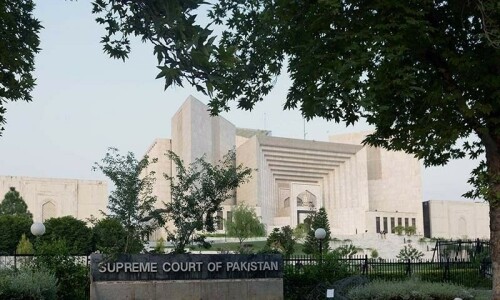
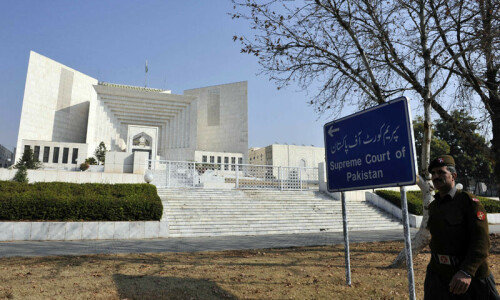
ISLAMABAD: A number of petitions were filed before the Supreme Court on Monday against the 26th Amendment which “abrogates, repeals, alters and destroys the basic features of the Constitution” and “violates” fundamental rights.
Three petitions were filed before the Supreme Court namely by the Balochistan Bar Council (BBC), Balochistan High Court Bar Association (BHCBA) and former Supreme Court Bar Association (SCBA) president Abid Shahid Zuberi along with Chaudhry Ishtiaq Ahmed Khan, Tahir Faraz Abbasi, and Shafqat Mehmood Chawhan.
On Oct 24, veteran politician Afrasiab Khattak filed the petition with a plea to strike down the 26th Amendment.
Senior counsel Muneer A. Malik represented the BBC as well as BHCBA in their petitions, which said the amendment, specifically sections 7, 10, 12, 13, 14, 17, 21, 22, and 27, were ultra vires to the Constitution and violated its salient features and fundamental rights.
Pleas seek restraining order against reformed judicial commission
They pleaded that the amendment also repealed, altered, abrogated and destroyed the salient features of the Constitution, including the fundamental rights, the independence of the judiciary, principles of separation of powers, and the right of access to justice.
The petition has also pleaded before the apex court to issue a restraining order against the new Judicial Commission of Pakistan constituted through amended Article 175-A from holding any meeting or taking any action or passing any order.
The petitioners pleaded that the amendment was passed by a controlled and incomplete parliament — which was yet to be fully constituted. According to the pleas, the government pushed through a critical constitutional amendment, allegedly in a non-transparent and hasty manner, without any meaningful debate or public consultation and votes were obtained through alleged coercion and duress.
Given the profound implications of this amendment for the independence of the judiciary and the separation of powers, such a significant change demanded thorough deliberation and broad consensus, the petitions argued.
The alarming lack of transparency in the process undermined its legitimacy and cast doubt on the motivations behind it, the petitions argued, adding the very role of parliament in passing the amendment was questionable.
It said concerns regarding its constitutionality and representative nature have been widely voiced, adding that a body whose own legitimacy was under scrutiny could not exercise the powers of a constituent assembly.
The amendment, in its entirety, was “undemocratic, non-est, void ab initio” and had been passed in violation of basic/salient features and fundamental rights as enshrined under the Constitution, the petitions highlighted.
The amendment to Article 175-A suffered from an inherent legislative defect, rendering it incapable of practical enforcement and therefore void ab initio.
It also granted the JCP the authority to conduct annual evaluations of judges’ performance, which significantly undermined the independence of the judiciary.
By allowing the executive to review and potentially exert control over judges’ professional conduct, this amendment eroded the essential principle of judicial autonomy, said the petitions, adding that the new clauses introduced in Article 175A, particularly 18 and 19, elucidated this concerning shift.
Published in Dawn, October 29th, 2024