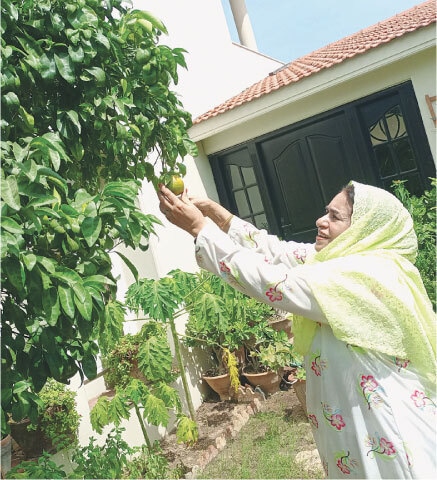
Fathiya Abdul Qadir gazes at her mandarin orange tree with mother’s pride. She grew this tree from seeds that she had brought with her from Sargodha. “The kinnow [Mandarin oranges] from Sargodha are the best in the world,” she exclaims as she examines a couple of greenish oranges on her tree. “They will be ready to be picked soon, just in time for my annual orange marmalade preparations for the flower show,” she tells Eos.
For more than 20 years now, Fathiya has been selling jams, jellies and marmalades in neat little jars at the Ladies Horticulture Club stall at the annual flower show organised by the Horticulture Society of Pakistan in Karachi. That is also how I got my hands on one of the jars. No other marmalade has ever tasted quite like it. Made at home with home-grown fruit by Fathiya, it carries absolutely no preservatives and is simply delicious.
“I also make guava, strawberry, peach and plum jam and jelly, but kinnow marmalade has remained my favourite,” Fathiya says. “It is also the most popular item at our stall,” she adds.
Growing up, Fathiya says she always had a fascination for English breakfast marmalade. “I wanted to know how it was made. I bought so many cookbooks and taught myself through trial and error,” she continues.
For over 20 years, Fathiya Abdul Qadir has been selling her legendary kinnow marmalade at Karachi’s annual flower show
Fathiya acknowledges that marmalade is the most difficult to make among the jams. “But I still like doing it as you don’t throw away anything in the making of marmalade,” she points out, while telling me about the four ‘Ps’ of marmalade making — peel, pith, pulp and pips.
“You need it all [for the marmalade], especially the pith, which is the white thread-like part between the peel and pulp,” Fathiya continues. This is done to extract pectin, she explains, which gives marmalade the stickiness that helps it set, adding that she doesn’t use any artificial setting agent for that purpose.
Fathiya makes three kinds of marmalades: the kinnow or orange one, one with Seville oranges and, finally, the lemon or lime marmalade. Of these, her favourite to make is the kinnow marmalade.
For the last five or six years, Fathiya, who originally hails from Dubai, has been spending some months in Canada, too. It was there that she heard about an annual marmalade competition at the Toronto Museum.
The condition there was to use no artificial ingredients, Fathiya tells Eos. “They wanted original marmalade as it used to be made 100 years ago, with just sugar, orange, lemon or lime, while using a single extra flavouring ingredient,” she continues. “I used saffron as my extra flavouring,” she continues.
Fathiya reveals that there was also a pastry competition, in which she got second prize. “But my marmalade did not win,” she adds with a tinge of disappointment. “Upon inquiring what was wrong with it, I was informed that the saffron was overpowering everything else. I was told that it should be the last taste whereas mine was the first and last taste,” she smiles.
Of course, Fathiya was back the following year, when her marmalade got the first prize as well as the second prize in another category.
Method
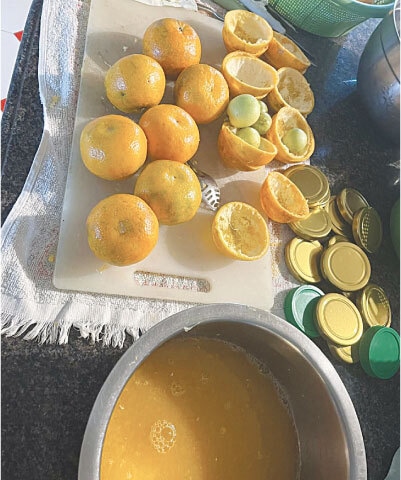
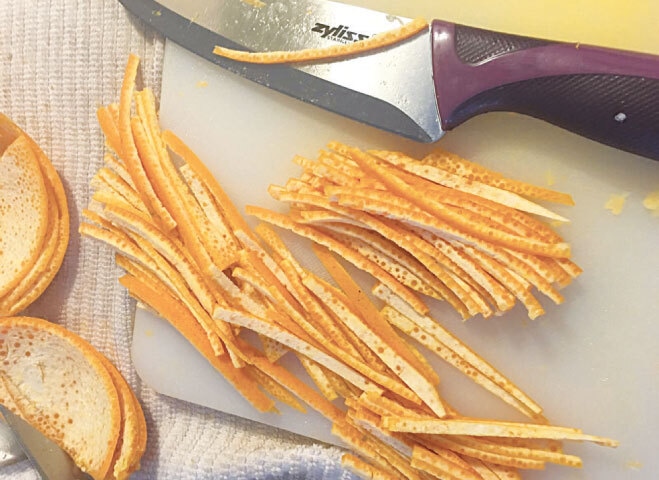
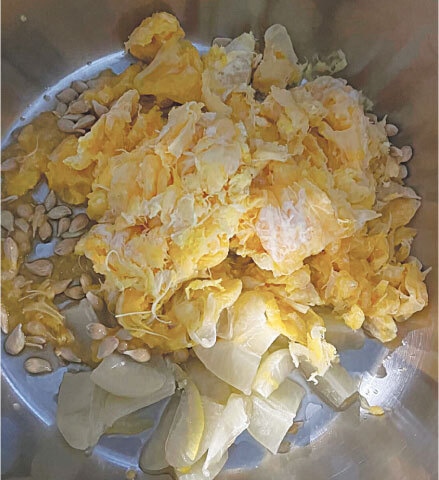
For her favourite kinnow marmalade, Fathiya begins by juicing the oranges. The pith is then removed from the peel, while the peel is cut into juliennes. Next, heat water with some lemon or and lime juice — for the extra citric acid — in a saucepan while adding the pith and seeds to simmer and boil.

In another saucepan, cook the peels to soften them. Then the pith and pips mixture is strained out, giving you golden pectin. After that, the softened peels and the golden pectin liquid are added to the orange juice and cooked until the liquid thickens to reach a setting point. That’s also when you add the sugar, according to your taste.
“What I have learned in my gardening and my cooking is that when there’s passion and love, there is magic,” Fathiya says with a twinkle in her eye. “When the pectin hits the sugar, it is all watery. But after you transfer it to a jar, the chemistry of it all has helped it set to perfection by the morning,” she beams.
The columnist is a member of staff.
X: @HasanShazia
Published in Dawn, EOS, October 12th, 2025