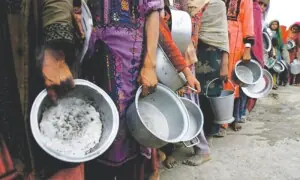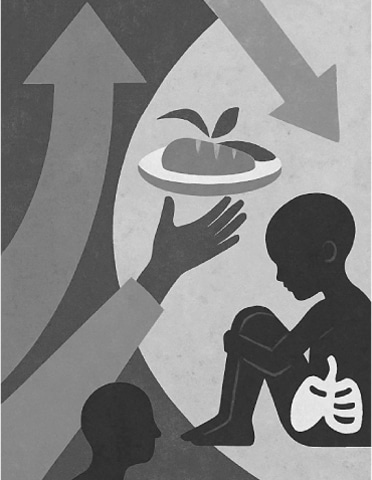
IN much less than a decade, the number of Pakistanis unable to access sufficient and nutritious food has more than tripled, crossing 100 million. This deterioration has taken place against the backdrop of several crises, including, among others, the locust outbreak in late 2019, the Covid pandemic in 2020, and devastating floods. The floods this year have again underli-ned how vulnerabilities are no longer domestic alone; they increasingly have a transboundary element.
Excessive water inflows from India inundated Punjab, the breadbasket of Pakistan, driving up food prices despite the relative economic stability and easing inflation observed in 2024-25. These episodes highlight the intersection of climate, economic and geopolitical risks that continue to challenge the country’s food security.
The Food and Agriculture Organisation (FAO) presents food insecurity as three-year averages to capture underlying trends rather than seasonal fluctuations. Between 2014-16 and 2017-19, the figures remained relatively stable: about 12-14 per cent of the population, or 26 to 32 million people, were moderately or severely food-insecure. After 2018, however, the picture began to change.
By the end of the 2018-20 cycle, the proportion had nearly doubled to 24.3pc, or 56 million people, and by 2019-21, it had risen further to 32.6pc, equal to 76.6 million people. The Covid pandemic and economic uncertainty intensified these pressures. By 2020-22, an estimated 41pc of the population, or 98.2 million people, were food-insecure. The most recent
FAO data for 2022-24 shows the situation worsening still: 42.1pc of Pakistanis, or more than 104 million people, cannot reliably access adequate food.
Alongside food insecurity, FAO data on the Prevalence of Undernourishment (PoU) has underscored the depth of the challenge. The most recent three-year average for 2022-24 shows that 16.5pc of the population, more than 40 million people, are undernourished. It is clear that food crises are increasingly unfolding, but the level of preparedness has remained low.
Acute disruptions in access to sufficient, safe and nutritious food often overwhelm national and local response capacities, pushing millions into malnutrition and poverty. These crises are also becoming more frequent, complex and prolonged, driven by the combined pressures of climate change, economic volatility and political instability. Although forecasting technologies and early warning systems now provide critical windows of oppor-tunity for anticipatory action, responses remain largely reactive.
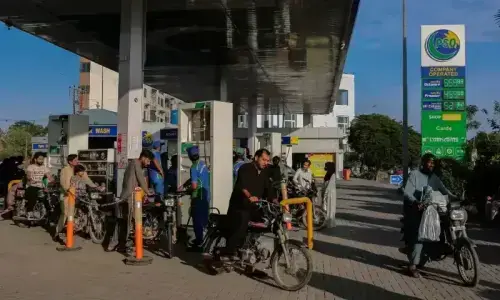
Climate extremes have repeatedly damaged crops in the country, affecting rural livelihoods. Inflation and currency depreciation have steadily reduced purchasing power. Global shocks, such as the Russia-Ukraine conflict, have further inflated food and energy import costs.
Meanwhile, weak management of food reserves and fragmented monitoring systems mean that warning signs, though visible, do not always lead to due timely action.
The FAO data underscores that Pakistan’s food insecurity is no longer a temporary crisis linked to individual disasters; it is becoming a long-term challenge. There are important opportunities to change course. Social protection systems can be strengthened to better support vulnerable households during price surges.
Investments in climate-resilient agri-culture from flood-resistant infrastructure to drought-tolerant seed varieties can help safeguard production. Building transparent food reserves and improving data systems would also give policymakers the tools they need to respond quickly and effectively.
Dr Syed Irshad Shah
Islamabad
Published in Dawn, October 10th, 2025