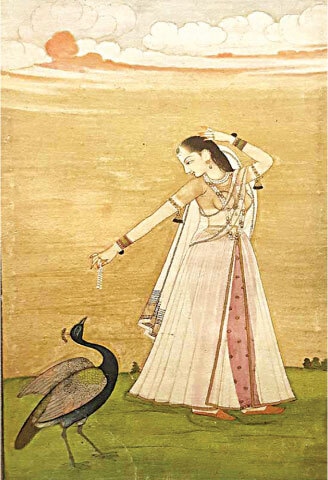
Honouring the legacy of the late Ustad Bashir ud Din (1922-1997), his son, Amin Rehman, brought forth a deeply personal exhibition titled ‘Restrained Grace’, which intertwined memory and legacy. At the Pakistan National Council of Arts (PNCA) in Islamabad, he showcased the works of his father, an accomplished artist and instructor at the Mayo School of Art — an institution that later evolved into the National College of Arts (NCA) Lahore.
Alongside this homage, Amin presented his own body of work in a separate gallery, titled ‘Bleeding Borders.’ Amin will also showcase ‘Bleeding Borders’ in Toronto in November 2025, extending this dialogue to a global audience.
Bashir’s artistic journey began as a student, and later a colleague, of the legendary Mohammad Abdur Rahman Chughtai. While the influence of his drawing master — particularly in the use of fine lines — is evident in Bashir’s work, their artistic expressions diverge in significant ways. A closer comparison of their paintings and sketches reveals differences in their stylistic approaches.
Bashir’s works on display at this exhibition can be broadly divided into two categories: watercolours and pencil drawings. One explores realistic portraiture, where the artist demonstrates remarkable control over his lines, details in facial features and in the formation of delicate contours, even capturing the gleam of light in the eyes of his subjects, such as in the portraits of Maulana Hafizur Rehman and Phullan Khan.
The watercolour paintings and pencil drawings of Ustad Bashir ud Din were put on display alongside the works of his son at PNCA in Islamabad
In some of the sketches, the influence of Renaissance masters is also quite evident. Most striking is the standing posture of certain figures, where one foot is placed slightly forward, recalling the contraposto pose — a hallmark of Renaissance art that conveys both balance and grace. This makes the figure appear more relaxed, lifelike and natural, as opposed to rigid and stiff. These features are evident in Veiled Woman with a Companion and Lady with a Candle.
In a pencil sketch titled A Woman Carrying Food, Bashir uses minimal strokes to convey movement, capturing the essence of rural life and daily traditions. The soft curves of the clouds in the background mirror the rounded lines of the woman’s attire, adding rhythm to the overall composition.
In some sketches — such as Portrait of a Lady, Woman and Child I and Figurative Sketch — the rustic, rural features suggest a raw and less polished treatment of the human face. Notably, the noses of the women appear somewhat distorted rather than classically straight or idealised. This seems to be a deliberate departure from aesthetic norms of the miniature painting tradition. Instead of aligning with the refined courtly ideals, these works appear to embrace the features of everyday individuals — anchoring the figures in lived, rural reality rather than an imagined perfection.
His work also draws inspiration from miniature paintings, Indo-Persian aesthetics and Punjabi folk traditions. The figures in these pieces, often elongated and dreamlike women with slender, pinched waists and elongated hands, exist in a space between reality and fantasy. Watercolour paintings rendered in the miniature style are another notable category in the artist’s oeuvre. While Reading is a compelling example — an amalgamation of realism and traditional miniature technique, infused with deeply spiritual subject matter. The painting depicts an elegant young woman, draped in a finely detailed garment, reciting the Quran. The artist’s command over line and detail is impeccable.
Similarly, A Lady with a Parrot captures a quiet, intimate moment of spiritual liberation — a bird perched outside its cage, holding a flower in its beak and extending towards the woman’s poised hands. Symbolising freedom, it offers a subtle commentary on personal and emotional release. Also on display were the artist’s watercolour landscapes.
In contrast, the works of Amin were altogether a different style of expression. As he himself says, unlike his father, Amin’s work engages with politically charged themes and the lives of communities beyond the border, politics of the place, the intricacies of cultural globalisation and the unresolved questions of post-colonial ideologies.
‘Restrained Grace’ and ‘Bleeding Borders’ were on display at the PNCA in Islamabad from September 2-12, 2025
The writer is an art critic, fine artist and educationist based in Lahore. She can be reached at ayeshamajeed2015@gmail.com
Published in Dawn, EOS, September 14th, 2025