Transitory stay of Afghan refugees in Pakistan can’t be ‘indefinite arrangement’: FO spokesperson



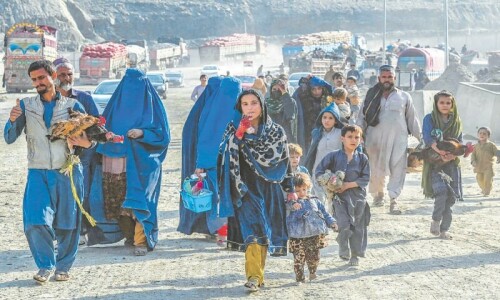
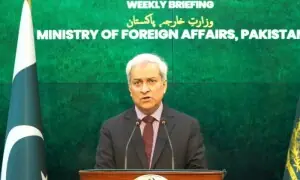
Foreign Office (FO) spokesperson Ambassador Shafqat Ali Khan on Friday said the transitory stay of Afghan refugees in Pakistan could not be an “indefinite arrangement”.
He further stated that it was Pakistan’s “sovereign right to decide who we allow into our country and for how long”.
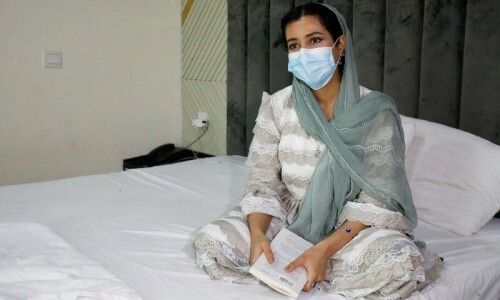
Khan made these remarks during a media briefing, where he was asked about Germany’s allegation that Pakistan had deported more than 2,000 Afghan refugees who were waiting to travel to Germany.
The FO pointed out that Germany had committed to taking in a certain number of Afghan refugees and that the country had said that it took the matter of Afghan refugees seriously. He expressed the hope that “this seriousness will be translated into action, and that the German … will be expedited”.
Khan said, “We are willing to work with Germany because we have decades old relationship; on the basis of goodwill and mutual respect. We will see what we can do.”
But he also asserted that the transitory stay of Afghan refugees in Pakistan, waiting to travel to other countries, could not be an “indefinite arrangement”.
“It is our sovereign right to decide who we allow into our country and for how long. We are willing to work with our friends with empathy and with mutual understanding. But it cannot be an open-ended arrangement.”
In response to another question about the United Nations High Commissioner for Refugees chief calling on Pakistan to halt the deportation of Afghan refugees amid relief activities following a deadly earthquake in Afghanistan, she FO spokesperson said: “Regarding this notion of expulsion of Afghans, I would say we have an overall policy and it is not targeting Afghans. Any person who is illegally [staying] in Pakistan will be sent back. It doesn’t matter where he or she is from. There is no targeting of Afghans.
“This is the global norm, and this is our sovereign decision regarding who do we allow to enter or stay in our country. So, any person, who’s illegal, we will repatriate that person.”
Last month, Pakistan started deporting up to one million documented Afghan refugees ahead of its deadline for them to leave, following the interior ministry’s July 31 announcement that Proof of Registration (PoR) cardholders — the last category of Afghans legally residing in Pakistan without visas — became unlawful residents after their cards expired on June 30.
“Germany should take in these refugees as soon as possible,” the spokesperson added. “Pakistani law will apply to those Afghans living here. We will decide what to do with refugees in Pakistan.”
Pakistan is not a signatory to the 1951 Geneva Convention. Instead, it operates under the Foreigners Act, which empowers the authorities to arrest, hold, and deport foreigners, including refugees and asylum seekers, who do not possess valid documentation.
Additionally, the spokesperson said that Kabul would need to take the issue of terrorism in Afghanistan seriously, stating, “Terrorist safe havens still exist in Afghanistan.
“Pakistan knows how to defend its territory and its people,” Khan said.
“An operation was carried out in the border area with Afghanistan against terrorists,” he added, referring to drone strikes allegedly carried out by Pakistan on August 28. “Afghanistan needs to stop allowing its territory to be used for acts of terrorism.”
Islamabad has repeatedly warned Kabul to prevent its soil from being used to stage attacks in Pakistan, and that it is fully capable of targeting terrorists who carry out such attacks.
During the recent Shanghai Cooperation Organisation’s (SCO) meeting of the Council of Heads of State, members reaffirmed their commitment to the country’s establishment as an independent, neutral and peaceful state, free from terrorism, war and drugs, and expressed their readiness to support the efforts of the international community to ensure peace and development in the country.
“Member states reiterated that the formation of an inclusive government with broad participation of representatives of all ethno-political groups of Afghan society is the only way to achieve lasting peace and stability in the country,” the declaration said.
Correction: This story previously misquoted the Foreign Office spokesperson as saying that Afghan refugees waiting to travel to Germany should be deported at the earliest. The error is regretted and has been corrected.