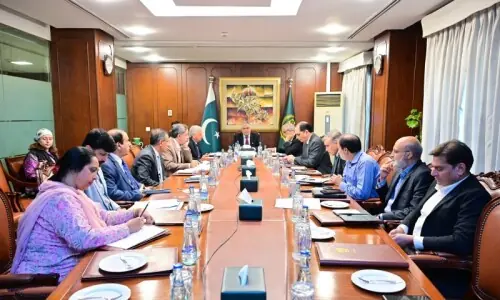
In the middle of navigating economic disturbance, Chinese Foreign Minister Wang Yi’s recent visit to Islamabad was more than a routine diplomatic engagement for Pakistan, as it presented an opportunity to secure stronger Chinese financial and strategic support.
Yet, even as the country seeks external backing, recent events at home — unprecedented rains and flash floods — have exposed deep-seated governance gaps, showing that economic and geopolitical gains may be undermined by internal administrative failures.
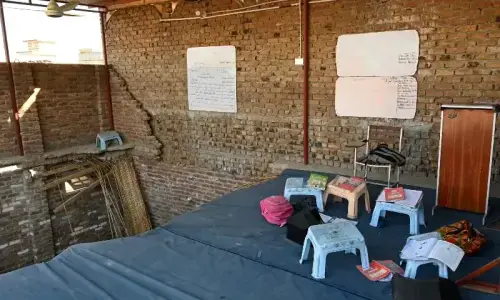
The country’s handling of these floods in Khyber Pakhtunkhwa and Karachi this month has highlighted that it is governance issues that impose heavier costs on lives, property, and infrastructure than most external shocks.
Karachi’s urban flooding was not simply a drainage problem; it revealed systemic flaws: poor planning, political exclusion, entrenched corruption, and an absence of effective administration. Citizens were left stranded as services collapsed, underscoring how repeated neglect in disaster response mirrors Pakistan’s broader economic vulnerabilities.
Our recent economic gains — lower inflation and a rising stock market — mask several similarly deep, structural weaknesses that threaten growth. Meeting the government’s 4.2 per cent GDP target in the current fiscal year will be difficult unless these systemic issues are addressed.
Urban flooding reveals serious, systemic flaws in national governance
The threat of political instability remains one of our largest obstacles, undermining good initiatives, fuelling unrest, and eroding investor confidence. In this environment, long-term planning is too difficult, and structural reforms struggle to take root.
The human cost of these structural weaknesses is immense. Families face uncertainty as inflation, unemployment, and inadequate public services erode living standards. Rural communities struggle with poor access to healthcare and education, while urban populations confront congested infrastructure and rising informal settlements. Persistent poverty fuels social unrest, creating a cycle that reinforces economic stagnation.
Addressing these challenges requires policies that are not only economically sound but also politically and socially inclusive, ensuring that growth translates into tangible improvements in daily life. Without this focus on citizens’ well-being, reforms risk being abstract numbers rather than lived progress.
A concentration of privileges further hinders the economy. Powerful groups benefit from exemptions that cost the treasury Rs5.84 trillion in the last fiscal year, over 50pc more than the previous year, according to a Dawn report based on data from the Economic Survey of Pakistan 2024-25. These exemptions, granted across key sectors, limit resources for social services and infrastructure.
Meanwhile, nearly half the population lives in poverty, with weak social spending and chronic underinvestment in infrastructure keeping demand subdued. Emerging priorities are evident: following a military clash with India, defence spending rose 20pc to Rs2.55tr even as the federal budget spending shrank by roughly 7pc.
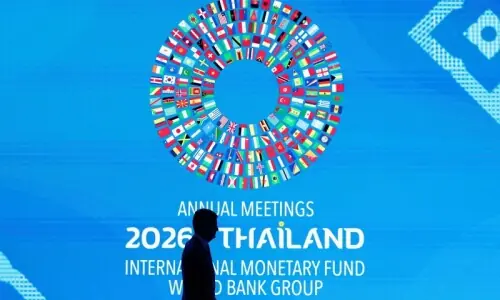
The International Monetary Fund remains a critical, if contentious, partner. Bailouts come with strict reform conditions — taxing exempt sectors, cutting subsidies, and rationalising tariffs — that successive governments announce but rarely fully implement. This pattern erodes credibility both at home and abroad.
Industrial production is faltering. Large-scale manufacturing contracted 0.74pc in the last fiscal year against a 3.5pc growth target. The textile sector, still a major employer and exporter, struggles under global competition, while emerging sectors like IT remain too small to offset losses. Energy constraints exacerbate stagnation, with circular debt reaching around Rs2.4 trillion at the end of March 2025, causing load-shedding and unreliable supply. Policy reversals in renewables have further deterred investment.
The government has proposed a new industrial policy, including corporate tax cuts from 29pc to 26pc over three years, debt restructuring for sick industries, and reforms in corporate and tax laws. Banks are encouraged to forecast industrial distress, but history suggests weak implementation may blunt these measures. Structural bottlenecks — low-value production, complex tariffs, and poor logistics — persist. Even tariff cuts in the budget primarily benefit existing players, leaving small and medium enterprises at a disadvantage.
Fiscal pressures are severe. Debt servicing alone will consume Rs8.2tr in FY26, nearly half of total expenditure, limiting resources for development. Inflation, after peaking at 38pc in May 2023, eased to 4.1pc in July 2025, but the target for FY26 is 7.5pc.
Interest rate cuts from 22pc to 11pc may support growth, yet misalignment between fiscal and monetary policies could reignite inflationary pressures.
In the outgoing fiscal year Pakistan’s savings rate stands at 14.1pc of GDP, with investment at 13.8pc, creating a gap that necessitates external financing. Projections for FY26 show savings at 14.3pc against investment at 14.7pc, still leaving a gap to be filled with external inflows. Foreign direct investment stood around $2.5bn in the last fiscal year, much below Pakistan’s potential and slightly above one-tenth of the external financing gap.
Industrial stagnation and fiscal-monetary discord are mutually reinforcing. Industry cannot revive without affordable credit, reliable energy, and supportive taxation, while fiscal stability depends on stronger industrial growth and competitive exports.
Yet opportunities remain. The information technology sector, though small, is expanding by double digits, with global outsourcing demand offering potential for job creation and foreign exchange earnings.
Agriculture, if modernised with technology and value-added, could provide both export revenue and food security. Renewable energy, despite policy reversals, remains viable given falling global costs and Pakistan’s natural endowment of sun and wind.
The way forward requires politically difficult but economically essential reforms. A progressive tax system, simpler import tariffs, market-determined exchange rates, and efficient public spending could restore credibility and attract investment.
More importantly, Pakistan needs a long-term economic charter that includes debt restructuring, predictable taxation, productivity-linked wages, transparent public projects, provincial performance benchmarks, and investment in human capital.
Published in Dawn, The Business and Finance Weekly, August 25th, 2025