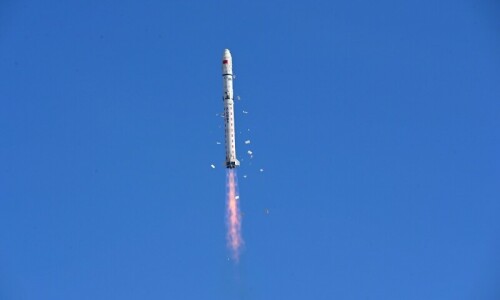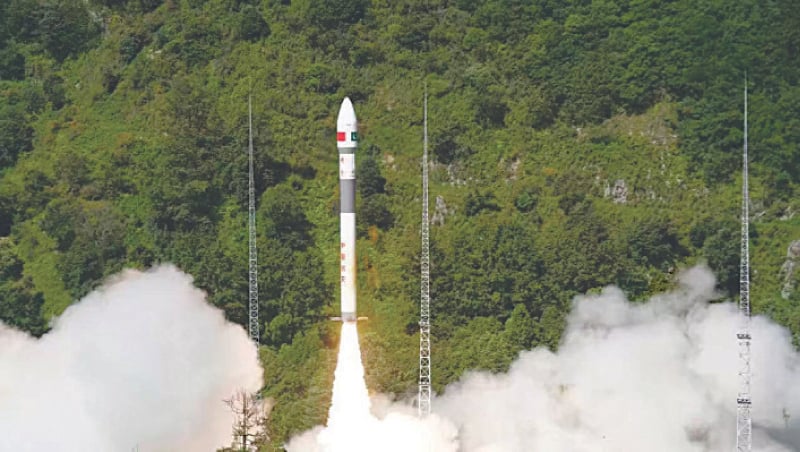
ISLAMABAD: A Pakistani satellite has been successfully launched from China’s Xichang Satellite Launch Center, the national space agency announced on Thursday.
The Pakistan Remote Sensing Satellite-1 (PRSS-1), aboard a Kuaizhou-1A carrier rocket, was launched at 10am (GMT+8) on Thursday.
It has successfully entered its preset orbit, Planning Minister Ahsan Iqbal has said.
The Space and Upper Atmosphere Research Commission (Suparco) said the new Remote Sensing Satellite will be a major milestone in Pakistan’s space exploration efforts and strengthen its position in Earth observation capabilities.
Celestial object to help in urban planning, disaster management, food security, ecology protection
“The Remote Sensing Satellite will provide imaging capabilities to revolutionise urban planning, disaster management, food security, and environmental protection. It will also greatly aid in monitoring climate change, managing water resources, mapping agricultural patterns and tracking deforestation,” said the space agency.
The launch was a result of the collaboration between Suparco, China Electronics Technology Group Corporation and MICROSAT China.
The satellite will support precision agriculture to boost crop yields, monitor infrastructure growth and urban expansion, and enable more effective regional planning.
It will also enhance disaster management efforts by providing timely warnings for floods, landslides, and earthquakes, while tracking glacier recession and deforestation.
Suparco Chairman Muhammad Yousaf Khan said the satellite would support national priorities across multiple sectors and will contribute towards sustainable socio-economic development.
It will contribute to national development initiatives such as CPEC by mapping transportation networks and identifying geohazard risks, Suparco said.
Planning Minister Ahsan Iqbal, who witnessed the launch ceremony as the chief guest, said the event was not only a technological milestone, but a “moment that lifts our national spirit and elevates our friendship with China”.
The Chinese embassy in Pakistan congratulated the country on the satellite’s launch.
In a post on X, Prime Minister Shehbaz Sharif congratulated Suparco on the successful launch and thanked Chinese partners for their contributions to the project.
President Asif Ali Zardari also congratulated the Pakistani scientists on the successful launch, saying, “Pakistan is proud of the capabilities of its scientists.”
Published in Dawn, August 1st, 2025