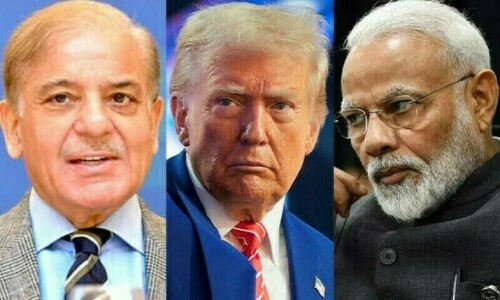
THOUGH there were initial reports of violations, the ceasefire between Pakistan and India, brokered by the US and other foreign actors on Saturday, has largely held.
This brings a welcome return to relative calm in the subcontinent after both states engaged in hostilities following India’s unprovoked aggression against Pakistan on May 7. The first priority should, of course, be to ensure that the truce holds, and is solidified, so that there is no further bloodshed and aggression. Meetings and calls between the military officials and diplomats of both states can help sustain the ceasefire, so that it develops into a longer-term truce.
But once calm is restored, the two states cannot afford to lose time in addressing the issue that is the biggest source of instability in South Asia: the unresolved Kashmir question. US President Donald Trump has again offered his good offices to see if a solution to the Kashmir dispute can be found. The Foreign Office has welcomed the American leader’s offer. It remains to be seen how receptive India is to US mediation. While they would be loath to accept foreign intervention in what they see as an ‘internal’ issue, refusing Washington’s offer may be difficult for New Delhi.
However, while Mr Trump’s offer is indeed welcome, if foreign prodding had been enough, the Kashmir dispute would not have continued to fester for close to eight decades now. It is only Pakistan and India that can take the big decisions on Kashmir. Pakistan has repeatedly expressed its desire to see a negotiated settlement to Kashmir. India, on the other hand, has displayed extreme rigidity.
The ill-conceived move to scupper Indian-occupied Kashmir’s limited autonomy in 2019 is the biggest example of the BJP government’s attempt to prevent a just solution to the dispute. It has, in fact, created new ‘facts’ on the ground. But while foreign powers cannot dictate peace, what they can surely do is to convince India that it is time to change its tune.
The blueprints exist for a fair and non-violent solution to Kashmir, such as the Musharraf-era formula. These, or any other acceptable proposal, should be pursued, either publicly or through the backchannel. Though shrill war lobbies on both sides, particularly in India, will object to peace parleys, the fact is that an out-of-the-box solution acceptable to Pakistan, India and the Kashmiris is the only hope for long-term peace in South Asia.
If India continues to employ brutality and violent tactics in held Kashmir, and pursues attempts to re-engineer the region’s demographic profile, public disaffection will continue. Statesmanship and vision are needed by all parties to the conflict to ensure that the path of confrontation is eschewed in favour of that of coexistence and peace.
Published in Dawn, May 12th, 2025