• Committee says it will never compromise on ‘dignity of its members’
• Reviews Railways audit irregularities; raises concern over Rs3.4bn procurement violations related to locomotive repairs
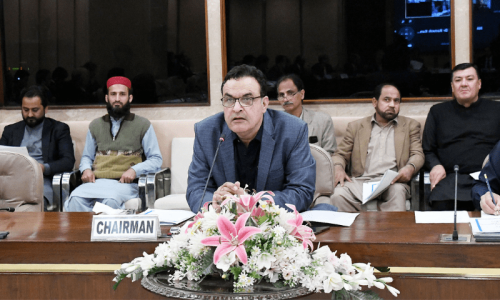
ISLAMABAD: The Public Accounts Committee (PAC) held a closed-door session on Tuesday, chaired by MNA Junaid Akbar Khan, with members first convening for an internal discussion before formal proceedings began.
A key issue under review was the controversial removal of electricity meters from the residence of PAC member Sanaullah Khan Mastikhel, reportedly carried out by staff from the Faisalabad Electric Supply Company (Fesco). The matter, which had previously been raised in committee, led to the adjournment of an earlier meeting in protest.
During Tuesday’s in-camera session, the power secretary briefed the committee and confirmed that the Fesco officials involved had already apologised to both the committee and Mr Mastikhel. “I have provided the necessary briefing; now it is up to the committee to decide how to resolve the matter,” the secretary said before leaving the session.
PAC Chairman Junaid Akbar Khan acknowledged Mr Mastikhel’s gesture of forgiveness but underscored the seriousness of the incident. “Such actions are completely unacceptable,” he said. “PAC will never compromise on the dignity of its members.”
He added that the day’s meeting was being held as a continuation of the committee’s protest. “Had Mr Mastikhel not chosen to forgive, strict action would have followed,” he said.
Separately, the PAC reviewed several audit objections against the Ministry of Railways. Railway Secretary Mazhar Zeeshan briefed the committee on several persistent challenges, including a significant budget shortfall that has left many pensioners without benefits for two years.
“We’ve received Rs64 billion in allocations, but liabilities still stand at around Rs13-14bn,” he said.
Mr Zeeshan also updated the committee on the delayed Main Line-1 (ML-1) railway upgrade project, claiming there were “no problems from our side”. He confirmed the revised design would support train speeds of up to 160 km/h.
The PAC also flagged concerns over procurement violations amounting to over Rs3.39bn between June 2020 and June 2022, related to the repair of 100 locomotives. Chairman Junaid Akbar Khan criticised the lack of actionable outcomes from Departmental Accounts Committee (DAC) meetings and deferred further discussion.
Other significant audit issues included the misappropriation of Rs506.6 million in high-speed diesel procurement and the unauthorised commercial use of land leased to Al-Shifa Eye Hospital in Sukkur. The committee ordered formal inquiries into both matters and demanded action reports, setting a 10-day deadline in the diesel case.
The committee reaffirmed its commitment to transparency and public accountability, warning that violations of public trust would not be tolerated — even in cases where members opted to forgive.
Published in Dawn, April 23rd, 2025