Pakistan to send first astronaut to space station soon: PM
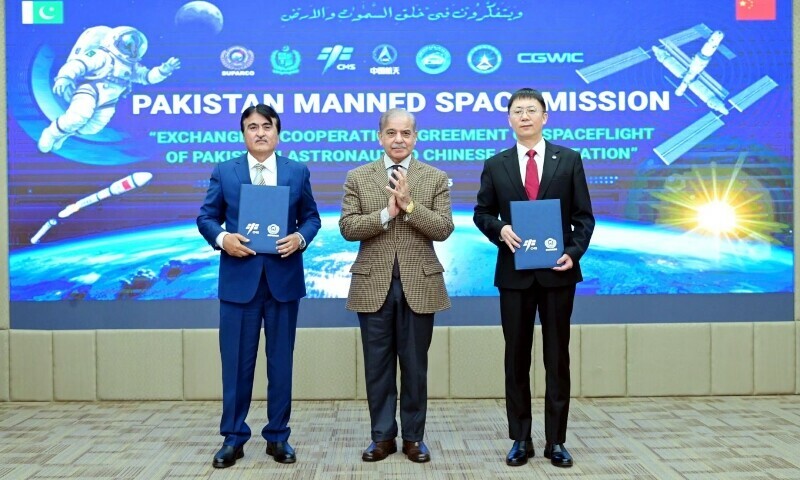


Prime Minister Shehbaz Sharif on Friday said that Pakistan, in collaboration with China, will send its first space manned mission to China’s space station.
Addressing a ceremony in Islamabad after witnessing the exchange of a cooperation agreement between Pakistan’s Space and Upper Atmosphere Research Commission (Suparco) and China Manned Space Agency (CMSA), the prime minister said that this was yet another wonderful gesture from the Chinese government to further deepen bilateral cooperation in this field.
He emphasised that under the “dynamic leadership” of Chinese President Xi Jinping, “Not only is this programme underway speedily … but also CPEC, which has really transformed Pakistan’s economic conditions.”
PM Shehbaz highlighted that Pakistan’s participation in the China Space Station (CSS) programme reflected the deep-rooted ties between the two countries and would contribute to mutual knowledge-sharing and the broader vision of peaceful space exploration.
Under the agreement, two Pakistani astronauts will undergo training at the Astronaut Centre of China. One selected astronaut shall be trained as a scientific payload specialist, preparing for specialised research aboard the CSS. The selection process will be completed by 2026 to fly in an upcoming mission as per CSS planning.
The first Pakistani astronaut’s mission at CSS will involve conducting cutting-edge scientific experiments in various fields, including biological and medical sciences, aerospace, applied physics, fluid mechanics, space radiation, ecology and material sciences, among others.
Minister for Planning and Development Ahsan Iqbal termed the agreement a historic milestone, underscoring its role in accelerating technological innovation, capacity building, and research.
“Collaboration with China extends beyond astronaut training, laying the groundwork for Pakistan’s long-term growth in human spaceflight and exploration,” he said.
CMSA Director General Dr Lin Xinqiang expressed his enthusiasm for this partnership, reaffirming China’s dedication to strengthening international cooperation in space exploration.
He highlighted that Pakistan’s participation in the CSS programme “reflects the deep-rooted ties between the two countries” and will contribute to mutual knowledge-sharing.
Suparco Chairman Mohammad Yousaf Khan regarded the agreement as a landmark in Pakistan’s space journey, emphasising “perseverance, adaptability, and technological progress”.
He invited youth, professionals, and academia to actively participate in Pakistan’s astronaut programme, encouraging them to contribute to space exploration efforts through research, innovation, and skill development.