THE country’s economy continues to demonstrate mixed positive and negative trends with a hazy long-term outlook as multiple problems are yet to be effectively addressed by basic structural reforms.
On the positive side, a record number of 3,442 companies across diverse sectors were registered in a single month by the Securities Exchange Commission of Pakistan in January, reflecting a 39 per cent increase compared to the previous year’s monthly average. And also noteworthy is the fact that the information technology and e-commerce sectors led the growth by registering 652 companies.
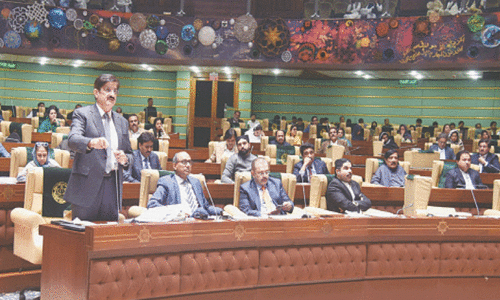
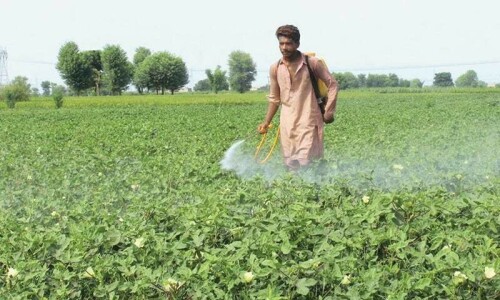
A noticeable progress was made in reforming the outdated mode of collecting agricultural income tax with negligible revenue yield. The Sindh Assembly unanimously passed the agricultural income tax bill 2025 on Feb 3. All four provinces have approved the income tax law as required by the International Monetary Fund.
Sindh’s new law proposes that annual agricultural income up to Rs0.6 million will be exempt from tax, while the maximum tax rate for income exceeding annual Rs5.6m will be 45pc.
Noticeable progress is being made with regard to agriculture tax and improved exports, though many problems still call for basic structural reforms
A progressive super tax has also been introduced, with no super tax on annual agricultural income up to Rs150m and a maximum of 10pc super tax applying to income exceeding Rs500m annually.
In the external sector, exports of merchandise recorded a healthy growth of close to $3 billion but imports also rose at the same time to over $5.2bn for the second consecutive month. The trade deficit widened by nearly 18pc to $3.2bn in January compared to the same month last year.
While boosting export earnings is a critical problem in managing external sector vulnerability, European Union’s Special Representative on Human Rights Olof Skoog has warned Pakistan not to take its GSP+ status for granted. Since 2014, Pakistan has enjoyed preferential access to the EU market in the form of tariff exemptions and reductions for its exports.
In exchange for this preferential treatment, Pakistan has made a number of commitments, including to protect human and labour rights and ensure good governance, among others. Mr Skoog’s visit to Pakistan coincided with amendments to the Prevention of Electronic Crimes Act.
While boosting export earnings is a critical problem in managing external sector vulnerability, Olof Skoog has warned Pakistan not to take its GSP+ status for granted
Analysts at Dawn caution, “Where international trade agreements are concerned, Islamabad cannot expect to get away with violating the commitments it has made to foreign partners.” History shows authoritarianism now haunting Pakistan tends to create and sustain economic stagnation.
We can recall what followed Gen Ayub’s development decade. It is worth noting here that on Feb 4, military officials attending a Corps Commander Conference stressed the need for accelerating “people-centred socio-economic development initiatives” in Balochistan to counter “externally driven narratives of exclusion”.
To quote US scholar Tim Wu, author of ‘The Curse of Bigness: Anti-Trust in the New Gilded Age,’ the centralisation of policy in the person of the US President would be more like a command economy. He adds, “Just call it command capitalism.”
Command capitalism, he points out, has several major drawbacks. For one, when success in business means gaining government favour as opposed to, for instance, making good products, the incentives for innovation and quality disappear. Companies that depend on government preferential treatment, such as Boeing or the aerospace industry generally, tend towards stagnation.
He notes that there appears to be a widespread sense that success in the Trump economy will particularly depend on staying on the president’s good side.
Rashid Amjad, a professor of economics at the Lahore School of Economics In Pakistan, argues, “In Pakistan, the process of bringing about basic structural changes in the economy has not even begun. So far, we have been only scratching the surface.”
The tax rates are among the highest in the world, while the country ranks among the lowest in providing basic services, say analysts at Business Recorder. In the tax year 2024, they noted that despite the potential of 15m filers, 5.9m entities (predominantly individuals) filed tax returns, down from 6.3m in 2023. Taxpayers receive little in return for their contributions, making evasion an obvious choice.
In economies that impose higher tax rates, the analysts added, citizens receive quality social services such as healthcare, education, a better environment, and security. Such countries tend to have a tax-to-GDP ratio exceeding 30pc.
Though federal tax revenue improved over last year, the shortfall in the targeted collection between July and January of the current fiscal year reached Rs468bn, also attributed to the falling inflation rate.
Highlighting plans for “transformative reforms in taxation,” India has announced a cut in personal income tax rates to boost middle-class spending power. Finance Minister Nirmala Sitharaman said she sought to increase private investment to strengthen growth. “This step of Narendra Modi’s government reflects the fact that it is fully aware of the real strength of India, which is its manpower,” says Syed Shabbar Zaidi.
Published in Dawn, The Business and Finance Weekly, February 10th, 2025