Sindh Assembly passes bill to tax agriculture income


• No tax on livestock
• SRB, not FBR, to collect farm tax in province
• Super tax on income exceeding Rs150m
• Murad slams Centre for not involving provinces in talks with IMF
KARACHI: In a rare show of unity, the provincial assembly on Monday unanimously passed the Sindh Agricultural Income Tax Bill to meet the requirements of the International Monetary Fund (IMF) programme amid reluctance and concerns.
Punjab and Khyber Pakhtunkhwa had already passed the amended agricultural income tax law that was a part of the federal government’s commitments under the IMF’s $7 billion agreement spanning 37 months.
Before the assembly session, the Sindh cabinet approved the draft of the bill amid concerns.
The bill was presented in the house by Law and Parliamentary Affairs Minister Zia Lanjar, who said that the progressive legislation aimed to strengthen the province’s tax collection framework and enhance fiscal responsibility within the agricultural sector.
Leader of the Opposition Ali Khurshidi and Jamaat-i-Islami member Muhammad Farooq supported the bill.
However, they said that the treasury did not consult the opposition before presenting the bill.
Speaking on the floor of the house, Chief Minister Syed Murad Ali Shah criticised the federal government for not engaging provinces in talks with the IMF, though the agricultural tax was a provincial matter.
“We were bluntly told that the IMF team would not arrive, and the country would default if the agriculture tax bill not passed into a law,” the chief minister informed the lawmakers.
He said that the new law was being brought in haste so that the agreement with the IMF would not be affected. “The PPP has accepted this decision for the sake of the country,” he added.
He criticised the Federal Board of Revenue (FBR) for “misguiding” the IMF that the agriculture sector was not taxed only to hide their own shortcomings while there had been an agricultural tax for the past 30 years.
He said that the FBR had failed to meet its targets while burdening taxpayers further, while the Sindh Revenue Board (SRB) had consistently met its targets.
He said that he was personally not in favour of enhanced taxes, but he was not against to modify the law.
He said that the provincial government did not pass the law in a hurry as alleged by the opposition members. “It was being discussed for many months but the IMF team was not coming, so we brought this bill now,” he said.
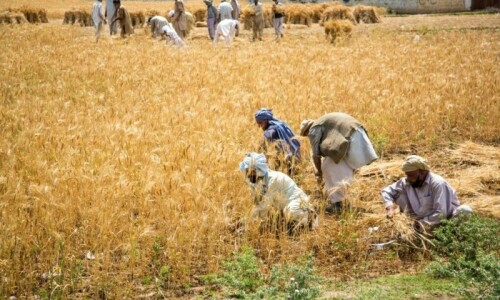
He said that the provincial government was concerned that if landholders did not get better income, they would start some other business, which would ultimately lead to food insecurity in the country.
He said that the FBR had been a hotbed of corruption. “We are told that the FBR will collect the enhanced agricultural tax which we have refused,” he said and added that the SRB would collect the enhance agricultural tax.
Senior Minister Sharjeel Memon, Local Government Minister Saeed Ghani, and Agriculture Minister Sardar Muhammad Bux Mahar also criticised the government for not consulting the provincial government during the talks with the IMF.
Up to Rs600,000 income exempted from farm tax
The new law proposes that annual agricultural income up to Rs600,000 will be exempt from tax, while the maximum tax rate for income exceeding Rs5.6 million annually will be 45 per cent.
A progressive super tax has also been introduced, with no super tax on annual agricultural income up to Rs150m and a maximum of 10pc super tax applying to income exceeding Rs500m annually.
Under the new law, the SRB will be the authority responsible for collecting and enforcing the agricultural income tax, ensuring a streamlined and efficient process.
The proposed Sindh Agricultural Income Tax Bill 2025 is set to take effect from January 1, 2025.
Additionally, the Bill aims to include corporate farming in the tax net. Small companies will be subject to a 20pc tax rate on their annual agricultural income, while large companies will face a tax rate of 29pc.
Notably, livestock has not been included in the tax net, and the advance agricultural income tax, based on land cultivation, will no longer be levied. The payment, collection, and filing of agricultural income tax will be fully automated for greater efficiency.
Later, the Sindh Agricultural Income Tax Act Bill 2025 was presented in the house, which was unanimously approved by the house.
Earlier, the Sindh Assembly unanimously passed the Shaheed Benazir Bhutto Institute of Democracy and Federalism Bill 2004, MH Panhor Institute of Sindh Studies Bill 2025.
Later, the house was adjourned to Tuesday (today) at 2pm.
Published in Dawn, February 4th, 2025