New US admin hires more Indians as ‘Samosa Caucus’ influence grows


WASHINGTON: The Trump administration has now confirmed the nomination of three Indian-Americans to key positions, as the informal ‘Samosa Caucus’ celebrates its expanded representation in the US Congress.
The nominations, coupled with the swearing-in of a record six Indian-Americans to the House of Representatives earlier this month, further highlight the growing influence of the Indian community in US politics.
With 4.5 million members, the diaspora has cemented its position in the American economy and education sectors, and is now becoming a critical force in US politics as well.
So far, President Donald Trump has nominated half a dozen Indian-Americans to key positions, from the FBI’s Kash Patel to other key officials in the White House.
Ricky Gill has been named senior director for South and Central Asia at the National Security Council (NSC). Kush Desai joins the White House as deputy press secretary, and Saurabh Sharma has taken on a role in the Presidential Personnel Office.
Meanwhile, the new Congress welcomed Ami Bera (California), Suhash Subramania (Virginia), Pramila Jayapal (Washington), Ro Khanna (California), Shri Thanedar (Michigan), and Raja Krishnamoorthi (Illinois).
Traditionally aligned with the Democratic Party, Indian-Americans are now increasingly gravitating toward the Republicans. Trump’s economic policies, which favour tax cuts and deregulation, have resonated with affluent and conservative segments of the diaspora. Shared values such as family, education and nationalism further align with Trump’s messaging.
High-profile Republican figures like Nikki Haley and Vivek Ramaswamy have amplified Indian-American visibility within the Republican Party, further encouraging a re-evaluation of political loyalties.
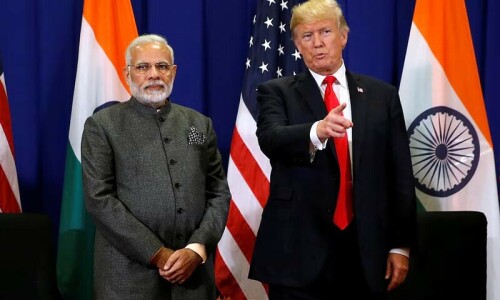
The deepening US-India relationship has significant implications for Pakistan. As India’s role in American strategic policy expands, particularly through initiatives like the ‘anti-China’ Quad-alliance and growing defence cooperation, Pakistan faces increased pressure to recalibrate its diplomatic strategies.
Observers warn that such advocacy for stronger US-India ties could overshadow Pakistan’s efforts to highlight its geopolitical relevance, particularly in Afghanistan and South Asia.
However, some analysts argue that Islamabad could leverage its strategic position in China’s Belt and Road Initiative (BRI) and its proximity to the Persian Gulf to maintain its importance in US policymaking circles, provided it navigates the shifting landscape with skilful diplomacy.
“The rise of Indian Americans in politics reflects not only their growing influence in domestic policymaking but also their ability to shape foreign policy narratives, particularly in relation to South Asia,” warns analyst Michael Kugelman, writing for Foreign Policy magazine.
“For Pakistan, this shift highlights the need to recalibrate its diplomatic engagements in Washington as Indian Americans take on prominent roles across the political spectrum,” he added.
Another report by the Stimson Centre in Washington warned that the new Trump “cabinet will test the US-Pakistan relationship as it is likely to contain many officials who seek to hinder China’s rise and who have characterised Beijing’s Belt and Road Initiative as a threat.”
Published in Dawn, January 27th, 2025