KARACHI: The overall import bills for vehicles and their spare parts have surged simultaneously of late.
The stakeholders are, however, divided on the cause for the surge — some of them blame thriving import of used cars for the development while others attribute it to the rising arrival of new vehicles, including EVs, hybrid and plug-in-hybrid vehicles.
As per data of the Pakistan Bureau of Statistics (PBS), the import of completely built-up (CBU) cars rose to $124 million in IHFY25 from $108m in the same period of the last fiscal year.
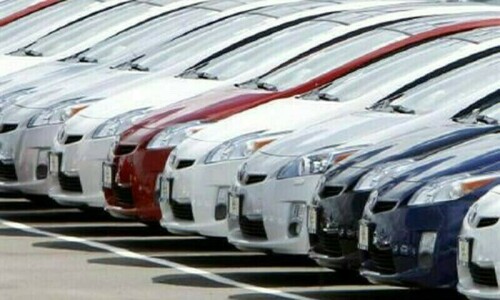
The country’s roads are getting clogged with used cars as expensive new and old hybrid vehicles, together with electric vehicles, are being imported by assemblers to test the consumers’ response before starting assembling these vehicles at home.
The PBS data revealed that import of CKD/SKD parts for the assembly of cars rose to $402m in IHFY25 from $379m in the same period of the last fiscal, indicating brisk auto sales over the past six months, as well as for the next three or six months of 2025.
A relatively low interest rate of 13 per cent, promotional offers on auto financing by banks and assemblers, and falling inflation have revived the demand for four-wheelers.
A big jump in remittances, which usually land in the real estate sector, is also contributing to the burgeoning car market.
But Mashhood Ali Khan, an auto parts maker and exporter, is dissatisfied with the rising sales figures of locally made cars, LCVs, pickups and vans. He sees the present numbers as very low considering that there are 10 assemblers in the business post-Covid who have at least four models at their disposal, while there were only three assemblers, with limited models, before the pandemic and yet they used to import around 250,000 units.
“Nations that have gained independence after Pakistan are making one to six million vehicles a year,” Mashhood Khan lamented.
“In real terms, the auto market has shrunk instead of showing any growth as assemblers are struggling to cross the previous 250,000 units benchmark.”
Despite the rising number of assemblers, the problem of low localisation in the spare parts industry persists as under the current auto policy, new entrants have an option to start assembling vehicles even with negligible locally made parts.
Hence vendors are content to make do with orders placed by old assemblers, Mashhood Khan said.
Import of new vehicles, especially electric vehicles, is rising along with the import of used ones.
Heavy vehicles
Production of buses, trucks and other heavy vehicles also appears promising in coming months as import of CKD/SKD kits by assemblers has swelled to $156m, from $83m during IHFY24.
The import of heavy vehicles has also surged to $48m from $34mn during IHFY24.
The Sindh government has been in the forefront vis-à-vis the import of heavy vehicles. It aims to add 8,000 electric buses to the Peoples Bus Service in phases.
Published in Dawn, January 26th, 2025