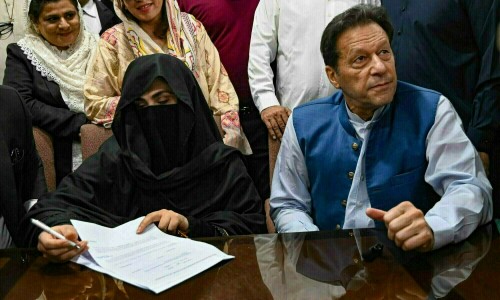
LAHORE: Legal experts have raised questions over the transparency and fairness of the judicial process that led to the conviction of former prime minister Imran Khan and his wife in the £190 million corruption case.
Talking to Dawn, they emphasised the need for equal scrutiny of all accused, including property tycoon Malik Riaz, the primary beneficiary in the case.
Lawyer Abdul Moiz Jaferii told Dawn.com that of all the cases against Mr Khan, this was the one “that held substance.”
He said that there was “clearly a misuse of authority by the prime minister to allow the illegitimate proceeds of Mr Riaz, seized by the UK, to be used to satisfy a pre-existing penalty in the Supreme Court.”
Say Imran’s appeal before high court will be test of ‘judicial impartiality’
“However, even when there is a case to answer, the process and method adopted by the state and judiciary reduce it to a farce. The fact that nothing has been said or done about the principal beneficiary, Malik Riaz, and the lack of explanation about everyone else’s roles makes it abundantly clear that this decision is motivated by factors other than a quest for justice.”
Supreme Court lawyer Safdar Shaheen Pirzada highlighted that the cabinet of then PM Khan acted beyond its jurisdiction in approving the controversial decision.
He pointed out that this action lacked transparency and accountability, undermining public trust.
Mr Pirzada also raised doubts over the prosecution’s narrative, specifically the claim that Mr Riaz’s donation of land to the Al-Qadir Trust was a favour in return for the cabinet’s decision.
He believed this aspect of the case may not hold up during an appeal before the high court.
He also criticised the prosecution over its failure to take meaningful steps to bring key accused, former accountability czar Shahzad Akbar and property tycoon Riaz — both declared absconders — to justice.
The lawyer also described these omissions as an “obvious weakness” and questioned the quantum of punishment awarded to Mr Khan.
He noted the evidence presented by the prosecution during the trial did not seem sufficient to justify the maximum sentence handed down to the PTI chairman.
Akmal Khan, a high court advocate, stated that the NAB reference raised broader questions about transparency, accountability, and adherence to legal procedures during Mr Khan’s tenure as prime minister.
However, acknowledging the gravity of the allegations, he stressed the importance of ensuring impartiality in the judicial process.
Mr Akmal argued that for the conviction to be seen as legitimate, all accused persons must be subjected to equal scrutiny, and the proceedings must be conducted transparently.
Mr Akmal noted any appeal filed by the ex-PM’s legal team would bring into question the due process of law.
Lawyer Ayman Zafar said the handling of Mr Khan’s appeal will be a “test of judicial impartiality”.
“The higher courts now have a choice: apply the law fairly or allow political expediency to dictate justice. The credibility of the legal system is on the line, and Pakistan’s future as a functional democracy depends on it.”
Lawyer Ahmad Maudood Ausaf raised another legal point and cited the former Supreme Court chief justice Mian Saqib Nisar’s 2015 ruling, which said judgments must be delivered within 30 days of the hearing’s conclusion.
However, he added that the verdict in this case was announced after prolonged “hide-and-seek”.
The verdict was delayed thrice before it was announced on Friday.
“When verdicts are tied to speculative narratives rather than solid evidence, they threaten not just the accused but the integrity of the judicial system itself,” Mr Ausaf told Dawn.com.
Published in Dawn, January 18th, 2025