FOR a country that produced the world’s youngest Nobel laureate for championing girls’ education, Pakistan’s statistics make for tragic reading.
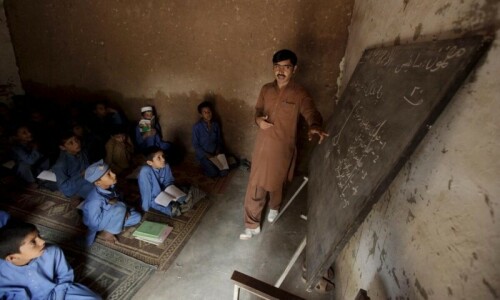
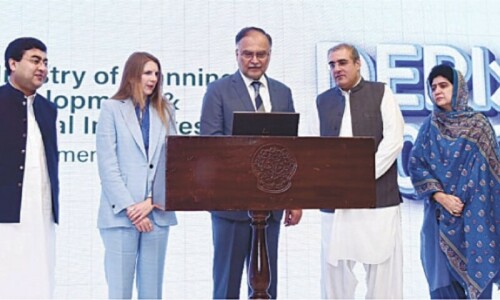
Some 22.8m children are out of school — roughly equal to the entire population of Sri Lanka — and the female literacy rate languishes at 49pc. Last week’s International Conference on Girls’ Education in Muslim Communities in Islamabad laid bare these truths, though solutions remained elusive. The gathering had a notable absentee. The Taliban regime in Afghanistan, where girls are banned from secondary education, declined to attend. This was not surprising: its interpretation of religion appears mediaeval; even Muslim societies of yore valued learning more highly than today’s Taliban do.
Pakistan’s own educational woes, while not so extreme, are scarcely less worrying. Prime Minister Shehbaz Sharif’s declaration of an “education emergency” joins a long list of similar pronouncements that have produced more hot air than actual learning. We spend a paltry 2.5pc of GDP on education, well below the Unesco-recommended 4pc. In contrast, Malaysia and Turkey, fellow Muslim-majority nations, boast female literacy rates of above 90pc. Bangladesh has surged ahead with over 70pc of its women able to read and write. The economics of ignorance are stark.
In an era where AI and quantum computing dominate conversations about the future, Pakistan’s tech sector remains stunted thanks to its educational shortcomings. The World Economic Forum ranks the country near the bottom in educational attainment and economic participation — a double whammy that threatens to leave us behind in the global knowledge economy.
Some bright spots exist. The Danish schools initiative in Punjab, which provides quality education in underdeveloped rural areas, shows what targeted intervention can achieve. The newly established Pakistan Education Endowment Fund aims to support children from low-income families in higher education. But such initiatives are few. The conference concluded with the signing of the Islamabad Declaration, a 17-point document that recognises girls’ education as both a “religious obligation” and a social necessity. The declaration will be presented to the UN Security Council, though cynics might wonder whether it will join the growing pile of well-intentioned but ineffective international commitments.
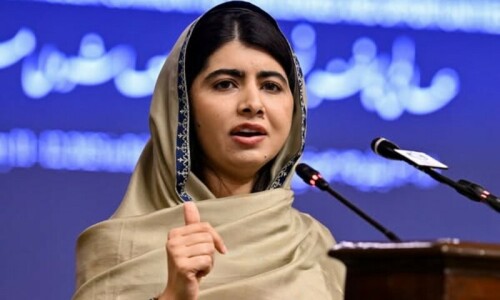
Malala Yousafzai, who attended the conference, put it bluntly: 12.5m Pakistani girls remain out of school. Ms Yousafzai, who survived a TTP assassination attempt in 2012 for advocating girls’ education, is a powerful symbol of both Pakistan’s educational challenges and its potential. But symbols alone cannot teach children to read.
The path forward is clear: substantially increase education spending, dismantle cultural barriers to girls’ education, and transform declarations into concrete action. Until then, Pakistan risks condemning another generation to ignorance — and itself to economic irrelevance in an increasingly knowledge-based world.
Published in Dawn, January 14th, 2025