0
0

REMITTANCES sent home by migrant Pakistani workers have been a saving grace for the country’s faltering economy for the last two decades.
With export revenues growing at a painfully slow pace — and often stagnating for years in between — and foreign capital and investment inflows drying, successive governments have relied on remittances to push import-based consumption to boost growth. Thus, even a tiny increase in cash sent home by overseas Pakistanis can always be a moment for celebration.
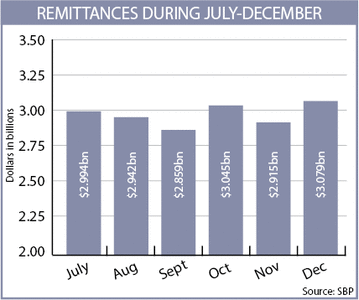
The ongoing fiscal year has proved to be exceptional for remittances, with inflows soaring by a third to a record level of $17.8bn in the first half of the year to December from $13.4bn a year ago. This lends hope that the country will be able to meet the targeted inflows of $35bn in remittances, far surpassing export earnings, this year. No wonder the prime minister has used this occasion to “congratulate’ the nation and boast of his government’s success in stabilising the economy while underlining the commitment of overseas Pakistanis to their country’s development.
The market players attribute the surge in remittances through formal banking channels to numerous factors: clampdown on illegal currency trade and smuggling to Afghanistan, stricter controls on exchange companies, exchange rate stability, and increased labour migration, especially young IT professionals, from the country in recent years. It is believed that remittances have a potential to grow to $60bn a year if illegal currency trade is stemmed and customs controls strengthened against under-invoicing of imports by major traders from China, Dubai and elsewhere.
The increase in remittances is indeed a positive development for the economy as these have been driving the current account surplus for the last several months, contributing significantly to exchange rate stability and improvement in the State Bank’s forex reserves in the absence of foreign direct investment, as well as any meaningful bilateral and multilateral inflows.
But it is not a wise policy to rely on them for external account stability. Remittances have their downsides as well. Studies have shown that higher remittances boost consumption and imports, lead to decline in domestic manufacturing and exports, and make economies of recipient nations more vulnerable to global and regional economic crises. No matter how favourable an impact these have on economic growth, remittances cannot be a substitute for exports and foreign private investment, which increase domestic productivity and generate jobs. Moreover, the quantum of remittances a country receives can never be predicted.
Remittances represent hard-earned money by migrant Pakistanis that must be channeled into productive use for the country’s social and economic development instead of squandering on imported luxuries. At the same time, the government needs to devise a strategy to increase industrial and agricultural productivity to boost exports and reduce reliance on uncertain remittances.
Published in Dawn, January 12th, 2025