Study says Gaza toll could be 40pc higher, estimates over 64,000 deaths


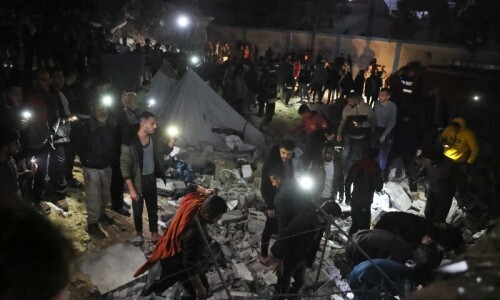
An official Palestinian tally of direct deaths in the Israel-Hamas conflict likely undercounted the number of casualties by around 40 per cent in the first nine months of fighting as the Gaza Strip’s healthcare infrastructure unravelled, according to a study published on Thursday.
The peer-reviewed statistical analysis published in The Lancet journal was conducted by academics at the London School of Hygiene and Tropical Medicine, Yale University and other institutions.
Using a statistical method called capture-recapture analysis, the researchers sought to assess the death toll from Israel’s devastating air and ground campaign in Gaza between October 2023 and the end of June 2024.
They estimated 64,260 deaths due to traumatic injury during this period, about 41pc higher than the official Palestinian Health Ministry count. The study said 59.1pc were women, children and people over the age of 65.
It did not provide an estimate of Palestinian combatants among the dead.
More than 46,000 people have been killed in the Gaza conflict, according to Palestinian health officials, from a pre-conflict population of around 2.3 million.
A senior Israeli official, commenting on the study, said Israel’s armed forces went to great lengths to avoid civilian casualties.
“No other army in the world has ever taken such wide-ranging measures,” the official said. “These include providing advance warning to civilians to evacuate, safe zones and taking any and all measures to prevent harm to civilians. The figures provided in this report do not reflect the situation on the ground.”
The conflict began on October 7 after Hamas gunmen stormed across the border with Israel, killing 1,200 people and taking more than 250 hostages, according to Israeli tallies.
The Lancet study said the Palestinian health ministry’s capacity for maintaining electronic death records had previously proven reliable but deteriorated under Israel’s military campaign, which has included raids on hospitals and other healthcare facilities and disruptions to digital communications.
Israel accuses Hamas of using hospitals as cover for its operations, which the group denies.
Study method employed in other conflicts
Anecdotal reports suggested that a significant number of dead remained buried in the rubble of destroyed buildings and were therefore not included in some tallies.
To better account for such gaps, the Lancet study employed a method used to evaluate deaths in other conflict zones, including Kosovo and Sudan.
Using data from at least two independent sources, researchers look for individuals who appear on multiple lists of those killed. Less overlap between lists suggests more deaths have gone unrecorded, information that can be used to estimate the full number of deaths.
For the Gaza study, researchers compared the official Palestinian Health Ministry death count, which in the first months of fighting was based entirely on bodies that arrived in hospitals but later came to include other methods; an online survey distributed by the health ministry to Palestinians inside and outside the Gaza Strip, who were asked to provide data on Palestinian ID numbers, names, age at death, sex, location of death, and reporting source; and obituaries posted on social media.

“Our research reveals a stark reality: the true scale of traumatic injury deaths in Gaza is higher than reported,” lead author Zeina Jamaluddine told Reuters.
Dr Paul Spiegel, director of the Centre for Humanitarian Health at the Johns Hopkins Bloomberg School of Public Health, told Reuters that the statistical methods deployed in the study provide a more complete estimate of the death toll in the conflict.
The study focused solely on deaths caused by traumatic injuries though, he said. Deaths caused by indirect effects of conflict, such as disrupted health services and poor water and sanitation, often cause high excess deaths, said Spiegel, who co-authored a study last year that projected thousands of deaths due to the public health crisis spawned by the conflict.
The Palestinian Central Bureau of Statistics (PCBS) estimates that, on top of the official death toll, around another 11,000 Palestinians are missing and presumed dead.
In total, PCBS said, citing Palestinian Health Ministry numbers, the population of Gaza has fallen 6pc since the start of the conflict, as about 100,000 Palestinians have also left the enclave.