• 685 security personnel laid down their lives amid 444 terror attacks across the country
• CRSS data shows KP and Balochistan were worst-hit by the violence
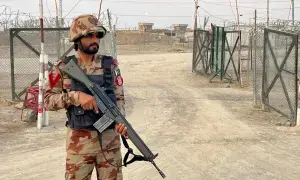
ISLAMABAD: With at least 685 members of security forces losing their lives amid a total of 444 terror attacks, 2024 turned out to be the deadliest year for civil and military security forces of Pakistan in a decade.
Equally alarming were the cumulative losses of civilians and security personnel: 1,612 fatalities, accounting for over 63pc of the total recorded this year and marking 73pc more losses compared to 934 outlaws eliminated.
According to the Inter-Services Public Relations (ISPR), security forces conducted a total of 59,775 operations this year during which “925 terrorists” were killed and 383 “brave officers and soldiers embraced martyrdom”. These figures were stated by ISPR Director General (DG) Lieutenant General Ahmed Sharif Chaudhry during a press conference on December 27.’
The overall fatalities recorded this year were a record 9-year high, and over 66pc more than 2023. On average, nearly seven lives were lost daily, with November emerging as the deadliest month, compared to all other months of the year.
The violence took the heaviest toll on Khyber Pakhtunkhwa (KP) which topped in human losses with 1616 fatalities, followed by Balochistan with 782 fatalities.
These are key findings of the Annual Security Report 2024 issued by the Center for Research and Security Studies (CRSS) think-tank.
According to a report of the think-tank, in 2024, the country suffered 2546 violence-linked fatalities and 2267 injuries among civilians, security personnel, and outlaws. This tally of casualties stemmed from 1166 terror attacks and counter-terror operations, marking a grim year for the country’s security landscape.
Compared to last year, these figures mark an over 66pc surge in violence (2546 vs 1533 fatalities), over 55pc more injuries (2267 vs 1462) and around 49pc more incidents (1166 vs 784).
Regional impact
KP and Balochistan accounted for 94pc of all fatalities and 89pc of all incidents across the country.
While KP suffered most of the fatalities (over 63pc) recorded this year, followed by Balochistan (31pc), the highest surge in violence, compared to last year, however, was recorded in the latter province (90pc), followed by the former (65pc).
November was the deadliest month across all metrics; with the highest number of attacks (125), fatalities (450) and injuries (625) recorded compared to all other months of the year.
The fatalities recorded this year mark a record 9-year high, exceeding the 2016 level (2432) and highest since 2015 (4366).
“Moreover, the data collected over the last 10 years shows a sharp downward trend from 2015 to 2020, with fatalities declining each year by around 33pc on average. This 6-year-long declining and in fact, an encouraging trend in Pakistan’s security landscape, was followed by resurgence in 2021. This is evident from the fact that violence in the country constantly surged by 38pc spike in 2021, 15pc in 2022, 56pc in 2023 and 66pc in 2024 (almost 44pc yearly surge in violence on average since 2021),” the report says.
The highest number of violence and counter-violence-linked fatalities were recorded in KP’s newly merged districts bordering Afghanistan such as Kurram, North Waziristan, Khyber; other districts in KP with significant fatalities included Dera Ismail Khan, Bannu, and Lakki Marwat. These districts were followed by Balochistan’s Quetta, Kech, Kalat, and Musakhail districts.
Moreover, the fatalities in these most severely affected districts of Balochistan in 2024 alone were nearly equal to their combined total recorded over the previous three years (2021–2023), while a similar trend was observed in the hardest-hit districts of KP.
Published in Dawn, December 31st, 2024