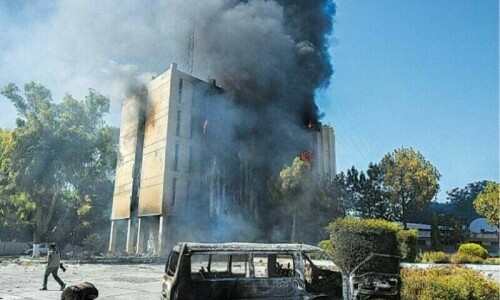
AND so, it has come to pass. All 85 individuals tried by military courts for their involvement in the May 9 riots have now been sentenced to up to 10 years of rigorous imprisonment.
Military courts, by their nature, are designed for exceptional circumstances such as martial law or active conflict. Pakistan was not in a state of war or emergency on May 9. The civilian judiciary, while overburdened, remains functional. Why, then, were these cases routed through a system outside the civilian domain? Reliance on these courts in peacetime sets the sort of precedent that makes it easier to normalise such practices in the future.
In a press conference yesterday, the DG ISPR asserted that the trials were conducted with full adherence to the law, including the right to legal representation, cross-examination, and appeal. He said that military courts have fulfilled the demands of justice efficiently for decades, citing endorsement by the International Court of Justice. However, these assurances do little to address the fundamental questions about transparency and jurisdiction.
The ambiguity surrounding the use of the Official Secrets Act remains unresolved. It is unclear how attacking defence installations — undeniably grave offences — falls under the ambit of the OSA, which primarily addresses espionage and the unauthorised disclosure of classified information. Nor has been clarified why certain cases were routed through military courts while others are proceeding in anti-terrorism courts. This inconsistency undermines confidence in the judicial process.
Moreover, the trials raise further questions. For instance, how thoroughly did these courts examine evidence and cross-examine witnesses before delivering the verdicts for 60 individuals?
The PTI has criticised these developments, calling for an independent judicial inquiry. The party has highlighted the need for fair trials, terming these courts incompatible with democratic principles. While ISPR says that “the process of justice will continue until all planners of the May 9 violence are punished”, the true measure of justice lies in transparency and public accountability. Secretive trials, shielded from scrutiny, fail to provide the answers that citizens deserve.
The judiciary, too, must confront its role in this process. By allowing these trials to proceed under a cloud of legal and ethical questions, the constitutional bench risks entrenching practices that weaken the rule of law and undermine democratic principles.
Published in Dawn, December 28th, 2024