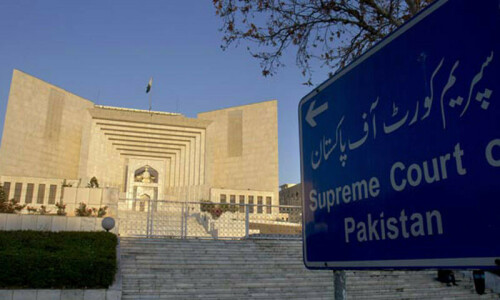
SC questions rationale behind handing over May 9 cases to military courts


ISLAMABAD: The Constitutional Bench of the Supreme Court, hearing intra-court appeals (ICAs) against the Oct 23, 2023 order nullifying the trial of civilians by military courts, raised questions about whether anti-terrorism courts (ATCs) had issued speaking orders explaining their reasons before handing over the accused involved in the May 9 violence to military courts.
“How did the ATC hand over the accused to the military?” asked Justice Naeem Akhtar Afghan, a member of the seven-judge bench headed by Justice Aminuddin Khan.
The bench was hearing on Monday multiple ICAs challenging the five-judge’s Oct 23 order that nullified the trial of civilians in military courts in connection with the May 9, 2023 violence.
On Dec 13, 2023, a regular bench of the Supreme Court, by a majority of five to one, had suspended the operation of its Oct 23 short order. The earlier order had declared as illegal the trial of 105 civilians identified for their alleged involvement in the May 9 violence.
Justice Hilali asks if corps commanders’ residences were declared ‘offices’ after the date
The Dec 13 decision allowed military courts to commence the trial of the accused but barred them from announcing any final decision, whether convicting or acquitting, until the pendency of the government-instituted ICAs.
On April 8 this year, the federal government, through Attorney General for Pakistan (AGP) Mansoor Usman Awan, informed the Supreme Court that 20 individuals arrested for their involvement in the May 9 violence had been released after serving their sentences to allow them to celebrate Eidul Fitr with their families.
“Is there any reason-based order from the ATC courts while handing over cases to the military courts?” Justice Naeem Akhtar Afghan asked, directing senior counsel Khawaja Haris Ahmed, representing the defence ministry, to note down the queries and respond at the end.
During the hearing, Justice Musarrat Hilali questioned whether the corps commanders used their residences as offices and whether these premises were officially declared as offices. How true is it that this idea of claiming their houses as their offices emerged only after the May 9 incident, the judge asked.
Justice Jamal Khan Mandokhail urged the lawyers representing various petitioners to assist the court in reaching a definitive conclusion by completing the case as expeditiously as possible.
During the hearing, Justice Musarrat Hilali, addressing TV analyst Hafeezullah Niazi, inquired whether he had met his son Hasan Niazi, who has been in physical custody for several months.
Mr Niazi replied in the affirmative, but explained that due to the court’s earlier decision to stay the announcement of final judgements by the military courts, a hostage-like situation had been created. Let the military courts be allowed to announce their decisions so that their decisions could be challenged before the superior courts, he said.
However, Justice Aminuddin Khan cautioned him against making such statements in court.
Additional Attorney General (AAG) Chaudhry Aamir Rehman suggested that since the military trials of the accused had been completed, they should now be allowed to pronounce their verdicts.
However, Justice Hilali observed that vacating the stay at this stage would imply the court’s acceptance of the military courts’ jurisdiction to try civilians.
During the hearing, Khawaja Haris argued that it was incorrect to suggest civilians cannot be tried in military courts, stating that the Pakistan Army Act (PAA) also applies to employees of private companies affiliated with the armed forces.
Justice Jamal Khan Mandokhail, however, observed that these were a specific category of civilians, such as those working in the Ordnance Factory.
Mr Haris maintained that the PAA broadly covers civilians, without distinguishing specific roles.
Justice Syed Hassan Azhar Rizvi asked about the trials of those involved in the Army Public School attack.
The counsel explained that the trials of individuals responsible for the APS massacre were conducted when special military courts were established under the 21st Amendment.
Justice Mandokhail recalled that the Constitution had been amended at that time specifically to facilitate the trial of civilians by military courts.
The court later adjourned further proceedings until Tuesday.
Ex-CJP’s petition
Also on Monday, the Constitutional Bench imposed a fine of Rs20,000 on an application moved by former chief justice of Pakistan Jawwad S. Khawaja, seeking to adjourn the case regarding the trial of civilians in military courts until a final decision on the pending challenges to the 26th Amendment.
The application had argued that resolving the challenges to the 26th Amendment was crucial before proceeding with the ICAs related to military courts. It had contended that the Constitutional Bench was formed by the Judicial Commission of Pakistan (JCP), which itself was established through the 26th Amendment.
If the amendment were declared null and void, the actions of the JCP, including the formation of the current bench, would be “invalidated”.
Arshad Sharif murder case
Separately, the Constitutional Bench directed the government to submit a detailed report on the tragic killing of journalist Arshad Sharif.
AAG Rehman informed the court that the federal government had prepared a mutual legal assistance (MLA) agreement with the Kenyan government, which is set to be signed on Tuesday. Therefore, the government could not file the report.
The Supreme Court had earlier taken suo motu notice of the journalist’s killing. The government previously informed the court that a draft MLA had been finalised to formally seek assistance from Kenyan authorities in gaining access to suspects involved in the case.
On July 8, 2023, the Kenyan High Court in Kajiado declared that the 2022 killing of Arshad Sharif by Kenyan law enforcement personnel was unlawful.
Published in Dawn, December 10th, 2024