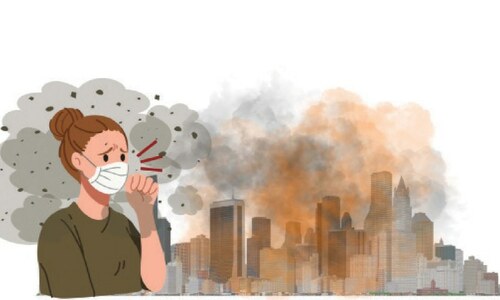
Dust pollution takes heavy toll on people as respiratory illness cases surge in Karachi


• Doctors say patients suffering from asthma, bronchitis, flu, chronic obstructive pulmonary disease, pneumonia ‘doubled’ this year in Karachi
• Link the worsening situation with people’s reduced purchasing power
KARACHI: With the onset of winter, a sharp increase in respiratory illnesses has been witnessed in the metropolis in recent weeks as experts believe that the number of patients is significantly higher this year than the previous years.
They attributed the situation to poor air quality, especially due to heavy dust pollution, currently affecting almost all city roads amid massive loss of green cover.
The experts also linked it to growing poverty levels due to an unprecedented hike in prices of essential food and medicine, increasing people’s vulnerability to disease and disability manifold.
“While cases of respiratory diseases do increase with the winter’s onset (because colder and drier air traps more pollutants), their numbers have almost doubled this year. This is for both inpatients and outpatients,” Dr Javaid Ahmed Khan, senior professor and consultant pulmonologist at the Aga Khan University Hospital (AKUH) told Dawn.
He contributed the disease pattern to heavy dust pollution. “I think air quality has declined (sharply). A lot of road work is going on across the city, trees are being chopped off and people continue to burn waste on streets. There is no check on vehicles releasing toxic fumes.”
Dr Khan explained that poor air quality could increase the risk of bronchitis by exposing people to pollutants like dust, fumes, traffic emissions, and chemicals, while negatively impacting the immune system, which could increase the risk of lung and other infections.
“Any form of pollution affects the immune system and this relationship is scientifically established through several studies. People living in a polluted environment are more likely to catch pneumonia, upper respiratory tract infections and allergic rhinitis as well as tuberculosis.
“The reason is once irritants — including particulate matter 2.5 — enter the airways, they destroy respiratory system’s immune mechanism that acts as a shield against various germs. Once the immune system is destroyed, the body becomes very vulnerable to all kinds of infections and diseases including cancer.”
Normally the average diameter of human hair is approximately 70 micrometres. While particulate matter 2.5 are fine inhalable particles, with diameters that are generally 2.5 micrometres and smaller. According to Dr Khan, studies have also linked poor air quality with an increased incidence of cardiovascular diseases as particulate matter 2.5 enters the bloodstream and blocks the arteries.
Seconding his opinion, Dr Abdul Ghafoor Shoro, senior general physician practising in Keamari, said that he had been seeing an increase of 50 per cent in cases of respiratory illnesses, including asthma, bronchitis, flu, chronic obstructive pulmonary disease (COPD), pneumonia, in recent weeks.
“Wherever you go from Malir, Quaidabad, Korangi to Gulistan-i-Jauhar, Mauripur, Keamari, Orangi and Saddar, you will encounter heavy dust pollution either due to dug-up roads or construction activity. There is no way for the masses to escape pollution.”
Senior general physician Dr Sajjad Siddiqui believed that the disease situation was also linked to people’s reduced purchasing power.
“The masses are living in extremely challenging conditions. They are forced to drink contaminated water because gas is non-existent in many areas and people buy cylinders for cooking food that’s barely enough to survive. And, if they fall sick, they don’t have money to buy essential medicines,” he regretted.
At the Dr Ruth Pfau Civil Hospital Karachi, Additional Medical Superintendent Dr Liaquat Ali Halo shared that the chest department at the facility had seen around 25 to 30 per cent increase in all forms of respiratory illnesses, especially among children.
“We are getting children with pneumonia and adults with COPD and asthma. Often COPD patients are those who are forced to work in a polluted environment or are smokers.”
The experts believe that people should, at least, wear good quality face masks or use a cloth for protection (or use helmets if they are on bikes) when they go out, though these steps couldn’t provide complete protection from the toxic air.
“Indoor air quality is equally important. Hence, it’s important that a house is properly ventilated even in winters. People should avoid burning mosquito coils and sticks as there is growing concern over their adverse effects on health,” said Dr Halo, adding that using gas stoves in kitchens lacking ventilation also affected air quality.
Published in Dawn, December 12th, 2024